
Image Credit: World Labs
On February 18, 2026, Reuters reported that World Labs, the “spatial intelligence” startup founded by renowned computer scientist and "Godmother of AI" Fei-Fei Li, raised $1 billion in new funding. The round included AMD, Nvidia, Autodesk, Emerson Collective, Fidelity Management & Research, and Sea, among others, with Autodesk contributing $200 million and taking an advisory role.

It’s a striking number not just because of the size, but because of what it signals: investors are placing a massive wager on the idea that the next leap in AI won’t come from better chatbots, it will come from models that can perceive, reason about, and generate the 3D world.
World Labs is positioning itself at that frontier.
1. Fei-Fei Li: The Founder's Journey
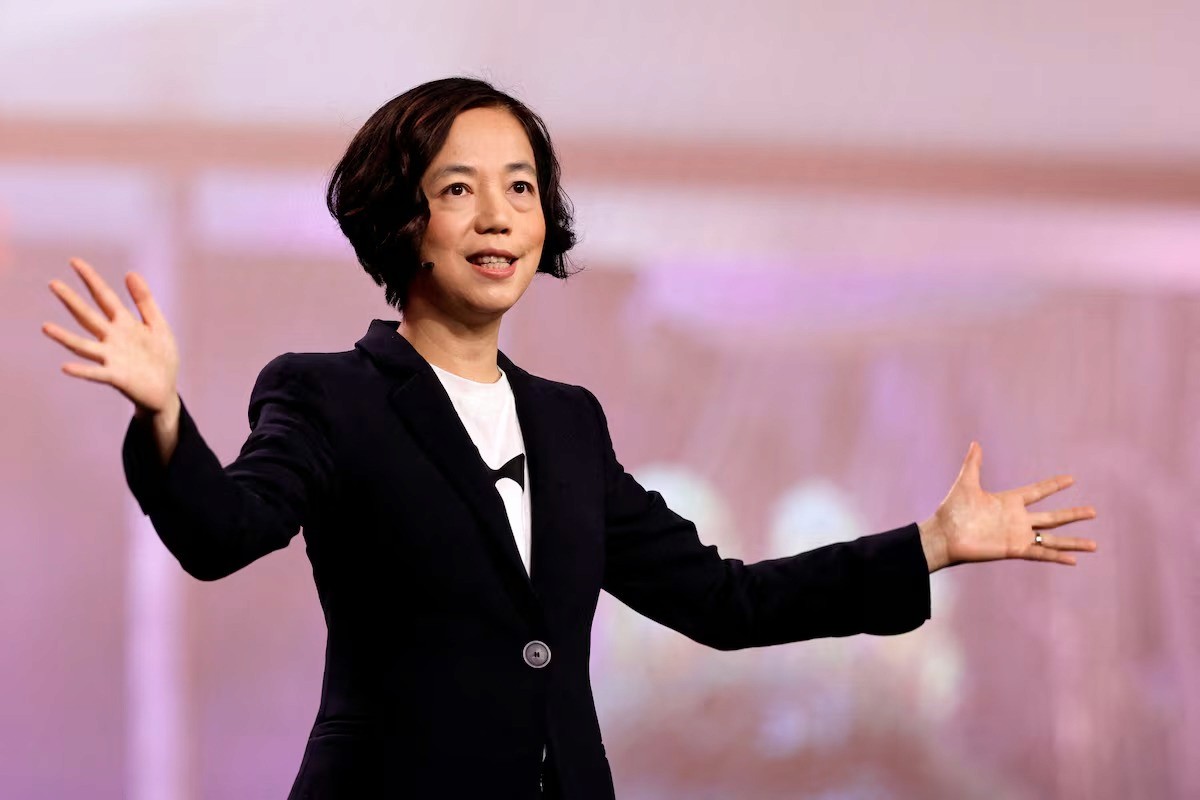
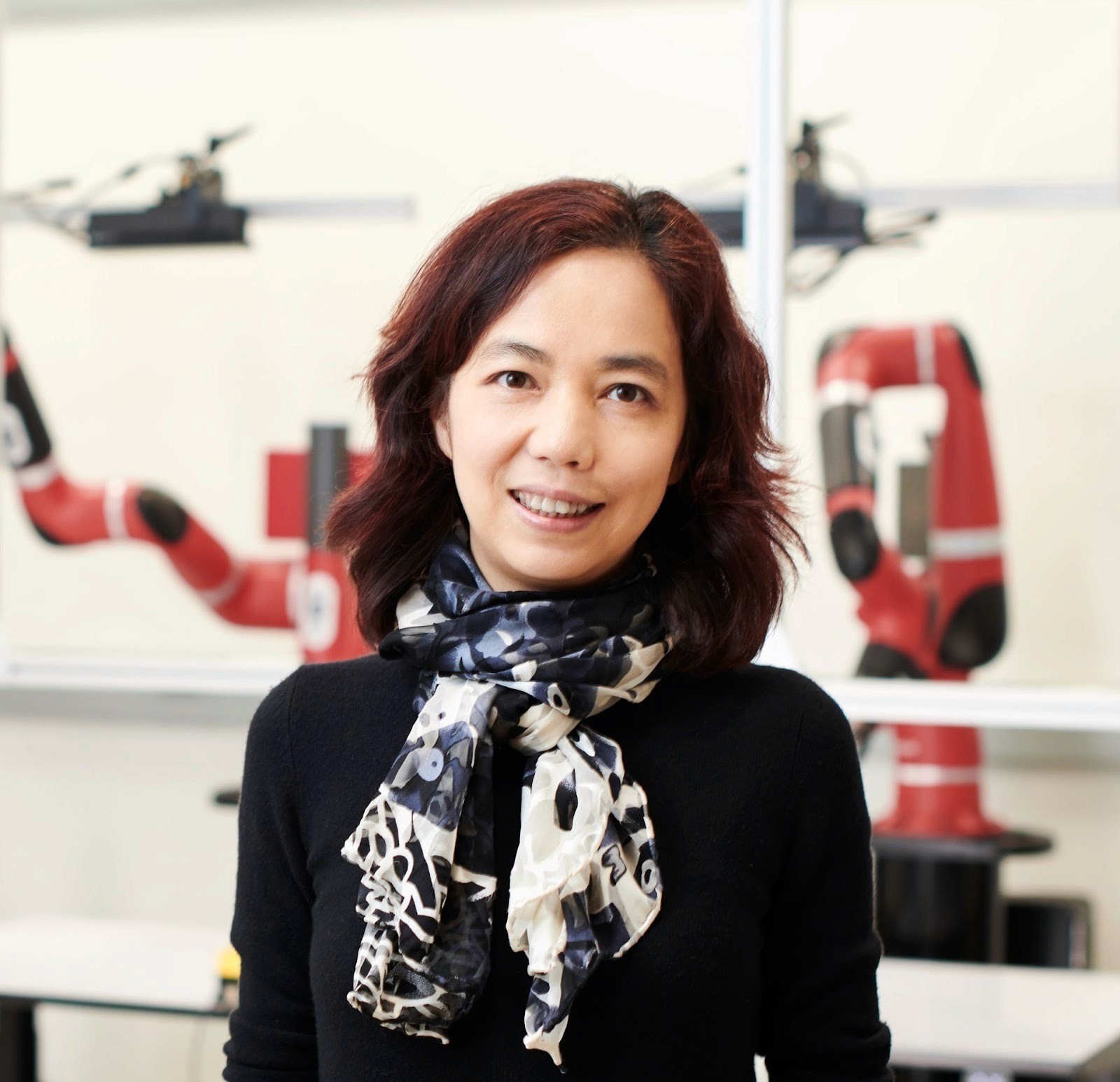
Image Credits: Reuters, Stanford
Born in China in 1976, Fei-Fei Li moved to the United States at 16, a story she recounts in her memoir The World I See. Her family settled in New Jersey, where her parents ran a small dry-cleaning store. As a teenager, Li split her time between school and long hours helping at the shop, learning English while navigating the pressures of financial uncertainty.
Those early years shaped her worldview. Education wasn’t abstract, it was survival and possibility. Science became, in her words, a way to claim agency in an unfamiliar world. That belief propelled her to Princeton, where she studied physics before turning toward a deeper question: how intelligence itself works.
"I was a nobody, just an immigrant kid who didn't speak English. But seeking knowledge and truth was in my blood." Fei-Fei Li.
ImageNet: Teach Machines to See
As a young professor at Stanford, Li identified a critical bottleneck in artificial intelligence: progress in computer vision was constrained by the lack of large-scale, high-quality labeled data. If machines were to “see” like humans, they needed exposure to the vast diversity of the visual world.
That insight led her to build ImageNet, a dataset of millions of labeled images across thousands of object categories (14 million labeled photographs across 20,000 categories). At the time, the project was seen as overly ambitious. But in 2012, a deep neural network AlexNet trained on ImageNet dramatically outperformed previous systems, triggering a breakthrough that helped ignite the deep learning revolution.
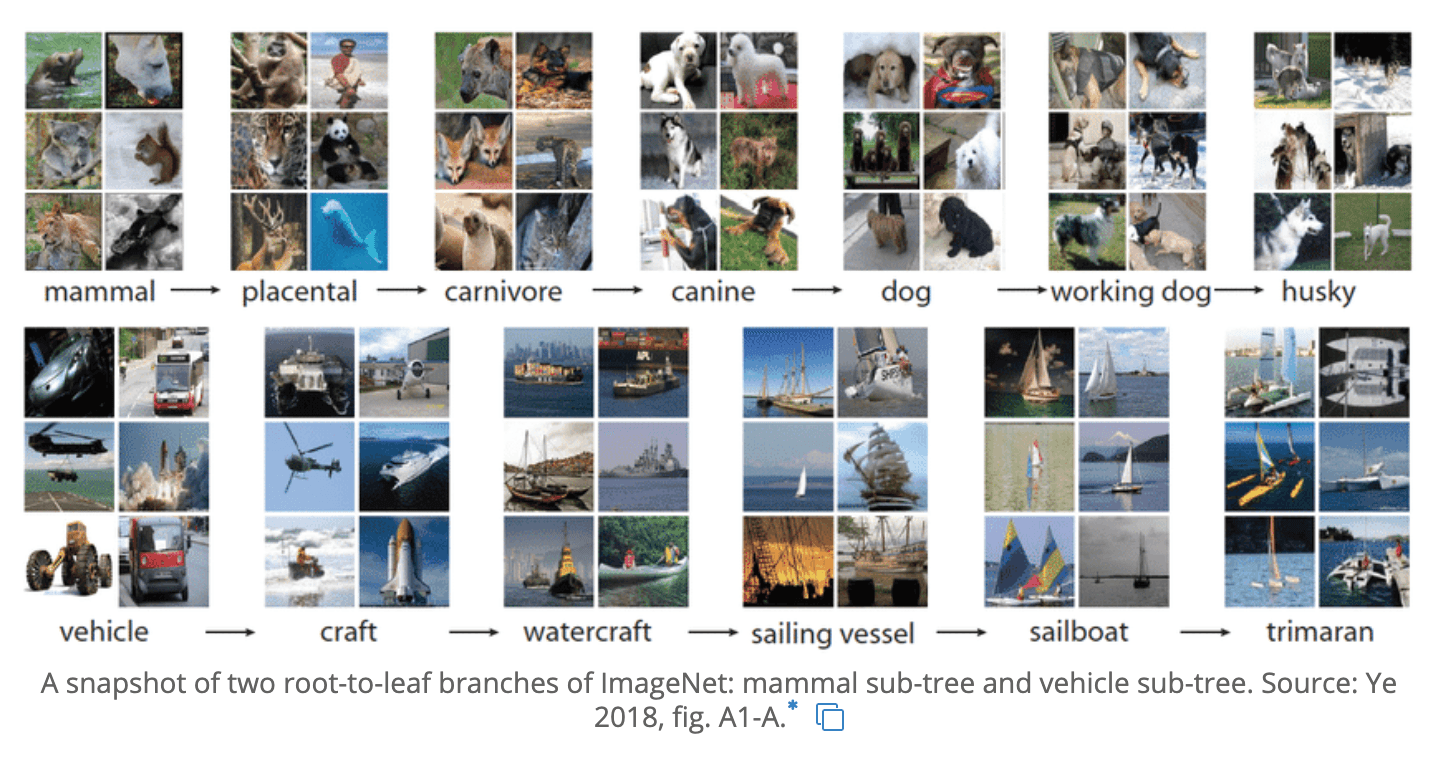
Image Credit: https://devopedia.org/imagenet
Because ImageNet fundamentally reshaped modern AI and accelerated the field’s rapid progress, Li was widely referred to as the “godmother of AI”, a recognition of the foundational role her work played in today’s AI era.
Why World Labs: From seeing objects to understanding worlds
Yet ImageNet also revealed a limitation. AI could label objects in photos, but it did not truly understand space, depth, physics, or how environments persist and function. It recognized a “chair” but didn’t comprehend how a chair exists within a room. For Li, that gap became the next frontier. If ImageNet gave machines 2D perception, the next challenge was spatial intelligence, models that can reason about and generate coherent 3D worlds.
That conviction led her to found World Labs. In 2024, while on partial academic leave from Stanford through the end of 2025, Li co-founded World Labs Wikipedia alongside three co-founders with deep expertise in 3D AI: Ben Mildenhall (co-creator of NeRF, or Neural Radiance Fields, a breakthrough technique for 3D scene reconstruction), Justin Johnson (a computer vision researcher and former student of Li's), and Christoph Lassner (a 3D graphics and generative AI expert). The founding team is a deliberate assembly of people who have spent careers on the exact problem World Labs is trying to solve: understanding and generating 3D worlds.
2. What World Labs is actually building
World Labs describes itself as a "spatial intelligence company, building frontier models that can perceive, generate, reason and interact with the 3D world," calling its AI systems "large world models" (LWMs), a deliberate echo of "large language models" but oriented toward physical space rather than language.
Marble: The World You Can Walk Into
In late 2025, World Labs launched its first product, Marble, described as a tool that "lets you create, edit and share high-fidelity, persistent 3D worlds." Unlike static image generators, Marble is designed to create interactive, persistent 3D environments, meaning they remain stable and can be explored and edited over time rather than being one-off renders.
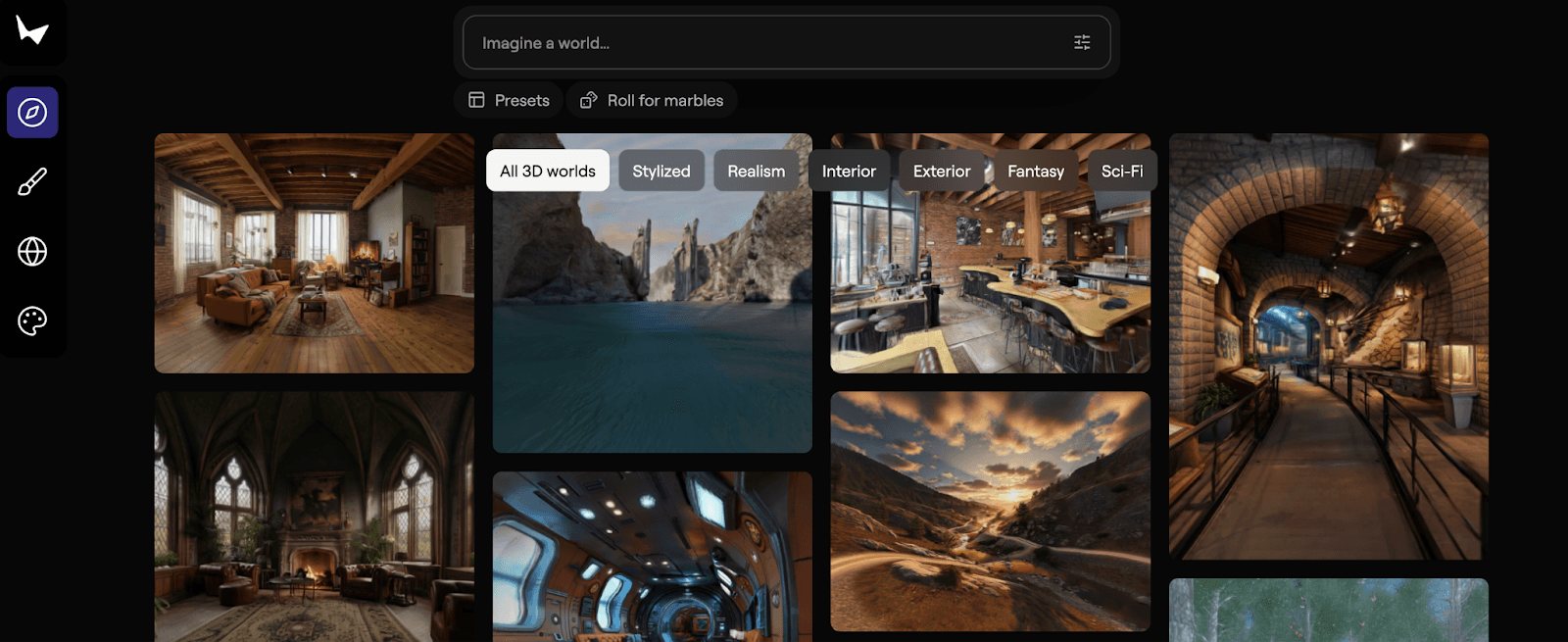
Image Credit: World Labs
The Marble multimodal world model creates 3D worlds from image or text prompts. Users can input a photo or a text description and receive a navigable, interactive 3D space in return. World Labs also announced a collaboration with HTC VIVERSE to turn these AI-generated worlds into interactive XR (extended reality) experiences, and a partnership with Lightwheel AI to advance evaluation for embodied AI systems, suggesting an early trajectory toward robotics applications.
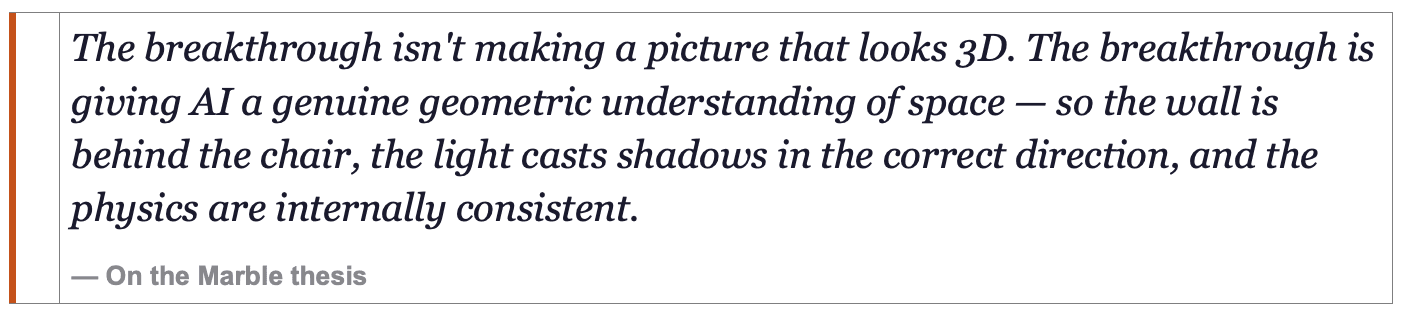
Alongside Marble, World Labs also shipped Chisel, a companion tool that allows users to refine and edit AI-generated 3D environments through plain-language instructions. Think of Marble as the generator and Chisel as the sculptor.
Target customers include game studios, movie studios and visual effects houses, architects, designers, engineers, and eventually robotics developers.
Partnership Ecosystem
HTC VIVERSE: Turning Marble-generated worlds into interactive XR experiences.
Lightwheel AI: Using AI-generated worlds as evaluation environments for embodied AI and robotics.
Autodesk: Integrating spatial generation directly into professional design tools (AutoCAD, Maya, 3ds Max).
The Autodesk integration, if it ships at scale, would put spatial AI directly in the hands of millions of architects, engineers, and VFX artists who shape the built world.
3. The Full Funding Timeline
World Labs' fundraising trajectory is one of the fastest in recent AI startup history. Here is the complete timeline from inception to today:
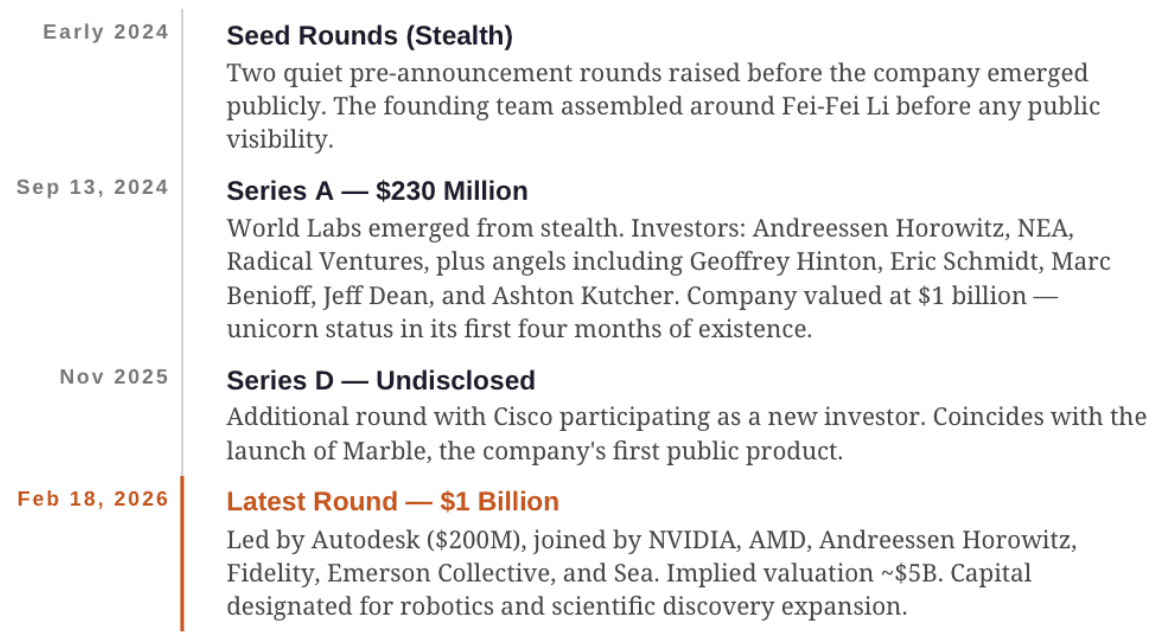
The angel investor list deserves special attention: Geoffrey Hinton (the "Godfather of AI", Turing Award winner) backed the company in its very first round — a notable show of conviction from someone who has been increasingly vocal about AI's risks. Eric Schmidt, Marc Benioff, Jeff Dean, and Nvidia's corporate venture arm also participated in early rounds.
4. Looking Ahead
Over the next few years, World Labs’ ambition is to evolve from a breakthrough model into a full platform, improving Marble’s ability to generate spatially consistent, editable 3D worlds while embedding it deeply into existing creative and simulation workflows, particularly through partners like Autodesk, and expand from entertainment-grade world generation into higher-stakes domains like simulation and robotics.
Competition is intensifying: research leaders such as Google DeepMind and ecosystem giants like Nvidia are also investing heavily in world models and simulation infrastructure. The outlook is high-reward but competitive: if World Labs can deliver production-ready, controllable virtual worlds, it could become a core layer of spatial AI; if not, larger platforms may absorb the opportunity.
—
Further Learning: a16z interview with the founders, Lenny’s Interview with Fei-Fei Li, IEEE Spectrum Article