Back to All Articles
Private Company Valuations 101: Understanding Primary vs Secondary Markets for Retail Investors
Learn how private company valuations work across primary and secondary markets. This Jarsy guide explains valuation methods, market mechanics, liquidity, risk-reward dynamics, and access pathways so retail investors can confidently evaluate pre-IPO opportunities.

Every year, thousands of private companies chart multi-billion-dollar trajectories before ever listing shares publicly, yet most retail investors lack direct pathways to these high-growth opportunities. This guide delivers expert insight on private company valuations, illustrating how primary and secondary markets shape worth for emerging businesses. We’ll explain core valuation methods, dissect capital-raising in the primary market, demystify trading in the secondary market. By mastering these themes—valuation fundamentals, market mechanics, access strategies, risk-reward trade-offs, and regulatory guardrails—you’ll gain the context and confidence to integrate pre-IPO investments into a diversified portfolio.
What Is a Private Company and How Is It Valued?
Private companies are entities that raise capital without listing on public exchanges, relying instead on negotiated funding rounds and off-market transactions to finance growth. Valuation in private markets combines financial projections, comparable benchmarks, and asset assessments to establish a company’s implied worth—enabling investors to price shares before an IPO and to facilitate trading in off-exchange markets.
What Defines a Private Company?
A private company is an organization that issues shares privately to founders, employees, and a limited pool of investors rather than through a public stock exchange. These firms often exhibit:
Controlled share transfer protocols limiting liquidity
Confidential financial disclosures
Funding staged by venture capital, angel investors, or private equity
Their closed-door status preserves growth flexibility and confidentiality but creates valuation opacity that specialized methods must address. In valuation, adjustments for discounts related to limited marketability (illiquidity) and lack of control are essential. Typical marketability discounts range from 30%-45%, while control discounts can vary from 10%-45%, reflecting the reduced liquidity and influence of private shares compared to public securities.
What Are the Main Methods for Valuing Private Companies?
Valuing a private company typically involves three core approaches:
Valuation Method | Mechanism | Value to Investors |
|---|---|---|
Discounted Cash Flow (DCF) | Projects free cash flows and discounts at a required rate | Reflects intrinsic value and future profit potential |
Comparable Company Analysis | Benchmarks multiples (e.g., P/E, EV/Revenue) of peers | Offers market-aligned pricing based on similar firms |
Asset-Based Valuation | Totals net asset value on the balance sheet | Guarantees floor value based on tangible resources |
Valuing a private company typically involves multiple approaches, including Discounted Cash Flow (DCF), Comparable Company Analysis, Precedent Transaction Method, Asset-Based Valuation, and sometimes the First Chicago Method, which uses scenario analysis to capture different outcomes.
Each model delivers a distinct perspective: DCF reveals long-term profitability, comparables ground estimates in real-world markets, and asset-based metrics safeguard downside risk.
Private Company Valuation Challenges and Approaches
Valuing private companies presents unique challenges compared to public firms due to the absence of readily available market values for debt and equity, as well as less detailed financial statements. Despite these hurdles, valuation typically involves discounting future cash flows to the firm or its equity, requiring careful estimation in the absence of public market data.This research from a prominent finance academic directly supports the article's discussion on the inherent difficulties and core methods involved in valuing private companies, emphasizing the lack of market data.
Which Factors Influence Private Company Valuations?
Several variables drive valuation outcomes for private enterprises:
Market Timing: Valuations fluctuate with investor sentiment and macroeconomic cycles.
Growth Trajectory: Revenue and user growth rates underscore multiple expansion potential.
Risk Profile: Stage of development, regulatory hurdles, and competitive landscape shape discount rates.
Industry Trends: Sector momentum—such as fintech innovation—can amplify premium multiples.
Exit Prospects: Likelihood and timing of an eventual IPO or acquisition directly impact price expectations.
These factors interact dynamically to form implied valuations that inform both primary issuances and secondary trades.
How Is Implied Valuation Used in Private Markets?
Implied valuation translates negotiated share prices into company-wide worth by multiplying per-share price by total outstanding shares. This mechanism enables:
Price discovery for new funding rounds
Reference benchmarks for employee stock option exercise prices
Baseline valuations in secondary share transfers
By standardizing private share pricing, implied valuations foster transparent negotiations and inform subsequent investment decisions.
What Is the Primary Market for Private Company Securities?
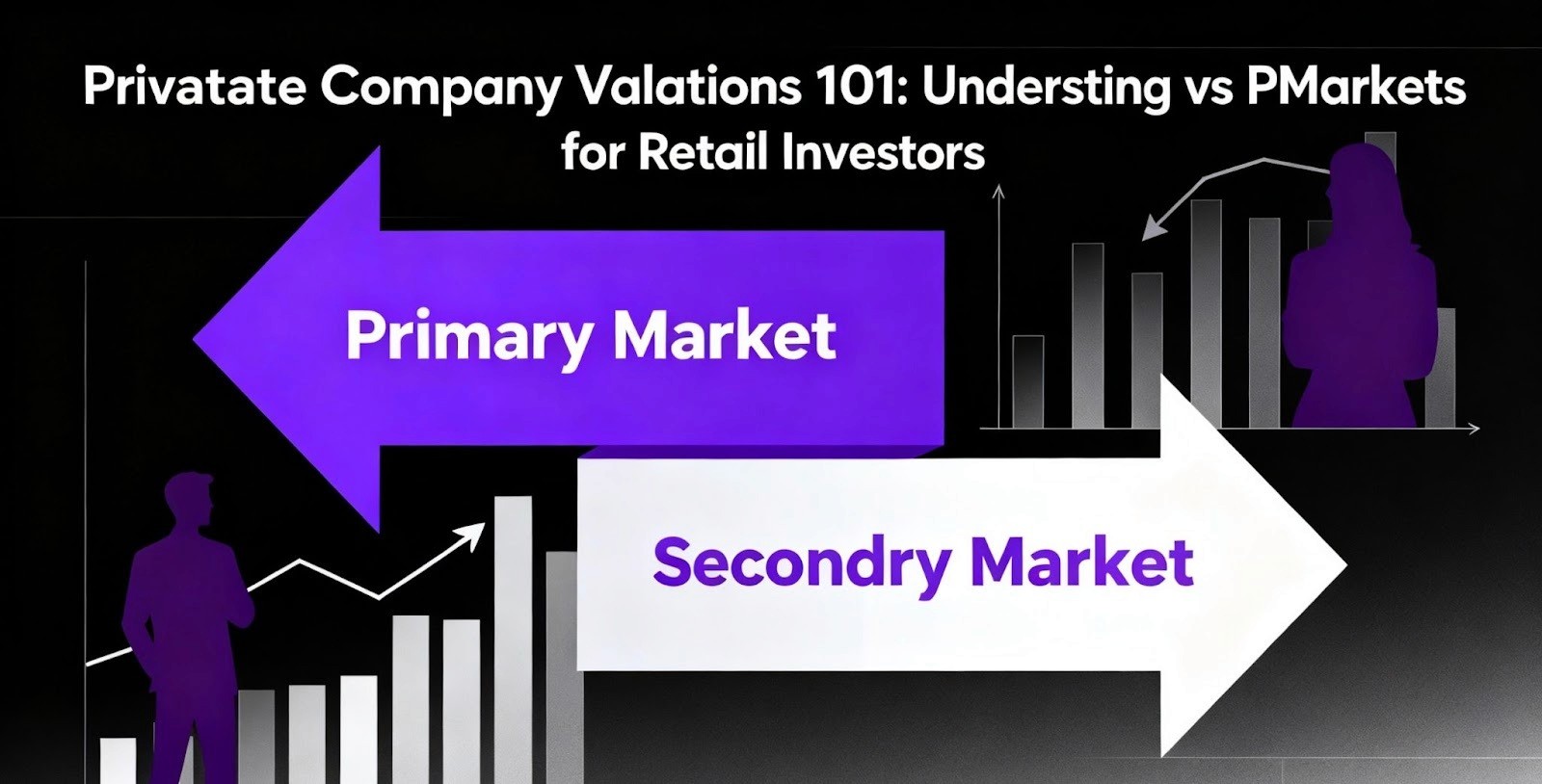
The primary market for private securities is where companies issue new shares directly to raise capital, typically through private placements without public underwriting syndicates. This market fuels innovation by matching institutional and accredited investors with early-stage ventures in exchange for ownership stakes.
How Do Private Companies Raise Capital in the Primary Market?
Private firms utilize structured mechanisms to secure growth funding:
Equity Private Placements: Companies sell newly issued shares to venture capitalists or accredited investors under negotiated terms.
Special Purpose Vehicles (SPVs): Aggregated capital pools invest collectively, streamlining participation in a single private deal.
Convertible Notes & SAFEs: Debt or simple agreements convert into equity at future financing events, balancing risk and reward.
These vehicles furnish critical growth capital while preserving negotiated control over valuation and share distribution.
Unlock deeper details on SPV structures via Jarsy’s guide on unlocking pre-IPO investments via SPV.
Who Are the Key Participants in Private Primary Markets?
Participants in private capital formation include:
Venture Capital Firms providing staged funding in exchange for equity
Angel Investors offering early-stage capital and strategic guidance
Corporate Venture Arms investing in emerging technologies aligned with strategic goals
Founders and Executive Teams structuring funding rounds and negotiating valuation
This ecosystem aligns sophisticated investors with high-growth entrepreneurs, laying the groundwork for future liquidity events.
What Are the Characteristics of Primary Market Transactions?
Primary market deals exhibit five defining traits:
New Securities Issuance: Shares are created and sold for the first time.
Negotiated Pricing: Valuation hinges on private negotiations, not public market forces.
Long-Term Capital: Funds support multi-year development cycles.
Subscription Agreements: Detailed terms govern investor rights, board seats, and liquidation preferences.
Limited Access: Participation typically restricted to accredited or institutional investors.
Such features calibrate risk and control while enabling capital-efficient scaling for innovators.
How Does the Primary Market Impact Private Company Valuations?
Primary capital rounds set fresh valuation benchmarks by:
Establishing per-share price implicit in funding terms
Signaling confidence from high-profile investors, often boosting subsequent multiples
Influencing employee equity incentives and retention through updated share-value metrics
These infusion points serve as critical inflection markers for a company’s worth trajectory.
How Does the Secondary Market for Private Equity Operate?
The secondary market for private equity allows existing shareholders to sell their stakes to new investors, unlocking liquidity in otherwise illiquid assets. By matching supply and demand off-exchange, secondary trading helps price discovery and gradual portfolio rebalancing for both companies and shareholders.
Growth and Importance of the Private Equity Secondary Market
The private equity secondary market experienced robust growth, with transaction volumes reaching approximately $102 billion in the first half of 2025, a 51% increase year-over-year, and projected to reach about $176 billion for the full year, driven by fund secondaries and direct secondaries alike. This surge is attributed to a decline in IPO activity and investors' increasing need to rebalance portfolios and seek liquidity. The secondary market provides a crucial avenue for investors to exit positions and manage exposure in private equity assets.This citation provides recent, verifiable data supporting the article's claims about the increasing activity and importance of the secondary market in providing liquidity for private equity investments.
What Is Market Liquidity in the Secondary Private Market?
Market liquidity in private secondary trading refers to the ease and speed with which private shares can be bought or sold. Enhanced by platforms that aggregate orders and facilitate transactions, liquidity provides:
Exit avenues for employees and early-stage investors
Price transparency through recorded trades
Flexibility for portfolio adjustments without waiting for IPO events
Stronger liquidity directly reduces holding-period risk, enabling more dynamic private market participation.
Who Participates in Secondary Market Transactions?
Secondary private equity trades involve:
Founders & Employees seeking partial liquidity for vested options
Early Investors such as angel groups selling stakes post-milestones
Hedge Funds & Private Equity Firms acquiring discounted private shares
Family Offices & High-Net-Worth Individuals diversifying into pre-IPO assets
This mix balances seller motivations with buyer appetite for emerging growth stories.
How Do Market Makers Facilitate Secondary Private Equity Trading?
Market makers in private equity serve as intermediaries that:
Provide bid-ask quotes, narrowing spreads for sellers and buyers
Assume temporary inventory risk to maintain continuous pricing
Offer confidentiality and settlement efficiency for off-market trades
By stabilizing pricing and providing ready counterparties, market makers boost confidence in transacting illiquid shares.
What Are the Risks and Benefits of Secondary Market Investing?
Secondary market investing presents:
Benefits:Accelerated liquidity opportunitiesPrice discovery reflecting real-time demandDiversified access to companies beyond funding rounds
Risks:Wider bid-ask spreads and valuation uncertaintyLimited regulatory oversight compared to public exchangesPotential lock-up or transfer restrictions
These trade-offs require careful due diligence to balance market flexibility against pricing and regulatory considerations.
What Are the Key Risks and Rewards of Pre-IPO Investing?
Investing in pre-IPO private companies offers a compelling mix of high-growth potential and inherent uncertainties. Understanding reward drivers and risk factors is essential for prudent portfolio construction.
What Are the Benefits of Investing in Pre-IPO Private Companies?
Pre-IPO stakes deliver:
Early Access to Innovation: Opportunity to back companies before broad valuation uplifts
Enhanced Return Potential: Historical analysis shows outsized gains from top-performing unicorns
Portfolio Diversification: Non-correlated asset exposures beyond public markets
Embedding private equity alongside traditional holdings can significantly uplift long-term returns.
What Risks Should Investors Consider in Pre-IPO Markets?
Key risks include:
Illiquidity: Limited exit options until secondary trades or IPO events
Valuation Uncertainty: Private pricing often lacks frequent market corroboration
Regulatory Exposure: Private securities face evolving compliance frameworks
Operational Risks: Early-stage companies may experience product, management, or cash-flow challenges
Mitigating these risks requires disciplined diversification and thorough due diligence.
How Does Pre-IPO Investing Compare to IPO Investing?
Pre-IPO investing occurs at negotiated private prices, often at lower valuations than public IPO pricing, whereas IPO investing exposes participants to public market volatility and underwriting fees. Pre-IPO stakes typically involve:
Less liquidity but lower entry multiples
Longer holding periods with private governance dynamics
Reduced regulatory disclosures compared to public filings
Balancing pre- and post-IPO allocations can optimize risk-adjusted returns across a company’s lifecycle.
What Best Practices Help Maximize Opportunities and Manage Risks?
Investors should adopt:
Rigorous Due Diligence: Analyze financials, cap table structures, and growth plans.
Diversification Across Rounds: Spread allocations across industries and funding stages.
Structured Vehicles: Use SPVs or tokenized platforms to streamline pooling and governance.
Ongoing Monitoring: Track secondary transactions and company milestones.
What Regulatory and Transparency Factors Affect Private Company Valuations?
Regulatory regimes and disclosure standards underpin trust in private markets by ensuring fair practices and investor protection. Compliance frameworks shape valuation transparency and drive market integrity.
What Are the Key Regulations Governing Private Markets?
Private securities offerings and trades typically fall under:
SEC Rules (U.S.): U.S. offerings often rely on exemptions such as Regulation D under the Securities Act, which allows private companies to raise capital without registering securities publicly, subject to investor qualification standards and offering limits.
FINRA Oversight: Supervising broker-dealer conduct and secondary trading platforms
Accredited Investor Standards: Criteria limiting participation based on income or net worth
Cross-Border Securities Laws: Varying rules impacting global investor eligibility
Understanding these guardrails helps investors navigate compliance requirements and valuation methodologies.
How Does Transparency Impact Private Market Trust and Valuation?
Greater transparency in financial reporting, cap table disclosures, and transaction records leads to:
Improved Price Discovery: More reliable secondary prices aligned with actual demand
Reduced Information Asymmetry: Equal access to performance data for buyers and sellers
Stronger Valuation Confidence: Investors calibrate models with credible, audited inputs
Transparent ecosystems foster enhanced market participation and tighter valuation spreads.
How Are Investors Protected in Private Equity Markets?
Protections include:
Contractual Rights: Preferred share terms such as liquidation preferences and anti-dilution clauses
Legal Safeguards: Fiduciary duties for boards and key stakeholders
Regulatory Enforcement: Oversight by securities regulators to prevent fraud and misrepresentation
Dispute Resolution Mechanisms: Arbitration or court processes outlined in subscription agreements
These measures balance growth potential with robust investor safeguards.
How Do Primary and Secondary Markets Differ in Private Company Valuations?
Primary and secondary private markets serve distinct but interlinked valuation roles, shaping company worth through fresh capital influxes and continuous price discovery for existing shares.
What Are the Main Differences Between Primary and Secondary Markets?
Market Aspect | Primary Market | Secondary Market |
|---|---|---|
Function | New securities issuance to raise capital | Trading of existing shares among investors |
Participants | Issuer, underwriters, venture capitalists | Shareholders, market makers, private equity buyers |
Liquidity Profile | Lower immediate liquidity; capital formation | Enhanced liquidity; price discovery |
Pricing Mechanism | Negotiated round valuations | Market–driven bid–ask spreads |
How Do Valuation Dynamics Vary Across These Markets?
Primary rounds establish headline valuations based on negotiated terms and investor confidence, while secondary trades refine and validate those valuations through real-time demand signals. Secondary pricing often reflects:
Discounted rates to primary round multiples
Adjustments for liquidity and transfer restrictions
Market sentiment shifts between funding events
Together, these dynamics create a comprehensive valuation ecosystem from issuance through exit.
Why Is Understanding Both Markets Important for Retail Investors?
Retail investors gain strategic advantage by:
Leveraging primary round insights to anticipate valuation uplifts
Utilizing secondary market transactions to execute timely portfolio rebalances
Comparing deal structures and liquidity terms across both venues
Mastery of primary-secondary interplay empowers more precise allocation decisions and risk management in private equity investing.
Private company valuation mastery begins with grasping how primary issuance benchmarks and secondary trading refine and reveal true company worth. By combining rigorous valuation fundamentals with selective access through tokenized platforms, retail investors can secure growth-stage opportunities once reserved for institutions.
Frequently Asked Questions
What are the key differences between primary and secondary markets for private companies?
The primary market involves the issuance of new securities directly from private companies to raise capital, typically through private placements. In contrast, the secondary market facilitates the trading of existing shares among investors, allowing for liquidity and price discovery. While the primary market focuses on capital formation and negotiated valuations, the secondary market reflects real-time demand and can adjust prices based on market sentiment. Understanding these differences is crucial for investors looking to navigate private equity effectively.
How can retail investors assess the value of private companies?
Retail investors can assess the value of private companies by utilizing various valuation methods such as Discounted Cash Flow (DCF), Comparable Company Analysis, and Asset-Based Valuation. Each method provides unique insights into a company's worth based on projected cash flows, peer benchmarks, or tangible assets. Additionally, investors should consider market conditions, growth potential, and industry trends to form a comprehensive view of a company's valuation. Engaging with platforms that provide access to private market data can also enhance this assessment.
What role do venture capitalists play in private company valuations?
Venture capitalists (VCs) play a critical role in private company valuations by providing funding in exchange for equity stakes. Their investment decisions are often based on rigorous due diligence, including financial projections, market potential, and the company's growth trajectory. VCs also influence valuations through their negotiation power during funding rounds, as their participation can signal confidence to other investors. Additionally, VCs often help shape a company's strategic direction, which can further impact its valuation over time.
What are the implications of tokenization for private equity investments?
Tokenization transforms private equity investments by enabling fractional ownership of shares, which lowers entry barriers for retail investors. This process enhances liquidity, as tokenized shares can be traded on blockchain platforms, allowing for quicker transactions and price discovery. Furthermore, tokenization increases transparency by providing immutable records of ownership and transaction history. As a result, investors can access previously illiquid assets with greater ease, making private equity more accessible and appealing to a broader audience.
How do regulatory factors influence private company valuations?
Regulatory factors significantly influence private company valuations by establishing the legal framework within which these companies operate. Compliance with regulations, such as SEC rules for private placements, affects how companies can raise capital and disclose financial information. Regulatory oversight ensures fair practices and investor protection, which can enhance market confidence and, consequently, valuations. Additionally, evolving regulations may impact investor participation and the overall attractiveness of private equity investments, making it essential for investors to stay informed about these changes.
What are the potential exit strategies for investors in private companies?
Investors in private companies typically consider several exit strategies, including initial public offerings (IPOs), mergers and acquisitions (M&A), and secondary market sales. An IPO allows investors to sell their shares on public exchanges, potentially realizing significant returns. M&A can provide liquidity through the sale of the company to a larger entity, while secondary market sales enable investors to sell their stakes to other private investors. Each exit strategy carries its own risks and rewards, and investors should evaluate their options based on market conditions and company performance.
How can investors mitigate risks associated with pre-IPO investments?
Investors can mitigate risks associated with pre-IPO investments by conducting thorough due diligence, diversifying their portfolios, and utilizing structured investment vehicles like Special Purpose Vehicles (SPVs). Rigorous analysis of a company's financial health, market position, and growth potential is essential. Diversification across different industries and funding stages can help spread risk. Additionally, staying informed about market trends and regulatory changes can aid in making informed investment decisions, ultimately enhancing the likelihood of successful outcomes in pre-IPO investments.