Spain's triumph, football's biggest live technology experiment, and the lessons from a tournament that reshaped sports, media and prediction markets. Image Credit: Jarsy
In June, we published World Cup 2026: Beyond the Game, arguing that this would be the biggest, richest and most technologically advanced tournament in history. It delivered on that vision, but not without a few surprises and disappointments.
Spain lifted the trophy. Officiating technology largely performed as intended, though it still sparked plenty of controversy. And prediction markets didn't just become part of the tournament but far exceeded our expectations.
Now that the biggest sporting event in history has come to a close, this report looks back at what happened, what worked, what didn't, and what it all means for the future of sport, technology and business.
1. The Games: How It Played Out
Source: FIFA. © 2026 Jarsy Research
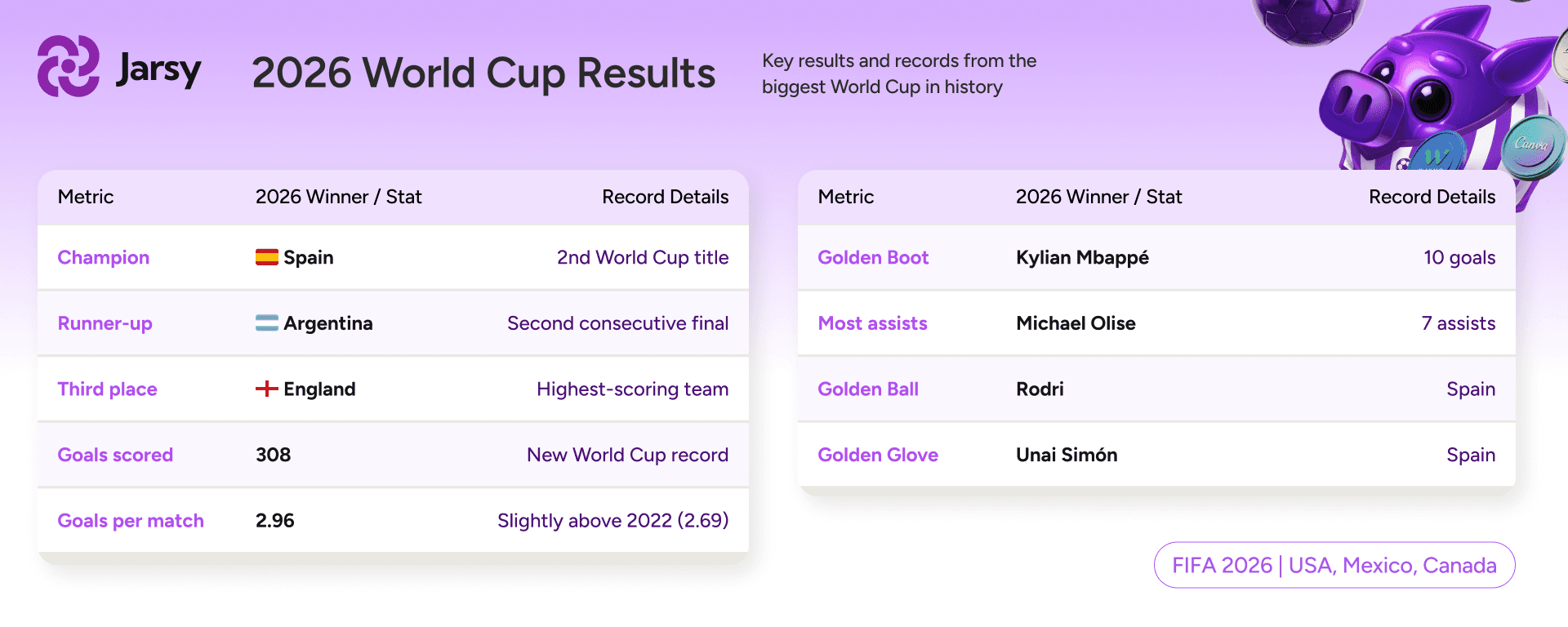
The 2026 FIFA World Cup delivered on its promise to become the biggest tournament in football history. Spain defeated Argentina 1-0 after extra time to claim its second title, having controlled much of the final against an Argentine side that looked tired and disjointed after one day less rest. Emiliano Martínez kept Argentina alive with a remarkable series of saves, but Spain ultimately proved the stronger team.
For many fans, however, the defining image of the tournament came after the final whistle, as Lionel Messi left the World Cup stage for what is expected to be the last time. At 39, he had once again carried Argentina to the final, and although a second consecutive title slipped away, his performance throughout the tournament ensured his legacy only grew stronger. His farewell left many fans in tears and marked the end of the sport's most extraordinary international careers.
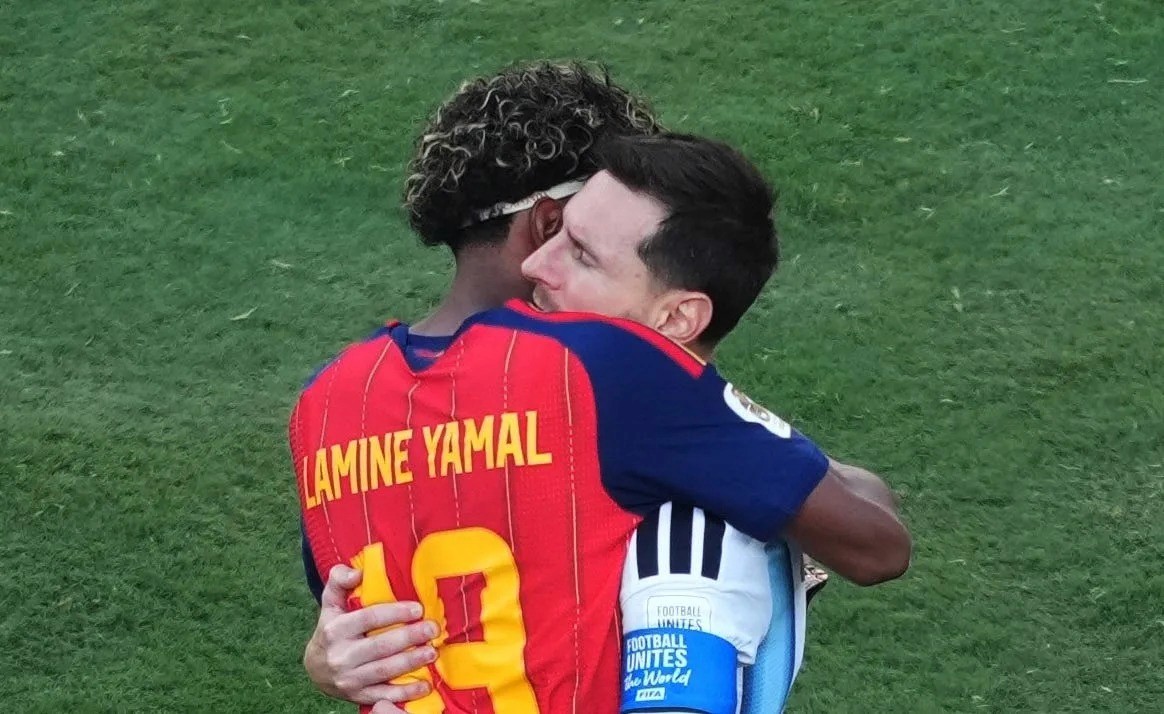
Messi and Yamal hug after the final whistle. Image Credit: Yahoo Sports
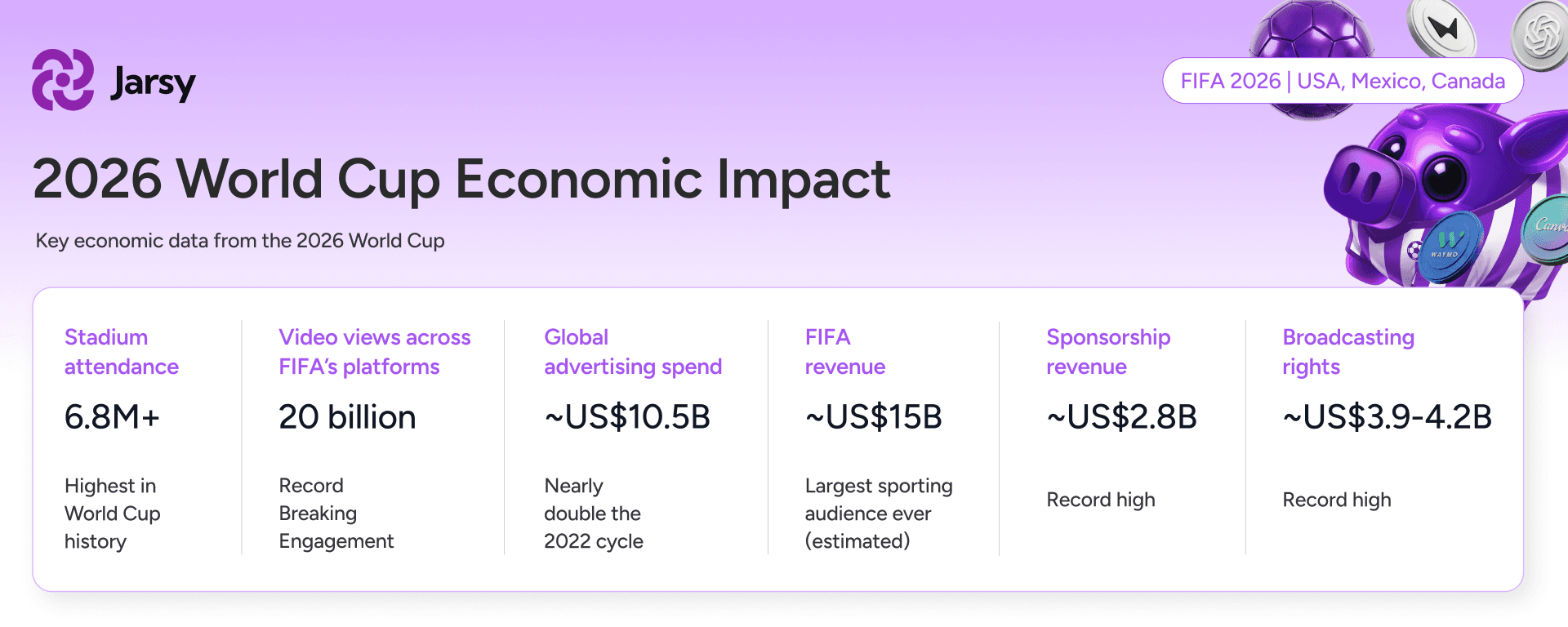
Beyond the football itself, the expanded tournament produced 104 matches, drew more than 6.6 million spectators, reached nearly six billion viewers, and generated an estimated US$15 billion in revenue for FIFA, cementing the World Cup as both a global sporting event and a powerful technology, media and business platform.
Sources: FIFA, Reuters, The Guardian. © 2026 Jarsy Research
2. The Technology: The Live Test, Graded
Our June report described the 2026 World Cup as the most instrumented sporting event ever staged and football's biggest live technology test. After 104 matches, the verdict is mixed. The technology largely delivered exactly as designed. Yet, precisely because it worked so well, it produced a summer of debate.
What worked
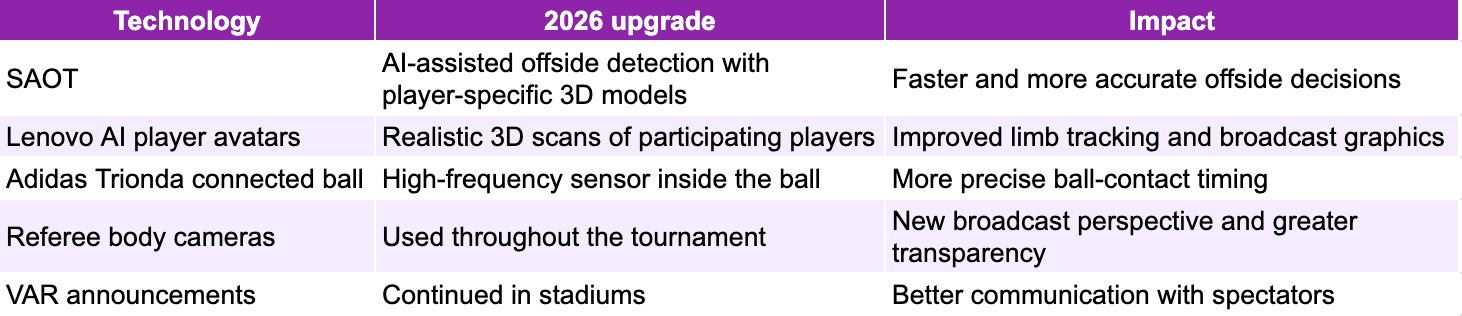
The officiating technology stack performed as promised. Semi Automated Offside Technology (SAOT) combined optical tracking with connected ball data to determine player positions and the exact moment the ball was played. The biggest upgrade from Qatar 2022 was FIFA and Lenovo's AI enabled player digital twins. Participating players were digitally scanned to create realistic 3D body models, replacing the generic avatars used four years earlier and improving both officiating accuracy and broadcast visualisations.
The Adidas Trionda connected ball continued transmitting high frequency sensor data, allowing officials to identify the precise moment of every touch. Referee body cameras were expanded across the tournament, while selected VAR decisions continued to be explained inside stadiums, giving fans greater visibility into the decision making process.
Sources: FIFA. © 2026 Jarsy Research
What didn't and the controversies
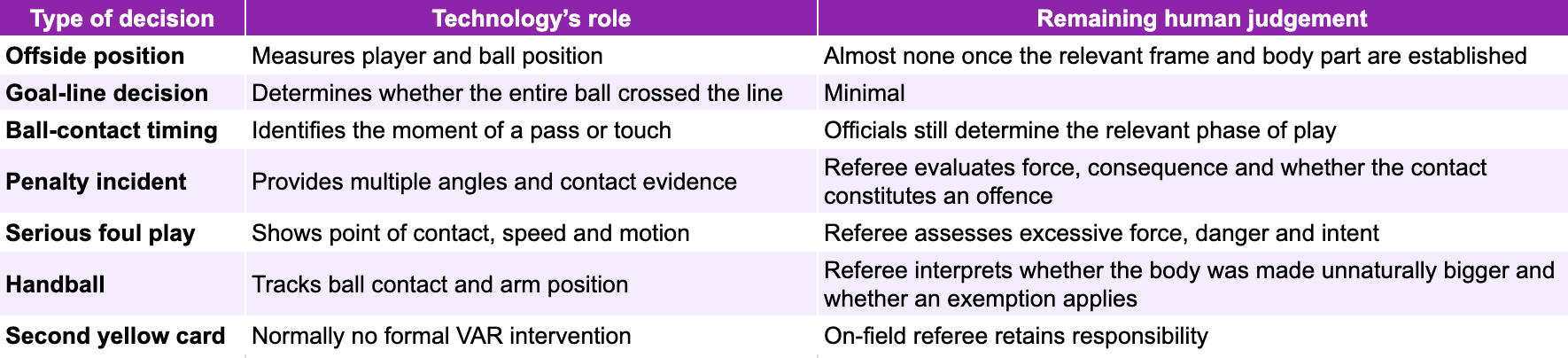
Technology is now precise enough to rule a player offside by the position of a toe, but the decisions fans argue about most, penalties, fouls and physical contact, remain matters of human judgement.
Iran had a dramatic late goal against Egypt ruled out for a marginal offside, while Colombia's Davinson Sánchez saw a goal disallowed because only part of his foot extended beyond the defensive line. The technology was functioning exactly as intended. The controversy was whether football should be decided by margins so small.

© 2026 Jarsy Research
The louder criticism, however, centred on subjective decisions. Challenges, penalties and handballs still depend on referee interpretation, and VAR only intervenes when officials judge that a "clear and obvious error" has been made. Croatia captain Luka Modrić openly criticised the officiating after Portugal's controversial penalty and Croatia's disallowed equaliser, highlighting that technology cannot eliminate disagreement over judgement.
Sources: FIFA. © 2026 Jarsy Research
The lesson from 2026 is clear. Automation has largely solved football's geometry, but it cannot solve football's judgement. The more precisely technology measures the game, the more supporters question whether every technically correct decision also feels fair. Football remains a human sport, where emotion, interpretation and context matter just as much as millimetres.
3. The Prediction-Market Breakthrough
The 2026 World Cup proved to be a watershed moment for prediction markets. In our June
report, we estimated that the tournament could generate approximately $11.8 billion in trading volume on Kalshi and $8.7 billion on Polymarket across their major World Cup markets. The actual outcome exceeded that forecast by a considerable margin.
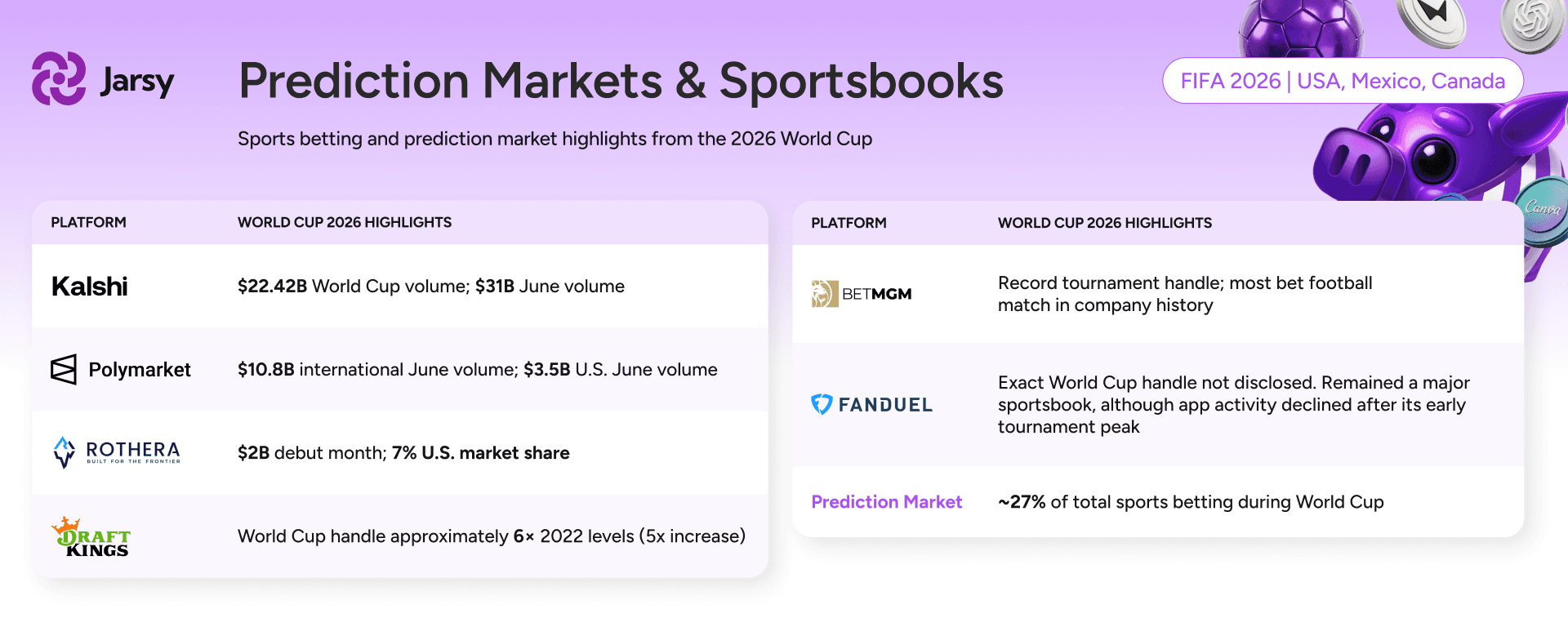
According to CoinDesk, Kalshi's World Cup markets generated $22.42 billion in notional trading volume, nearly double our estimate for the platform alone. Polymarket also recorded a record month, processing $10.8 billion on its international exchange and $3.5 billion on its new U.S. platform. Its World Cup Winner market alone attracted $4.32 billion in trading.
The World Cup also accelerated competition. Rothera, a new exchange backed by Robinhood and Susquehanna, launched in June and processed approximately $2 billion in its first month, capturing an estimated 7% of the U.S. prediction market. Meanwhile, trading firm DRW established a dedicated prediction markets desk, highlighting growing institutional interest.
A New Competitive Landscape
DraftKings reported that World Cup betting handle was approximately five times higher than in 2022, while BetMGM described the tournament as the biggest World Cup in its history. In the United States, the Round of 16 match between the U.S. and Belgium became the most-bet football match ever for several major sportsbooks.
Although sportsbook handle and prediction market trading volume are measured differently and cannot be compared directly, the tournament highlighted prediction markets as a rapidly growing channel for sports trading. According to Apptopia, Kalshi's daily active users increased 36% during the second half of June, even as activity on DraftKings, FanDuel, BetMGM and Caesars declined from their early tournament peaks. Kalshi and Polymarket also accounted for 78.5% of downloads among the six largest sports betting and prediction market apps during June. Separately, H2 Gambling Capital estimated that prediction markets represented approximately 27% of sports betting activity during the tournament.
Sources: CNBC; CoinDesk, Apptopia.com, Dune.com. © 2026 Jarsy Research
4. Viewership: Television vs Social
The 2026 FIFA World Cup reached one of the largest global audiences in sporting history. Television remained the primary platform for watching matches live, while social media extended the tournament's reach through highlights, creators and fan communities. Together, they created the most digitally connected World Cup to date.
Television Still Dominated Live Viewing
The tournament delivered some of the largest television audiences of the year across multiple countries. Home teams, knockout matches and the Final consistently attracted record viewership, underscoring football's unique ability to unite national audiences.
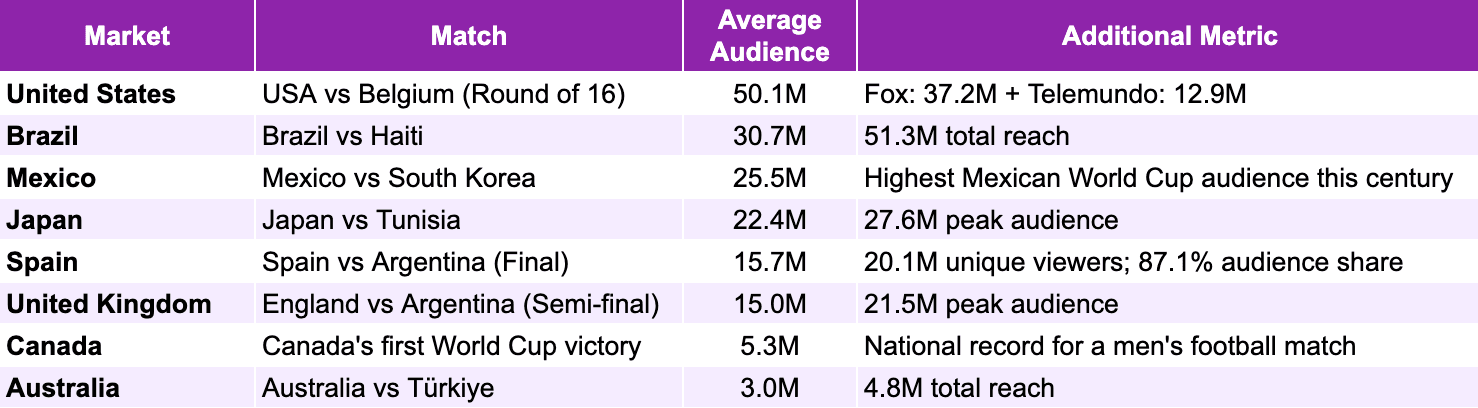
Audience examples. Sources: FIFA; Nielsen; Fox Sports; Globo; BBC; RTVE; TV Asahi; Numeris; OzTAM. © 2026 Jarsy Research
Social Media Extended the Tournament's Reach
While television concentrated audiences around live broadcasts, social media transformed the World Cup into a continuous global conversation. Fans consumed highlights, goals, celebrations and behind-the-scenes content across multiple platforms, allowing the tournament to reach audiences far beyond those watching matches live.
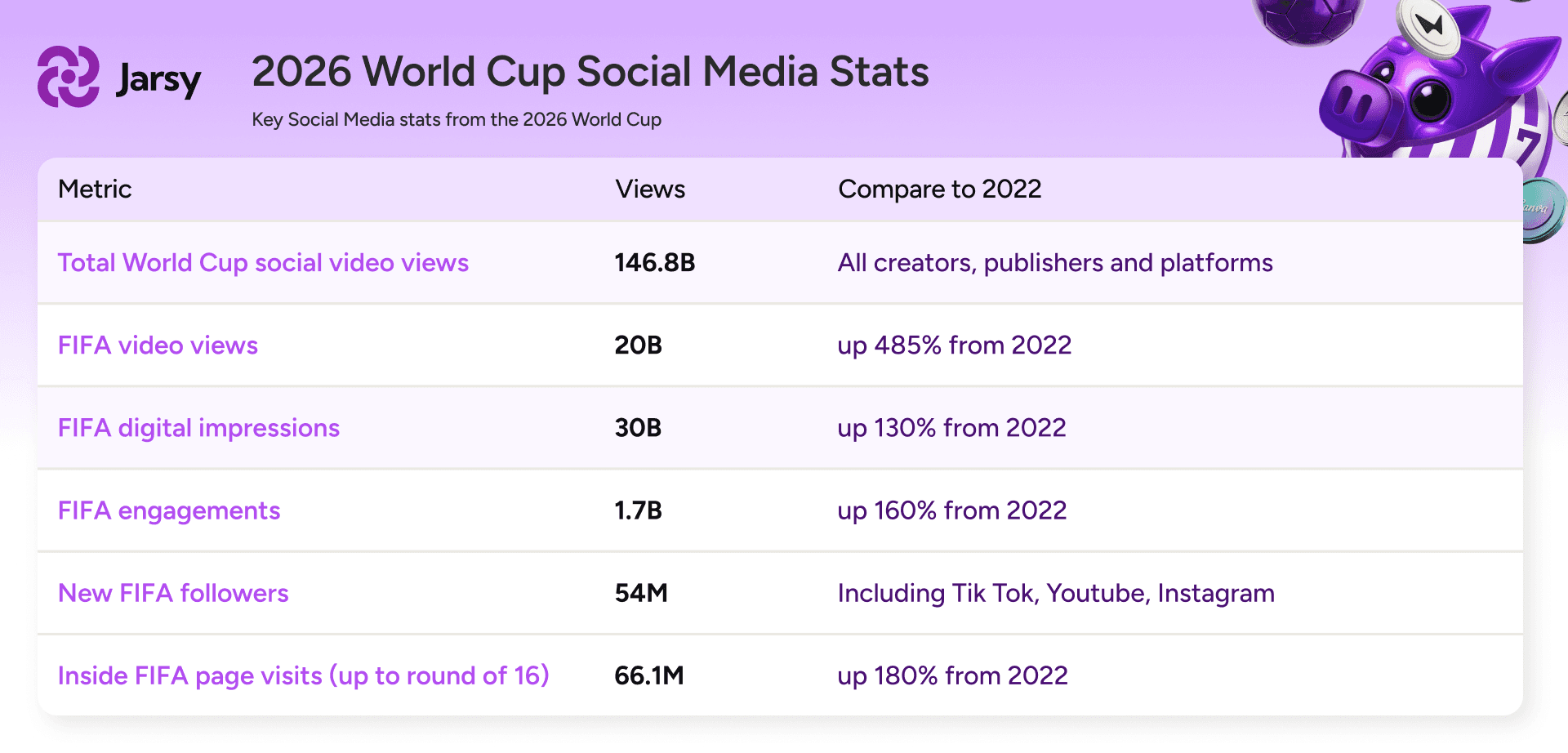
Sources: FIFA; Tubular Labs; Advanced television. © 2026 Jarsy Research
5. The Winners, and What Comes Next
The FIFA World Cup creates far more than a champion. It generates winners across media, technology, consumer brands, finance and even national economies. The tournament's record audience, expanded format and global attention created commercial opportunities that extended well beyond the football itself.
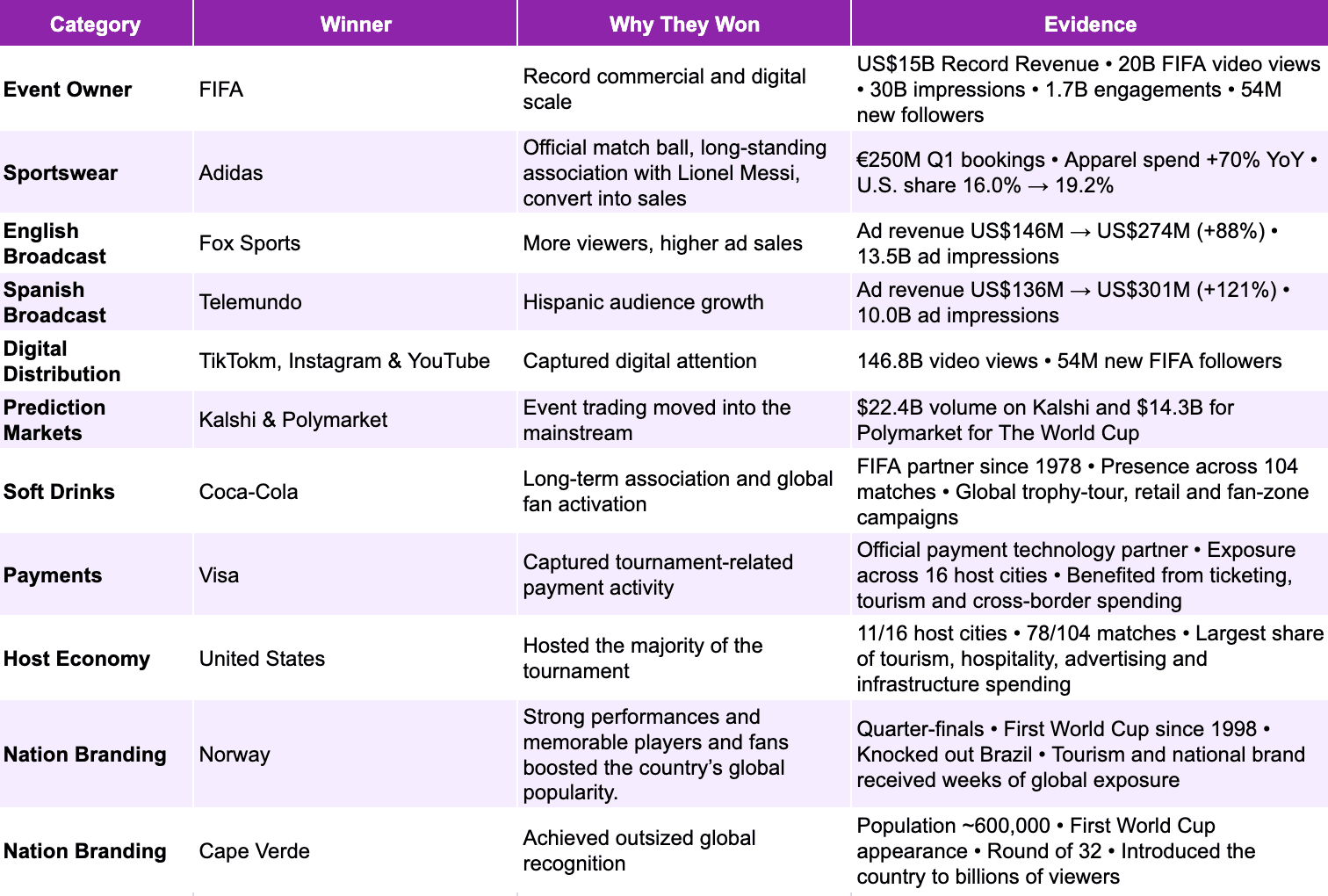
Source: FIFA; mediapost; Adidas; Vogue; Kalshi; Polymarket; & Jarsy Research. © 2026 Jarsy Research
While some of these gains were immediate, such as merchandise sales, advertising revenue and prediction-market trading volume, others are likely to have a much longer-lasting impact. The 2026 tournament accelerated several structural trends that are expected to shape how future sporting events are broadcast, consumed, commercialised and monetised.
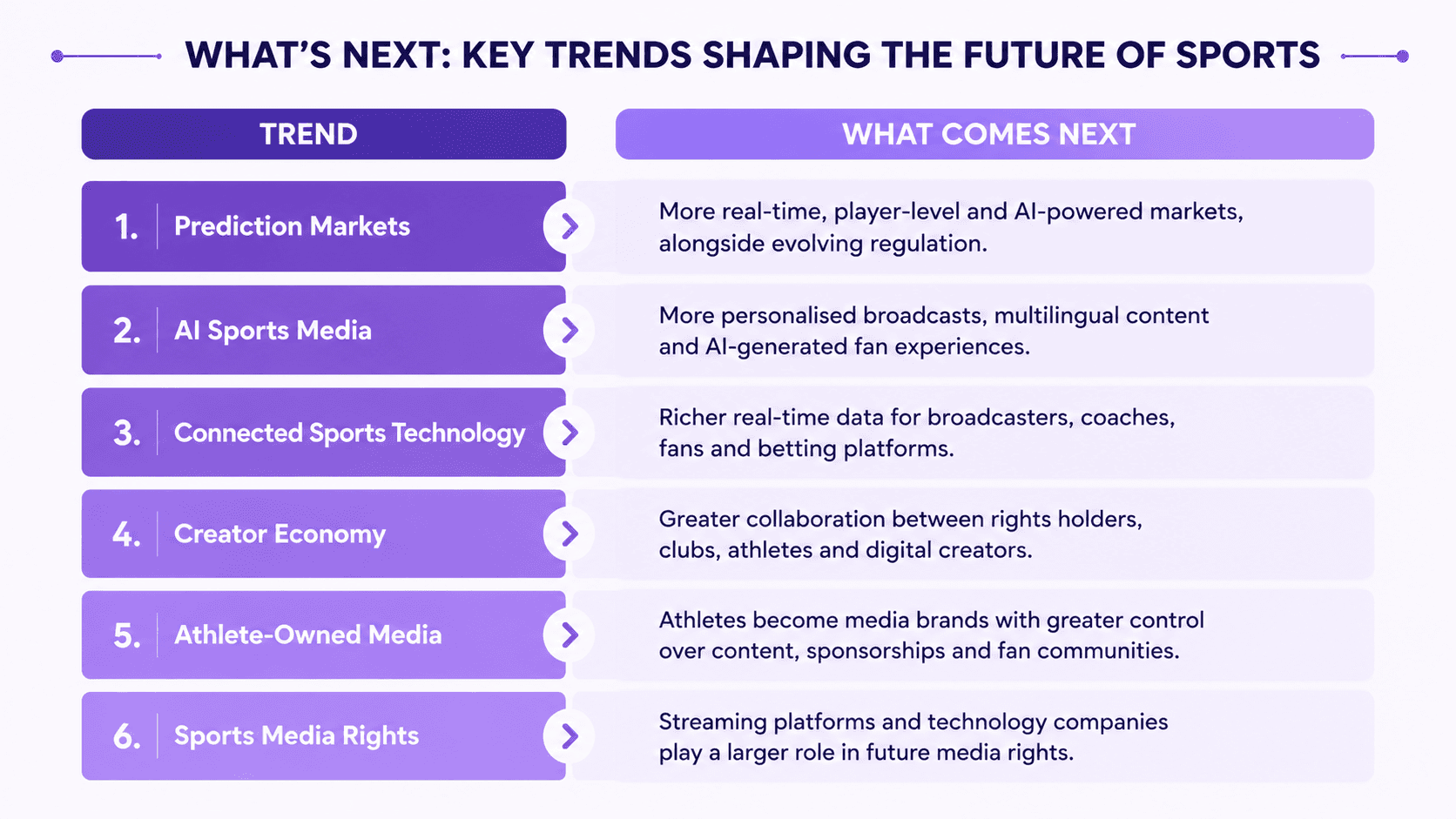
© 2026 Jarsy Research
Beyond the numbers, the 2026 FIFA World Cup was ultimately about people. It marked the farewell of some of football's greatest stars, whose performances created lasting memories for millions of fans, while also introducing a new generation ready to define the next era of the sport. Every World Cup leaves a legacy beyond the trophy, shaping culture, inspiring future players and bringing people together across borders.
By the time the tournament returns in 2030, many of the ideas that felt new in 2026 may simply be part of the game. Football will continue to evolve, but its ability to unite billions of people through a shared passion will remain its greatest strength. The next World Cup will bring new stories, new technologies and new questions. We'll be watching. ⚽🏆🌎💜🫶

Image Credit: FIFA