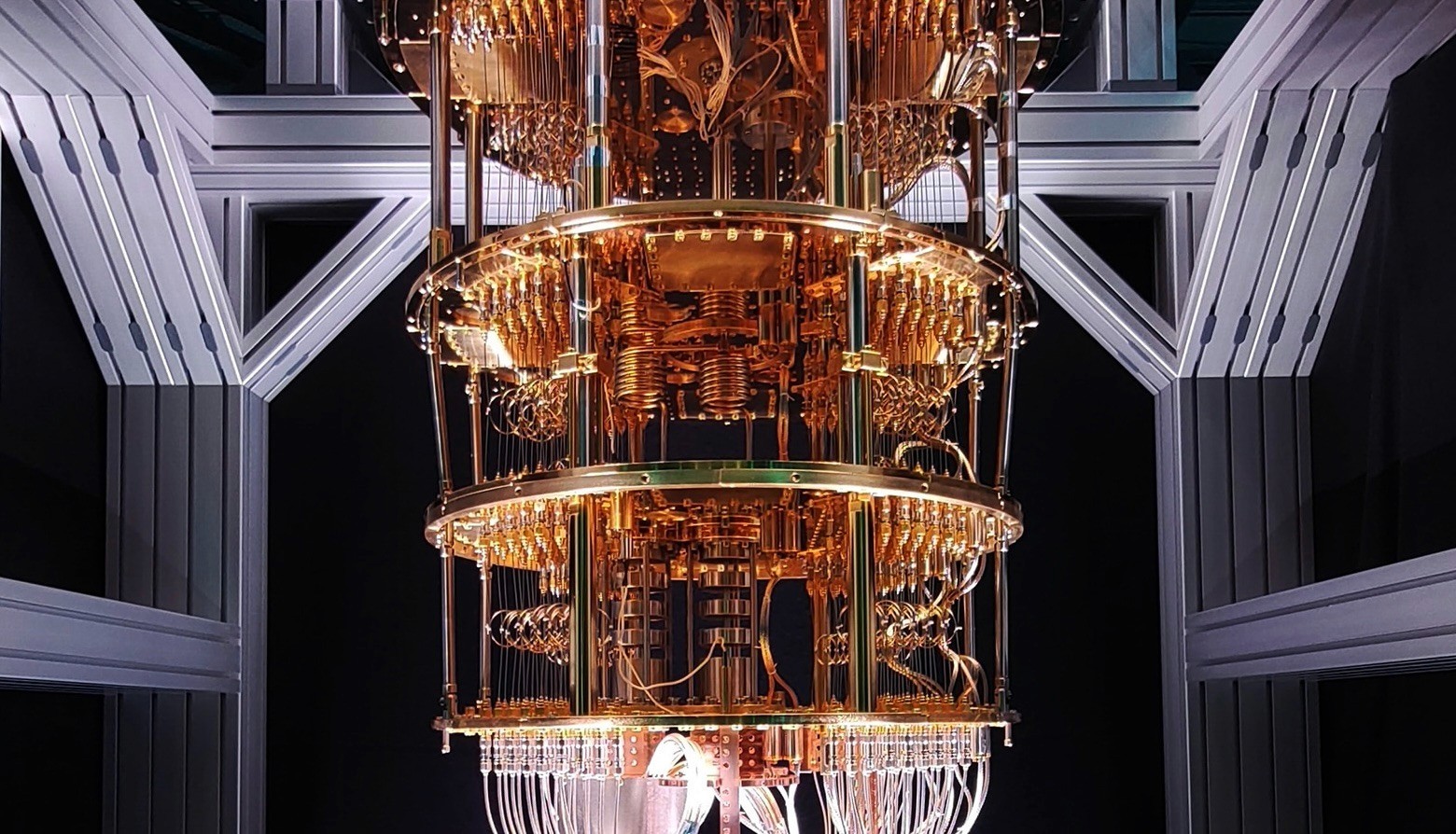
After the first generation of public quantum companies, a new group of startups is heading to the markets. Image Credit: IQM Quantum Computers
For years, quantum computing was largely confined to research labs and venture-backed startups. That changed during the 2021-2023 SPAC boom, when several companies, including IonQ, Rigetti Computing, D-Wave Quantum, and Quantum Computing Inc. went public, creating the first generation of listed quantum firms. Their volatile share prices and long development timelines have since highlighted the challenges of turning quantum research into commercial products.
Now a new wave of companies is preparing to join them. In the past few weeks:
IQM Quantum Computers announced an upcoming $1.8B SPAC merger
Infleqtion completed a $1.8B SPAC listing and start trading on Feb 17, 2026
Xanadu is moving toward a Nasdaq listing via SPAC
Quantinuum has confidentially filed for an IPO
Together they represent a second generation of quantum companies entering public markets, they represent four very different technological bets on how a scalable quantum computer will ultimately be built.
1. IQM - Europe’s Superconducting Quantum Challenger
Company Overview
IQM Quantum Computers is a Finnish startup founded in 2018 as a spinout from Aalto University and VTT Technical Research Centre of Finland. The company builds full-stack superconducting quantum computers designed for both on-premises deployment and cloud access (same technology pursued by IBM and Google). With more than 300 employees across 13 countries, IQM has emerged as one of Europe’s leading quantum hardware companies and has delivered multiple on-premise quantum systems worldwide.
Technology
IQM builds superconducting quantum processors using proprietary Star and Crystal qubit designs, which are optimized for high connectivity and efficient error correction. The company uses QLDPC (quantum low-density parity-check) codes that it claims reduce error-correction overhead by roughly 10x compared to the surface codes used by IBM and Google. IQM has achieved greater than 99.9% fidelity for single-qubit and two-qubit gates and readouts. Its next-generation Halocene system is expected to advance the company toward broad commercialization, with a long-term roadmap targeting fault-tolerant quantum computing by 2030 through merged topologies and over one million physical qubits.
IQM also recently deployed a 54-qubit system based on its Radiance platform at the Leibniz Supercomputing Centre in Germany as part of the Euro-Q-Exa project - the first EuroHPC quantum computer in the country - with plans for a 150-qubit system by late 2026.

IQM's Radiance platform. Image Credit: IQM Quantum Computers
Financials, Valuation, and IPO plan
IQM is already in the early commercial deployment stage, selling superconducting quantum systems to research institutions and high-performance computing centers in Europe and beyond. The company has delivered multiple on-premises quantum computers and works with national labs, universities, and industrial partners. IQM has raised roughly $600 million in total funding, including a $320 million Series B in 2025, and generates tens of millions of dollars in annual revenue.
IQM announced on February 23, 2026 that it will go public through a merger with the Nasdaq-listed SPAC Real Asset Acquisition Corp, valuing the company at about $1.8 billion. The transaction is expected to close around June 2026, after which IQM will trade on a U.S. exchange (likely Nasdaq), with the company also exploring a potential dual listing in Helsinki.
2. Infleqtion - Quantum Computing Meets Quantum Sensing
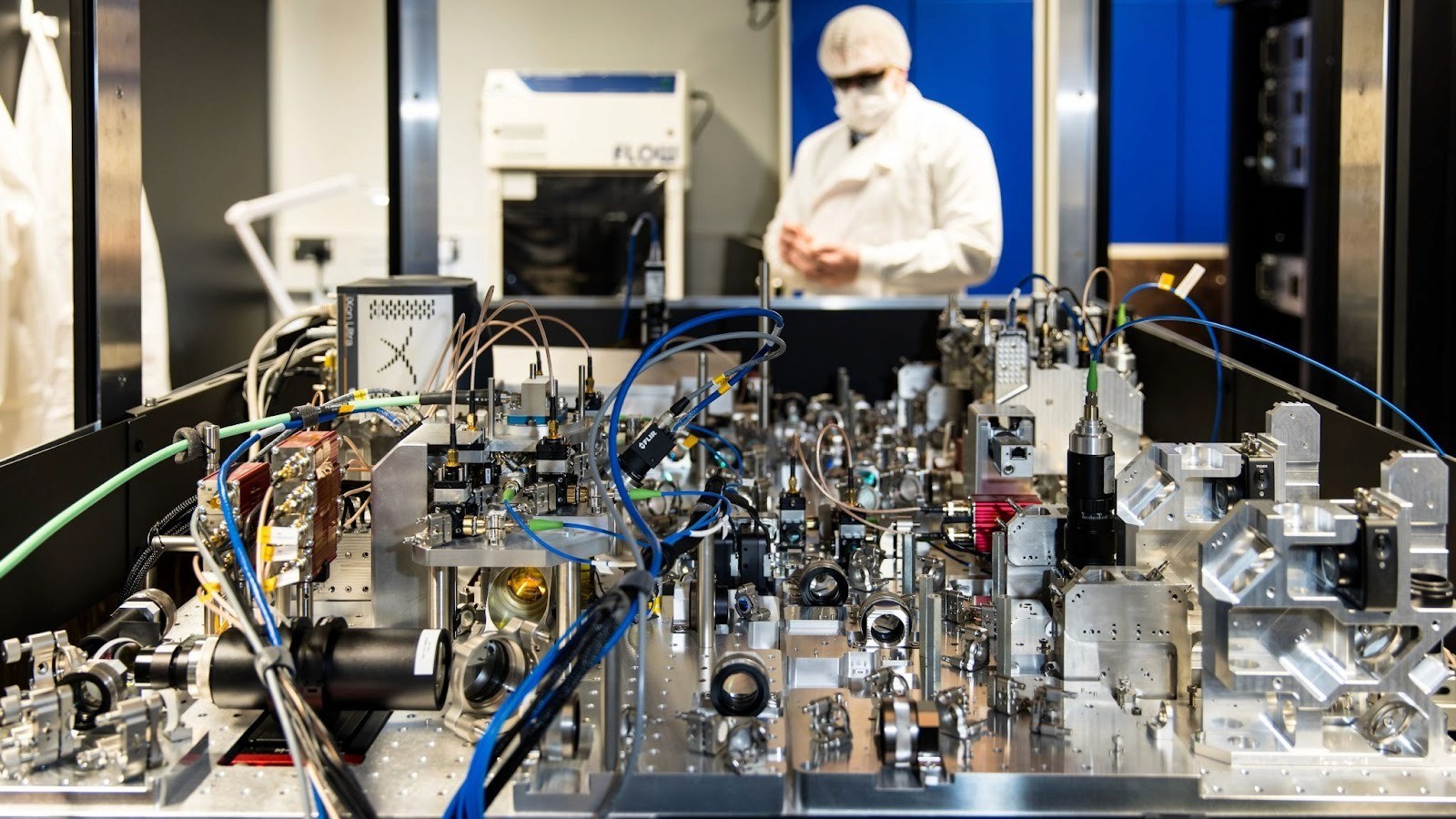
Infleqtion Lab. Image Credit: businesswire.com
Company Overview
Infleqtion (formerly ColdQuanta) was founded in 2007 by physicist Dana Anderson of the University of Colorado Boulder and the JILA. Led by CEO Matthew Kinsella, the company has evolved from a cold-atom laboratory equipment supplier into a quantum technology platform company, developing both neutral-atom quantum computing systems and high-precision quantum sensing technologies.
Technology
Infleqtion uses neutral-atom technology: atoms cooled to near absolute zero and manipulated with lasers, to build both quantum processors and quantum sensors. Neutral atoms are considered inherently scalable because they can be arranged in large, reconfigurable arrays. The company’s architecture is paired with its proprietary Superstaq software platform, which provides a full-stack development environment.
On the sensing side, Infleqtion has active contracts for quantum gravity sensors (a $20 million NASA mission to fly the world’s first quantum gravity sensor in space), resilient navigation and timing systems for the U.S. Army, and energy grid optimization under a $6.2 million ARPA-E ENCODE program. The company also collaborated with NVIDIA on a demonstration involving logical qubits for materials science applications.
Financials, Valuation, and IPO
Infleqtion operates at a hybrid commercial stage, generating revenue from quantum sensing, atomic clocks, and government contracts, while continuing to develop neutral-atom quantum computers. Prior to its SPAC listing, the company had raised hundreds of millions of dollars in private funding. The company reported $29 million in revenue for 2024, and $50 million of booked and awarded business in 2025. The company finalized its SPAC merger with Churchill Capital Corp X earlier this year and began trading on the New York Stock Exchange on February 17, 2026, under the ticker INFQ.
3. Xanadu - The Photonic Quantum Vision
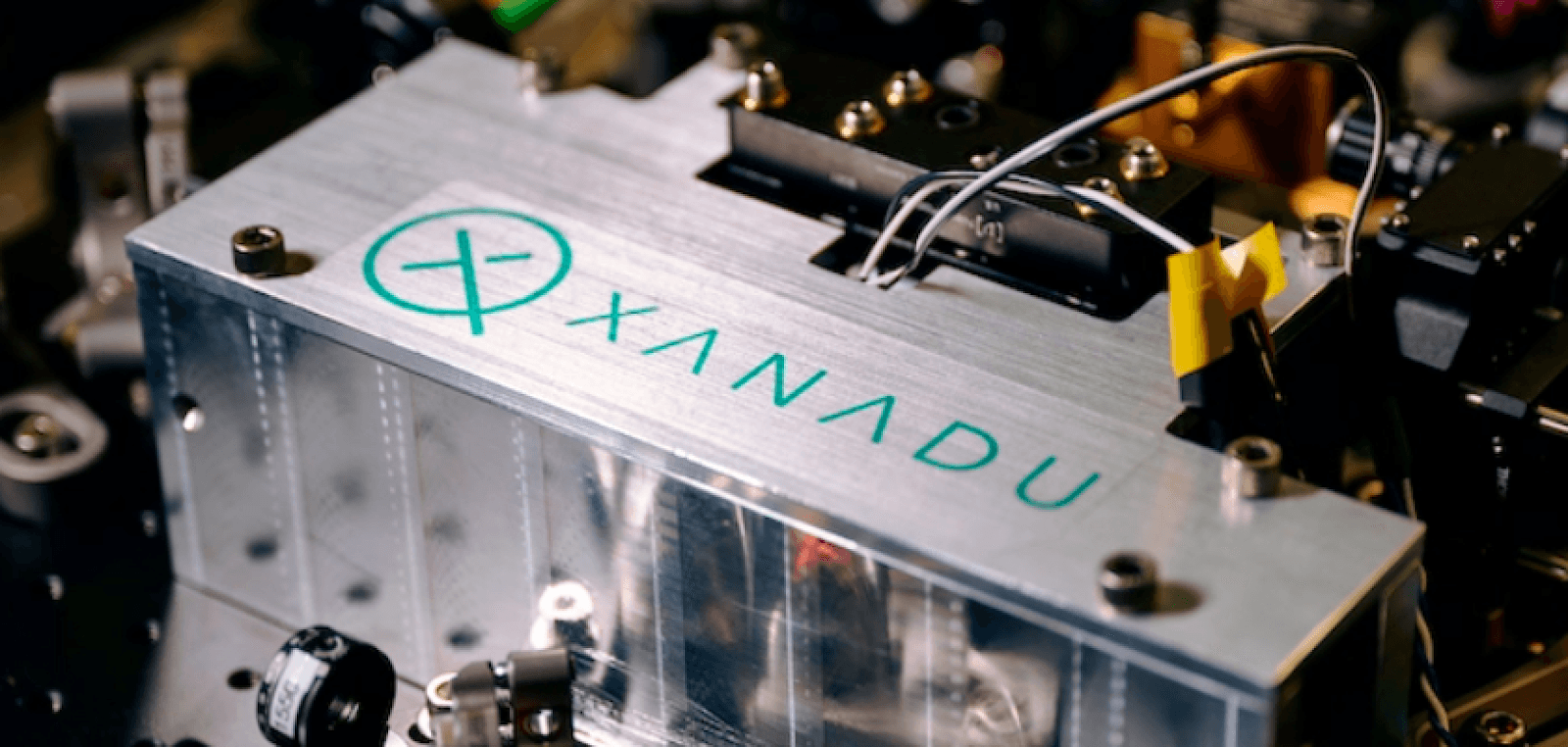
Image Credit: Xanadu
Company Overview
Xanadu is a Toronto-based quantum computing company founded in 2016 by CEO Christian Weedbrook, a quantum physicist. Xanadu is pursuing one of the most ambitious architectures: photonic quantum computing (similar to PsiQuantum). Instead of superconducting circuits or trapped atoms, Xanadu uses particles of light (photons) as qubits.
Technology
Xanadu develops photonic quantum computers, an approach that could operate closer to room temperature, integrate with fiber-optic networks, and scale through modular architectures. The company gained global attention in 2022 when its Borealis processor demonstrated a form of quantum computational advantage on a specialized sampling task, showing that photonic systems can perform calculations difficult for classical computers to simulate.
In February 2025, Xanadu introduced Aurora, a 12-qubit universal photonic quantum computer prototype built from modular server racks containing photonic chips connected by fiber optics. The company also created PennyLane, a widely used open-source framework for hybrid quantum-classical machine learning, which has helped build strong developer adoption. Xanadu ultimately aims to deploy a large-scale quantum computing data center by 2029 targeting applications in finance, climate modeling, and machine learning.
Financials, Valuation, and IPO plan
Xanadu remains largely in a development and ecosystem-building stage, with photonic quantum processors accessible through cloud platforms and a widely used open-source software framework, PennyLane. The company has raised roughly $250-300 million in venture funding, backed by major investors including Bessemer Venture Partners and Georgian.
Xanadu plans to go public via a merger with Crane Harbor Acquisition Corp, first announced in November 2025. The deal is expected to close later in 2026, with the combined company listing on Nasdaq.
4. Quantinuum - The Full-Stack Quantum Powerhouse
Company Overview
Quantinuum is widely regarded as the most technically advanced quantum computing company pursuing a public listing. Formed in 2021 from the merger of Honeywell Quantum Solutions (hardware) and Cambridge Quantum Computing (software), the company operates as a full-stack trapped-ion quantum computing platform. The company has over 630 employees, including 370+ scientists and engineers, spread across the U.S., UK, Germany, and Japan.
Technology
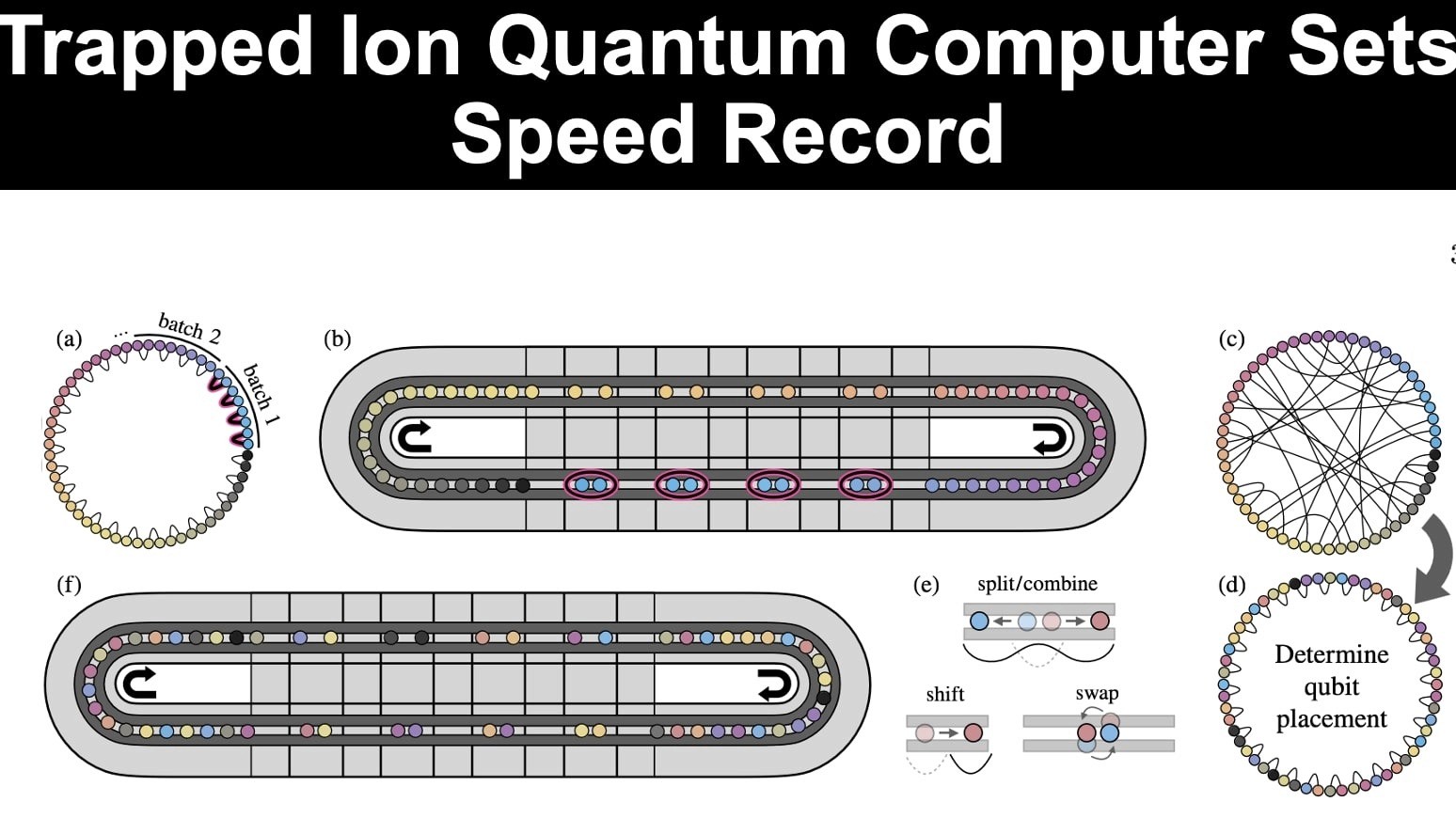
Quantinuum launched its flagship Helios quantum computer in November 2025, featuring 98 trapped-ion qubits with industry-leading fidelities (99.9975% single-qubit and 99.921% two-qubit gates). The system uses barium-137 ions, enabling cheaper visible-light lasers, and demonstrated up to 48 fully error-corrected logical qubits with a high physical-to-logical encoding efficiency. Helios is also integrated with NVIDIA’s GB200 platform for hybrid quantum-classical computing, with early partners including JPMorgan Chase, Amgen, BMW Group, and SoftBank.
The company’s roadmap targets Sol (2027, 192 physical qubits with 2D grid ion trap design) and Apollo (2029), which is intended to be Quantinuum’s first fully fault-tolerant quantum computer with thousands of physical qubits. Quantinuum was also selected by DARPA for Stage B of its Quantum Benchmarking Initiative, which aims to evaluate whether a utility-scale quantum computer can be achieved by 2033.
Financials, Valuation, and IPO plan
While detailed revenue figures are not public, the company has established partnerships with several large enterprises and government agencies. In 2025, Quantinuum raised $600 million in funding at a valuation of about $10 billion, one of the largest financings in the quantum sector (behind PsiQuantum). Quantinuum is preparing for a traditional IPO rather than a SPAC merger. In January 2026, the company confidentially submitted draft registration documents to the SEC, beginning the IPO process.
—
The tables below compare the four companies in this new IPO wave with the already listed quantum firms IonQ, Rigetti Computing, D-Wave Quantum, and Quantum Computing Inc., as well as private startup PsiQuantum.
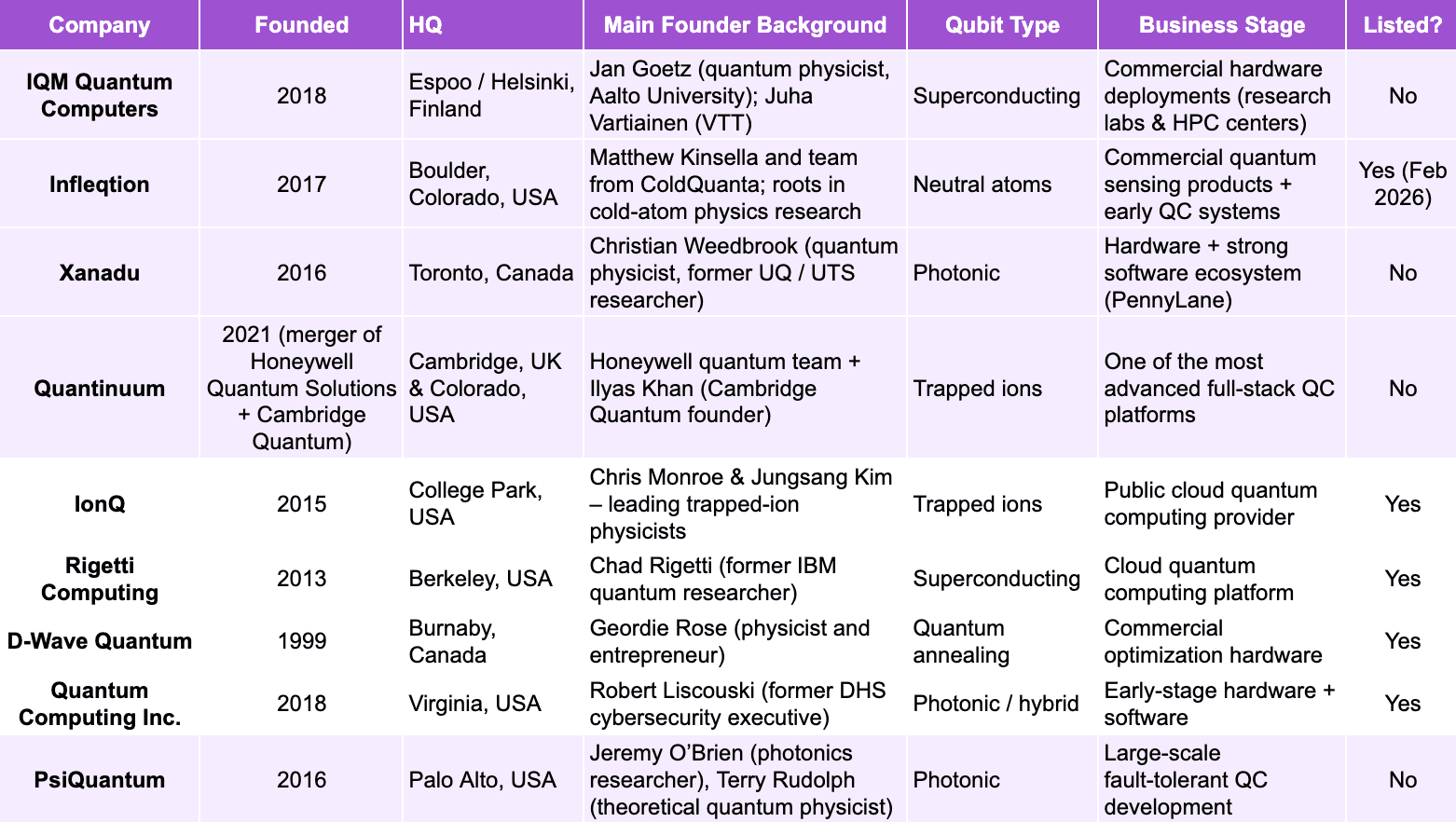
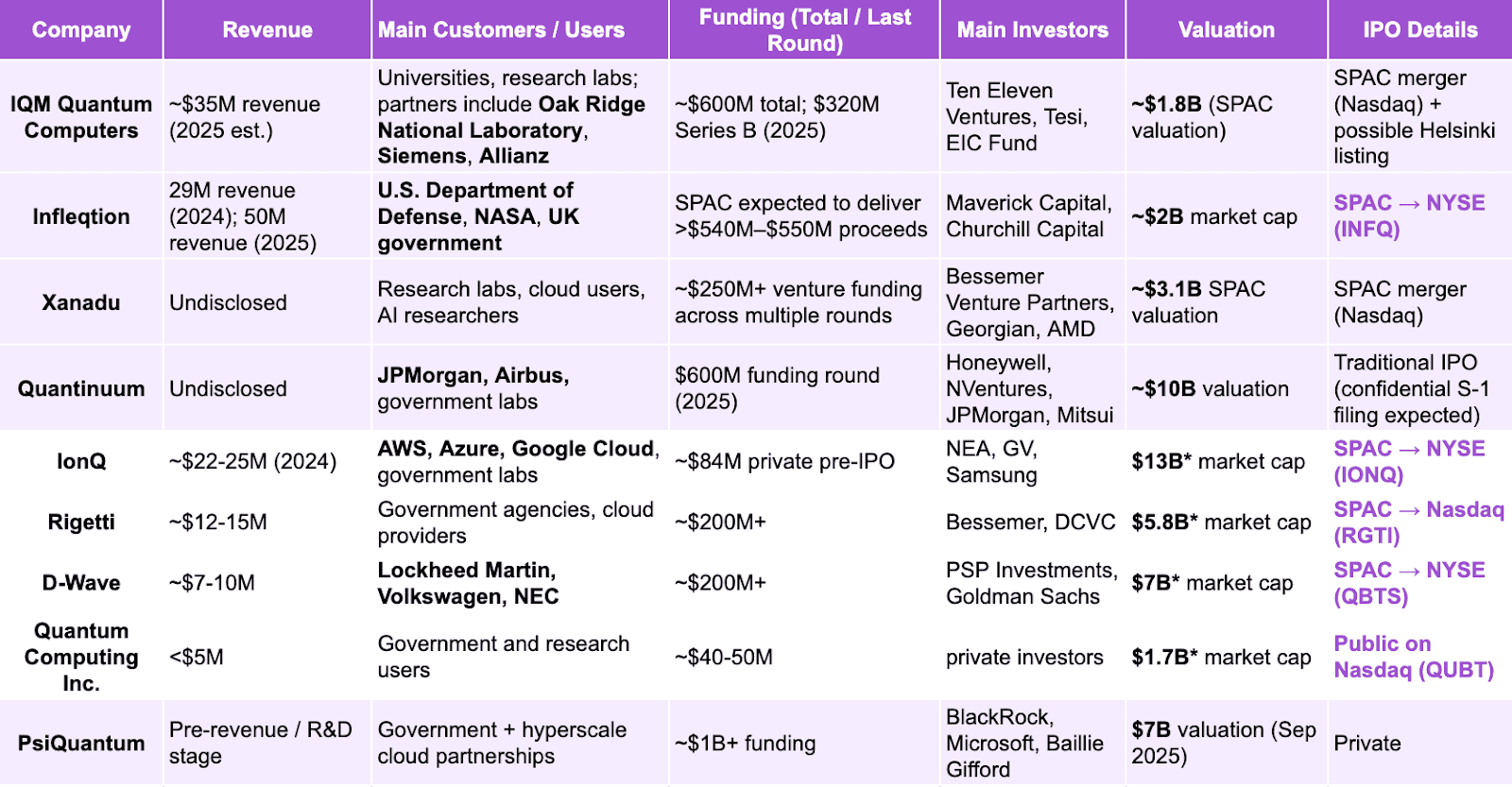
Copyright © Jarsy Research
As this new wave of listings unfolds, public markets are becoming an important proving ground for the quantum industry. Companies using different approaches—from superconducting and trapped ions to photonics and neutral atoms—are now competing not only in research labs but also in capital markets. While large-scale quantum computers are still years away, the coming years will show which technologies and companies can turn quantum promise into real-world impact. ⚛️
Further Learning: How Trapped-Ion Quantum Computers Work, Infleqtion CEO interview with Sherwood News, Xanadu's Borealis, Inside IQM’s quantum lab by TheNextWeb