The Markets That Bet on Everything: Polymarket, Kalshi, and the Rise of Event Trading | Jarsy
Prediction markets like Polymarket and Kalshi are transforming world events into tradable assets. This report explores their origins, product models, regulatory breakthroughs, and why markets increasingly outperform polls in forecasting elections, economics, and global events.

Han Qin
2025年12月3日


This article examines the development of Polymarket and Kalshi, outlining their origins, key milestones, and the role they have played in turning real-world events into tradable markets.
In the final weeks of the 2024 U.S. presidential race, two markets out-performed every pollster in America. On Polymarket, a crypto-based prediction exchange, more than $3.6 billion flowed into bets on whether Donald Trump or Kamala Harris would win, turning a blockchain start-up into an election-night obsession. At the same time, Kalshi, the first CFTC-regulated event-contract exchange, won a court fight in October 2024 that let it list election contracts legally in the United States.
Together they turned politics into a price feed. Polymarket’s odds were quoted on cable news, while Kalshi made it legal for anyone, not just professionals, to trade on political outcomes. For the first time, elections had a live market ticker, and ordinary people were setting the odds.
How They Started
Polymarket, launched in 2020 by New York University dropout Shayne Coplan, is built on the Polygon blockchain and allows users to use USDC to buy and sell “yes” or “no” shares tied to real-world events - elections, sports, economic data, even celebrity news. Each share’s price, from $1 to $0, represents the market’s collective probability that the event will happen or not.
Kalshi, on the other side, took the regulatory route. Founded in 2018 and launched on July 2021 by Tarek Mansour and Luana Lopes Lara, two MIT graduates, it became the first U.S. exchange to win federal approval from the Commodity Futures Trading Commission (CFTC) to list “event contracts”, financial instruments that pay $1 if an event occurs, and $0 if not.
Both of them converge on the same idea: that “Markets seek truth”.
The Origins of Prediction Markets
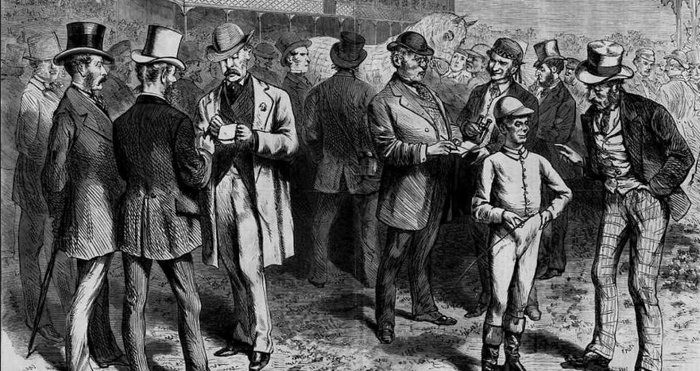
The impulse to bet on the future long predates modern finance. As early as the 16th and 17th centuries, people in Europe were speculating on royal successions and wars in informal betting circles. By the 1880s, Americans were placing “bucket shop” wagers on political outcomes, and by the 1910s, Wall Street operated political betting markets that mirrored today’s exchanges. Newspapers like The New York Times routinely reported betting odds on presidential races, treating them as serious indicators of public sentiment, and they were often right!
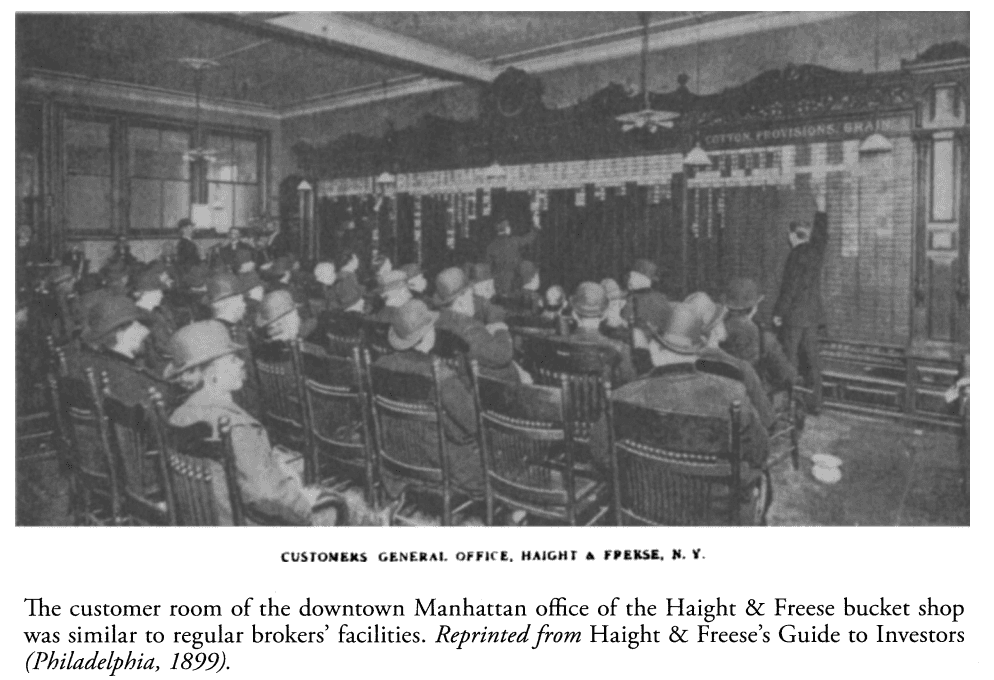
Photo Credit: The Journal of American History, Vol. 93, No. 2 (Sep., 2006), pp. 335-358
Yet it wasn’t until Friedrich Hayek’s 1945 essay, “The Use of Knowledge in Society,” that a formal explanation emerged. Hayek argued that prices aren’t just numbers, they’re a mechanism for sharing information, capturing what millions of people know and believe.
Four decades later, economists at the University of Iowa turned that idea into a real experiment. In 1988, they launched the Iowa Electronic Markets (IEM), allowing participants to trade on the outcome of the U.S. presidential election. The IEM’s results were groundbreaking: its price-based forecasts consistently outperformed opinion polls, proving that markets could be not just a measure of belief, but a mechanism for collective intelligence.
Founders from both Polymarket and Kalshi reached the same conclusion long explored by economists: That markets can capture collective knowledge better than experts.
Products and Business Model
On both platforms, Prices = Probabilities. Each share’s price reflects the market’s collective view of how likely an event is to happen. It’s a live forecast set by buyers and sellers, not by the platform. Just as exchanges don’t dictate stock prices, prediction markets don’t dictate odds; they emerge from supply and demand. And because users trade with one another, there’s no “house”, only a market where belief sets the price.
Let's look at an example of a most recent poll: When will the Government shutdown end?
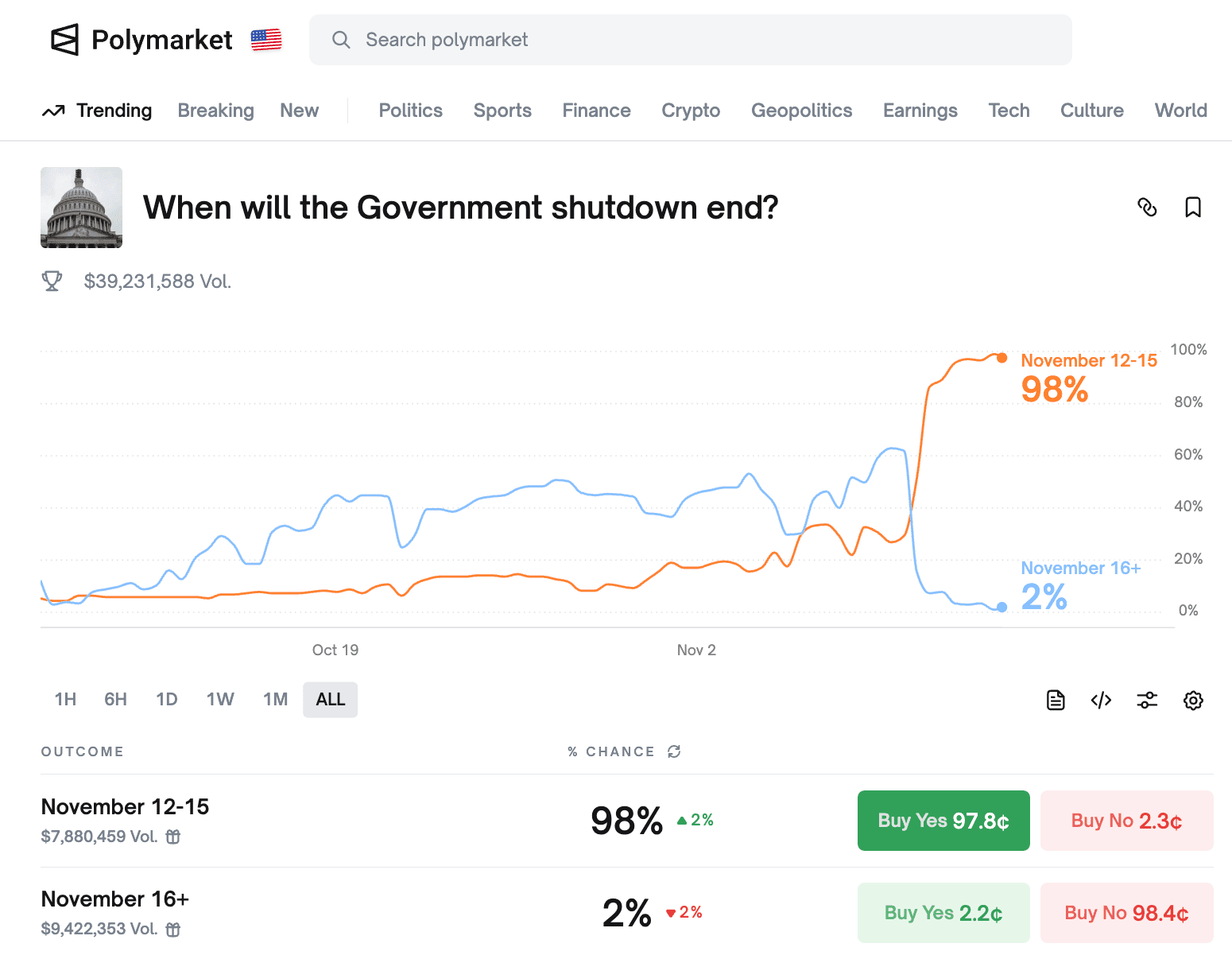
It indicates that, so far, users as a whole are betting on a 98% chance that the government will reopen between November 12 and 15.
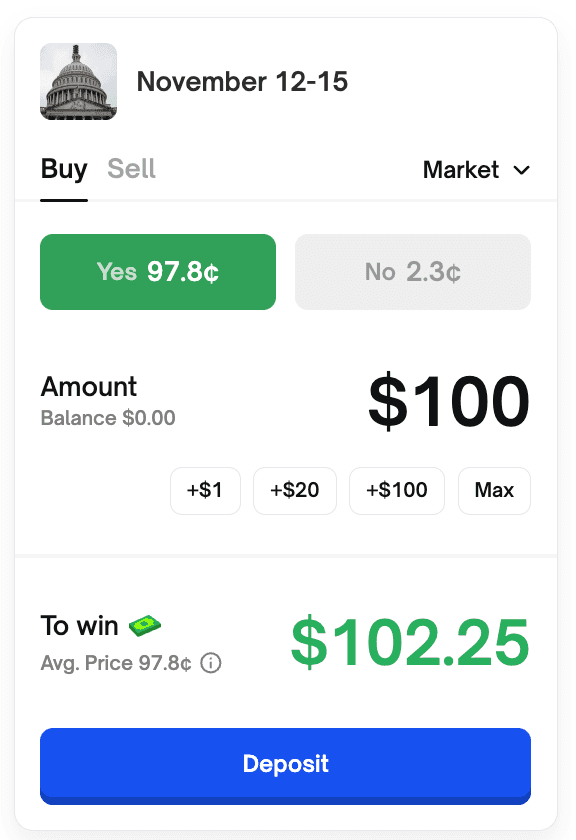
If you believe the reopening will happen within that window, you can buy “Yes” shares for around $0.98 each. Should the government indeed reopen during that period, each share settles at $1.00, earning you a small but highly probable return.
However, if you think the reopening will be delayed, you can buy “Yes” shares on the Nov 16 or later market for about $0.025 per share. If you’re right and the government does reopen after that date, those shares pay out $1.00 each — roughly a 40× payoff on your stake. (see Pictures below)
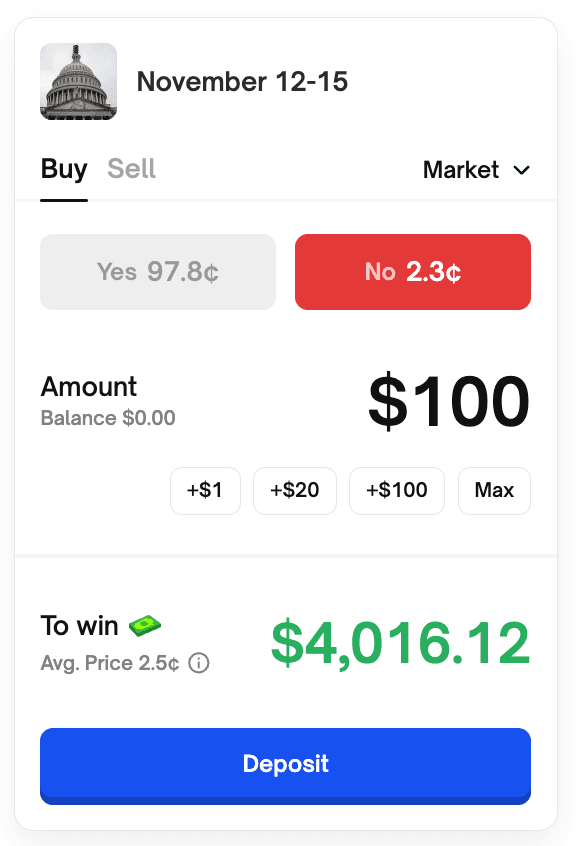
Although the logic behind both products is similar, the two platforms differ in many ways, with market coverage and fees being among the biggest distinctions. Polymarket has not been available in the U.S. since its 2022 exit, while Kalshi operated exclusively in the U.S. until October 2025. In addition, Polymarket charges no fees for trading or deposits, whereas Kalshi applies fees to most transactions. A detailed comparison is shown in the table below.
Category | Polymarket | Kalshi |
System Type | Decentralised crypto-based market on Polygon (USDC) | Regulated U.S. exchange (DCM* under CFTC) |
Currency | USDC (stablecoin) | U.S. dollars (cash) |
Eligible Regions | 180+ countries excluding US, UK etc, will launch US platform soon | Only US until Oct 2025, then expanded to 140+ countries |
Who you trade with | Other crypto users (peer-to-peer) | Other verified traders (cleared through Kalshi) |
Trading Fees | None | Variable Fee = 0.07 × C × P × (1-P), where C = contracts, P = price (USD). Ranging from 0.07% to 7% |
Maker / Limit Order Fees | None | Mostly none, some category has 0.02% - 0.44% fee, e.g. F1 race or CPI data |
Gas / Network Fees | Yes. Transactions mainly on Polygon. Typical gas on Polygon ≈ 0.001 - 0.01 MATIC ($0.001–$0.01). On Ethereum, can be $5–$50 | None |
Deposit / Withdrawal Fees | None | ACH: None. Wire: Bank fees only. Debit deposit: 2%. Debit withdrawal: $2 flat. |
Settlement | Smart contracts on blockchain | Kalshi Clearing house (CFTC-regulated) |
Primary Revenue | Currently not from trading fees; focuses on ecosystem growth and future data monetisation. | Trading and clearing fees on contracts, similar to futures exchanges. |
Potential Revenue | Data licensing, institutional analytics, fiat on-ramp/off-ramp fees, future U.S. exchange operations. | Market-data sales, institutional market-making, broker partnerships. |
Need KYC? | No in most eligible regions; likely required for upcoming U.S. launch | Yes, ID and Address |
(*DCM = Designated Contract Market; table copyright © Jarsy Research)
Funding and Growth
Both Polymarket and Kalshi have seen explosive growth since 2024, driven by the U.S. presidential election and a broader shift toward event-based trading. In October 2025, Polymarket hit a record $3.02 billion in monthly volume, while Kalshi topped it with $4.39 billion. Polymarket continues to lead political markets, while Kalshi has surged in sports, recording about $1.1 billion in sports volume (90%+ of its total volume) during one week of October versus Polymarket’s $357 million. Both platforms have also added major partnerships, including multiyear deals with the NHL; Polymarket later secured another headline partnership as the Official Prediction Market of the UFC. Kalshi further expanded its reach through a broad integration with Robinhood, bringing event contracts to millions of retail traders.
Investor confidence has accelerated alongside adoption. Polymarket’s backers include Founders Fund, Vitalik Buterin, and ICE, whose $2 billion investment supported its U.S. relaunch. Valued at around $9 billion in September 2025, the company is now in talks to raise at a $12–15 billion valuation, according to Bloomberg. Kalshi, backed by Sequoia, Andreessen Horowitz, and Coinbase Ventures, raised $300 million in 2025, lifting its valuation to about $5 billion, with further offers reportedly valuing it higher.
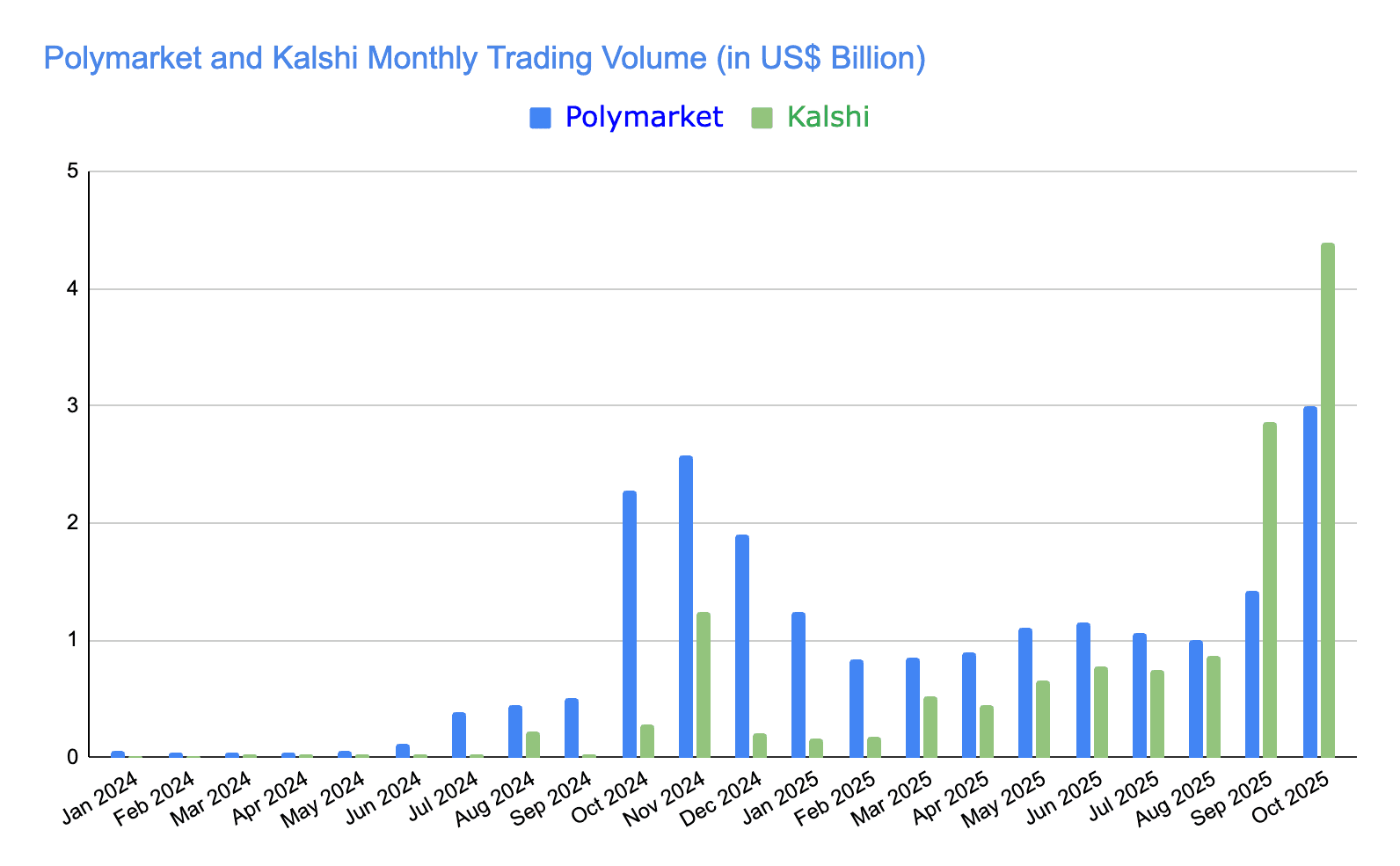
(Data: Dune.com; Chart compiled by Jarsy Research)
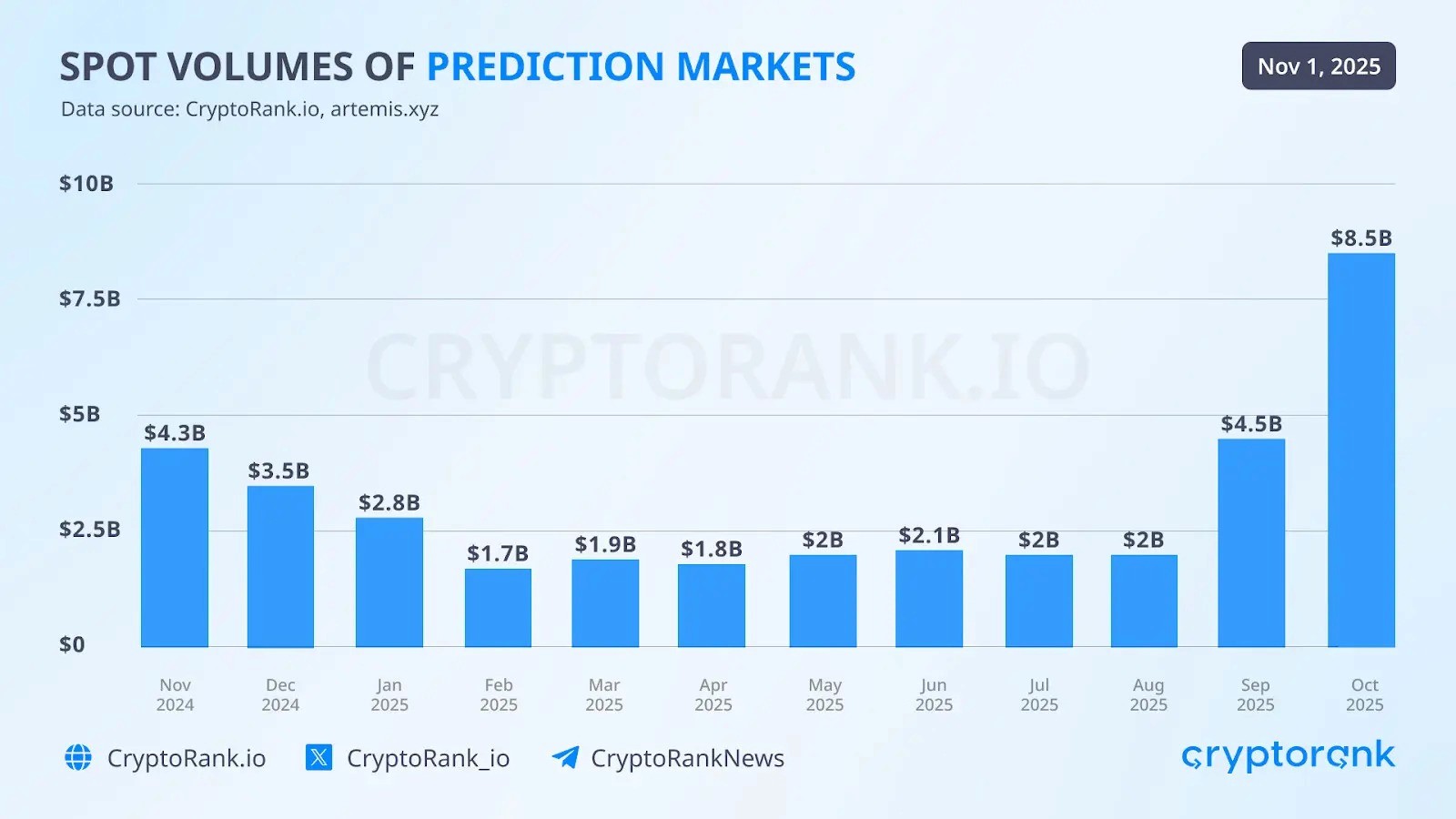
(Graph credit: CryptoRank.io)
Outlook
The next phase for both platforms looks promising, driven by clearer regulation and rapidly expanding mainstream adoption. Polymarket is preparing a compliant return to the United States with the backing of ICE’s multibillion dollar commitment, while Kalshi is accelerating its global expansion supported by new investment from leading venture firms. Distribution is widening on both sides, with retail access growing through partners like Robinhood and institutional demand strengthened through ICE’s data network.
Sports markets are now powering much of the recent momentum, driving Kalshi’s fastest growth and becoming more significant on Polymarket, while political markets remain the anchor during election cycles. As regulation stabilizes, both platforms are positioned to expand into macroeconomic, cultural and corporate forecasting. Prediction markets are no longer experimental; they are emerging as a durable layer of financial infrastructure for pricing uncertainty in real time.
Further Reading: Everything’s Casino by Business Insider; The Atlantic Article; October Volume by CoinLaw; The Use of Knowledge in Society by Hayek;
This article examines the development of Polymarket and Kalshi, outlining their origins, key milestones, and the role they have played in turning real-world events into tradable markets.
In the final weeks of the 2024 U.S. presidential race, two markets out-performed every pollster in America. On Polymarket, a crypto-based prediction exchange, more than $3.6 billion flowed into bets on whether Donald Trump or Kamala Harris would win, turning a blockchain start-up into an election-night obsession. At the same time, Kalshi, the first CFTC-regulated event-contract exchange, won a court fight in October 2024 that let it list election contracts legally in the United States.
Together they turned politics into a price feed. Polymarket’s odds were quoted on cable news, while Kalshi made it legal for anyone, not just professionals, to trade on political outcomes. For the first time, elections had a live market ticker, and ordinary people were setting the odds.
How They Started
Polymarket, launched in 2020 by New York University dropout Shayne Coplan, is built on the Polygon blockchain and allows users to use USDC to buy and sell “yes” or “no” shares tied to real-world events - elections, sports, economic data, even celebrity news. Each share’s price, from $1 to $0, represents the market’s collective probability that the event will happen or not.
Kalshi, on the other side, took the regulatory route. Founded in 2018 and launched on July 2021 by Tarek Mansour and Luana Lopes Lara, two MIT graduates, it became the first U.S. exchange to win federal approval from the Commodity Futures Trading Commission (CFTC) to list “event contracts”, financial instruments that pay $1 if an event occurs, and $0 if not.
Both of them converge on the same idea: that “Markets seek truth”.
The Origins of Prediction Markets
The impulse to bet on the future long predates modern finance. As early as the 16th and 17th centuries, people in Europe were speculating on royal successions and wars in informal betting circles. By the 1880s, Americans were placing “bucket shop” wagers on political outcomes, and by the 1910s, Wall Street operated political betting markets that mirrored today’s exchanges. Newspapers like The New York Times routinely reported betting odds on presidential races, treating them as serious indicators of public sentiment, and they were often right!

Photo Credit: The Journal of American History, Vol. 93, No. 2 (Sep., 2006), pp. 335-358
Yet it wasn’t until Friedrich Hayek’s 1945 essay, “The Use of Knowledge in Society,” that a formal explanation emerged. Hayek argued that prices aren’t just numbers, they’re a mechanism for sharing information, capturing what millions of people know and believe.
Four decades later, economists at the University of Iowa turned that idea into a real experiment. In 1988, they launched the Iowa Electronic Markets (IEM), allowing participants to trade on the outcome of the U.S. presidential election. The IEM’s results were groundbreaking: its price-based forecasts consistently outperformed opinion polls, proving that markets could be not just a measure of belief, but a mechanism for collective intelligence.
Founders from both Polymarket and Kalshi reached the same conclusion long explored by economists: That markets can capture collective knowledge better than experts.
Products and Business Model
On both platforms, Prices = Probabilities. Each share’s price reflects the market’s collective view of how likely an event is to happen. It’s a live forecast set by buyers and sellers, not by the platform. Just as exchanges don’t dictate stock prices, prediction markets don’t dictate odds; they emerge from supply and demand. And because users trade with one another, there’s no “house”, only a market where belief sets the price.
Let's look at an example of a most recent poll: When will the Government shutdown end?

It indicates that, so far, users as a whole are betting on a 98% chance that the government will reopen between November 12 and 15.
If you believe the reopening will happen within that window, you can buy “Yes” shares for around $0.98 each. Should the government indeed reopen during that period, each share settles at $1.00, earning you a small but highly probable return.
However, if you think the reopening will be delayed, you can buy “Yes” shares on the Nov 16 or later market for about $0.025 per share. If you’re right and the government does reopen after that date, those shares pay out $1.00 each — roughly a 40× payoff on your stake. (see Pictures below)


Although the logic behind both products is similar, the two platforms differ in many ways, with market coverage and fees being among the biggest distinctions. Polymarket has not been available in the U.S. since its 2022 exit, while Kalshi operated exclusively in the U.S. until October 2025. In addition, Polymarket charges no fees for trading or deposits, whereas Kalshi applies fees to most transactions. A detailed comparison is shown in the table below.
Category | Polymarket | Kalshi |
System Type | Decentralised crypto-based market on Polygon (USDC) | Regulated U.S. exchange (DCM* under CFTC) |
Currency | USDC (stablecoin) | U.S. dollars (cash) |
Eligible Regions | 180+ countries excluding US, UK etc, will launch US platform soon | Only US until Oct 2025, then expanded to 140+ countries |
Who you trade with | Other crypto users (peer-to-peer) | Other verified traders (cleared through Kalshi) |
Trading Fees | None | Variable Fee = 0.07 × C × P × (1-P), where C = contracts, P = price (USD). Ranging from 0.07% to 7% |
Maker / Limit Order Fees | None | Mostly none, some category has 0.02% - 0.44% fee, e.g. F1 race or CPI data |
Gas / Network Fees | Yes. Transactions mainly on Polygon. Typical gas on Polygon ≈ 0.001 - 0.01 MATIC ($0.001–$0.01). On Ethereum, can be $5–$50 | None |
Deposit / Withdrawal Fees | None | ACH: None. Wire: Bank fees only. Debit deposit: 2%. Debit withdrawal: $2 flat. |
Settlement | Smart contracts on blockchain | Kalshi Clearing house (CFTC-regulated) |
Primary Revenue | Currently not from trading fees; focuses on ecosystem growth and future data monetisation. | Trading and clearing fees on contracts, similar to futures exchanges. |
Potential Revenue | Data licensing, institutional analytics, fiat on-ramp/off-ramp fees, future U.S. exchange operations. | Market-data sales, institutional market-making, broker partnerships. |
Need KYC? | No in most eligible regions; likely required for upcoming U.S. launch | Yes, ID and Address |
(*DCM = Designated Contract Market; table copyright © Jarsy Research)
Funding and Growth
Both Polymarket and Kalshi have seen explosive growth since 2024, driven by the U.S. presidential election and a broader shift toward event-based trading. In October 2025, Polymarket hit a record $3.02 billion in monthly volume, while Kalshi topped it with $4.39 billion. Polymarket continues to lead political markets, while Kalshi has surged in sports, recording about $1.1 billion in sports volume (90%+ of its total volume) during one week of October versus Polymarket’s $357 million. Both platforms have also added major partnerships, including multiyear deals with the NHL; Polymarket later secured another headline partnership as the Official Prediction Market of the UFC. Kalshi further expanded its reach through a broad integration with Robinhood, bringing event contracts to millions of retail traders.
Investor confidence has accelerated alongside adoption. Polymarket’s backers include Founders Fund, Vitalik Buterin, and ICE, whose $2 billion investment supported its U.S. relaunch. Valued at around $9 billion in September 2025, the company is now in talks to raise at a $12–15 billion valuation, according to Bloomberg. Kalshi, backed by Sequoia, Andreessen Horowitz, and Coinbase Ventures, raised $300 million in 2025, lifting its valuation to about $5 billion, with further offers reportedly valuing it higher.

(Data: Dune.com; Chart compiled by Jarsy Research)

(Graph credit: CryptoRank.io)
Outlook
The next phase for both platforms looks promising, driven by clearer regulation and rapidly expanding mainstream adoption. Polymarket is preparing a compliant return to the United States with the backing of ICE’s multibillion dollar commitment, while Kalshi is accelerating its global expansion supported by new investment from leading venture firms. Distribution is widening on both sides, with retail access growing through partners like Robinhood and institutional demand strengthened through ICE’s data network.
Sports markets are now powering much of the recent momentum, driving Kalshi’s fastest growth and becoming more significant on Polymarket, while political markets remain the anchor during election cycles. As regulation stabilizes, both platforms are positioned to expand into macroeconomic, cultural and corporate forecasting. Prediction markets are no longer experimental; they are emerging as a durable layer of financial infrastructure for pricing uncertainty in real time.
Further Reading: Everything’s Casino by Business Insider; The Atlantic Article; October Volume by CoinLaw; The Use of Knowledge in Society by Hayek;
Subscribe to our newsletter
Recommended articles
本门户由 Jarsy, Inc.("Jarsy")运营,Jarsy 并不是注册的经纪-交易商或投资顾问。Jarsy 不提供关于本门户上显示的任何资产的投资建议、认可或推荐。本门户上的任何内容均不应被视为出售的要约、购买要约的请求或就证券的推荐。您有责任根据您的个人投资目标、财务状况和风险承受能力,确定任何投资、投资策略或相关交易是否适合您。您应咨询持牌法律专业人士和投资顾问,以获得任何法律、税务、保险或投资建议。Jarsy 不保证本网站上发布的任何投资机会的投资表现、结果或资本回报。通过访问本门户和其中的任何页面,您同意受门户为您提供的条款和政策的约束。在投资中涉及风险,并可能导致部分或全部损失。通过访问本网站,投资者理解并承认 1)投资一般而言,无论是在私募股权、股票市场还是房地产,都是有风险和不可预测的; 2)市场有其波动; 3)您所参与的投资可能不会产生正现金流或如您所期望的那样表现; 4)您投资的任何资产的价值可能随时下降,未来价值不可预测。在做出投资决策之前,建议潜在投资者查看所有可用信息并与他们的税务和法律顾问咨询。Jarsy 不提供关于本门户上发布的任何要约的投资建议或推荐。本文件中的任何与投资相关的信息均来自 Jarsy 认为可靠的来源,但我们对此类信息的准确性或完整性不作任何声明或保证,并因此不承担任何责任。链接到第三方网站或复制第三方文章并不构成 Jarsy 对所链接或复制内容的批准或认可。


