

Crusoe began with a simple energy-first idea: move computing workloads to available power rather than wait for power to reach conventional data centers. What began as modular computing infrastructure deployed alongside stranded energy has evolved into a broader platform spanning power development, AI data centers, GPU cloud services and managed inference.
On September 17, 2026, Crusoe announced the initial closing of an anticipated $3.9 billion Series F at a $30.9 billion post-money valuation, co-led by Atreides, Mubadala Capital and Valor Equity Partners. The company reported more than $140 billion in total contracted value, over 6 GW of contracted capacity and 1 GW in operation. This research explains how Crusoe’s businesses fit together, whether its vertical integration creates a defensible advantage, how it compares with its peers and what could determine its outlook.
1. Reinventing Crusoe
1.1 An energy-first beginning
Chase Lochmiller and Cully Cavness founded Crusoe in Denver in 2018 around a simple idea: instead of transporting energy to computing infrastructure, computing could move to where energy was abundant, inexpensive or otherwise wasted.
Crusoe first applied this approach through Digital Flare Mitigation. It placed modular generators and computing equipment at oil fields, converting natural gas that would otherwise have been flared into electricity for Bitcoin mining. The business gave Crusoe practical experience in power generation, modular construction, remote operations and the economics of energy-intensive computing.

Modular compute equipment at a Montana oil-and-gas well pad, the type of stranded-gas site where Crusoe first deployed Digital Flare Mitigation. Image Credit: Montana Free Press / Eric Dietrich
The environmental benefit was not absolute: the system still burned fossil fuel, and its impact depended on whether the gas would otherwise have been flared. More important to Crusoe’s later development was the operating model it established: designing computing infrastructure around the physical characteristics of energy supply.
1.2 The pivot
As demand for accelerated computing grew, Crusoe began applying its energy and infrastructure capabilities to GPU cloud services and permanent AI data centers. The transition happened gradually: Crusoe initially developed its AI business alongside Digital Flare Mitigation and Bitcoin mining before making AI infrastructure its primary focus.
Its March 2025 agreement to sell the Bitcoin-mining operation to NYDIG formalized the shift. The disposal removed the business most closely associated with Crusoe’s origins and allowed the company to concentrate capital and management attention on power development, AI data centers, cloud computing and managed AI services.
Four financing rounds marked the key stages of this transition and expansion:

Table 1: Crusoe’s funding rounds C to F. Sources: Crusoe, Reuters. © 2026 Jarsy Research
1.3 Crusoe’s four-part platform
Crusoe operates across four layers of AI infrastructure, from developing power and data centers to renting computing capacity and managing AI models. Its in-house manufacturing capabilities support the physical layers of this platform.

Table 2: Crusoe’s main businesses. © 2026 Jarsy Research
Energy infrastructure
Crusoe develops power systems alongside its data centers, extending its original idea of locating computing close to available energy. At Abilene, it built on-site power infrastructure and energized the first substation in less than six months. In Nevada, Crusoe and Redwood Materials developed a microgrid that uses solar generation and repurposed electric-vehicle batteries to power Crusoe Spark modular data centers. The project began with four Spark units and was subsequently expanded to 24, demonstrating how Crusoe can combine its energy and computing products in one deployment.

The Redwood x Crusoe Microgrid in Northern Nevada. Image Credit: Redwood Materials
AI data-center infrastructure
Crusoe develops purpose-built facilities for hyperscale customers. Its Abilene project began with a 206 MW, two-building development financed through a $3.4 billion joint venture with Blue Owl Capital and Primary Digital Infrastructure. The partnership subsequently expanded to support a broader 1.2 GW campus, whose first phase operates on Oracle Cloud Infrastructure. Crusoe is separately developing another 900 MW Abilene campus to support Microsoft.

Crusoe's Abilene data center. Image Credit: Crusoe
The model resembles build-to-suit development: long-term customer commitments support financing from infrastructure investors, while Crusoe develops, constructs and operates the facilities. This reduces the amount of project cost Crusoe must finance alone.
Alongside hyperscale campuses, Crusoe also manufactures Crusoe Spark, a modular AI data center that can be deployed closer to available power or customer demand. The smaller facilities are intended partly for distributed inference workloads.
Manufacturing
Manufacturing supports Crusoe’s energy and data-center businesses rather than operating as a separate product line. The company produces selected electrical equipment, power-distribution systems and modular infrastructure at facilities in Colorado, Oklahoma and Louisiana.
Bringing production in-house may reduce delays for equipment such as switchgear and allow component manufacturing to proceed alongside construction. It also adds fixed costs and operational complexity if demand slows or infrastructure designs change.

Crusoe's Second Tulsa Manufacturing Facility. Image Credit: Crusoe
Crusoe Cloud
Crusoe Cloud rents NVIDIA and AMD GPU capacity together with the storage, high-speed networking and software needed to run AI workloads. Customers can train and operate models without buying or managing the underlying hardware.
Named customers include Windsurf, Roboflow, Odyssey and Cartesia. Crusoe reported that Windsurf ran NVIDIA Hopper GPUs on its platform with 99.98% cluster uptime and at half the cost of traditional cloud providers. Roboflow uses Crusoe Cloud to serve more than 300,000 computer-vision models, while Cartesia uses its GPU clusters to train low-latency voice models.
Managed AI
Through Crusoe Intelligence Foundry, customers can fine-tune and deploy models without operating the underlying GPU clusters. Disclosed customers include Base44, Yutori and Perplexity.
Crusoe reported more than $100 million of contracted annual recurring revenue for Managed Inference less than a year after launch. The Wall Street Journal separately reported an annualized revenue run rate above $100 million by the summer of 2026.
Managed AI moves Crusoe beyond raw GPU rental toward potentially more recurring and higher-value inference services. It also brings the company into competition with specialized inference platforms, model providers and hyperscale clouds.

Crusoe Managed AI interface. Image Credit: Crusoe
2. The Power Bottleneck, and Crusoe’s Answer
2.1 Power is becoming the binding constraint
Building AI infrastructure is increasingly a power-development challenge. The International Energy Agency projects global data-center electricity consumption to more than double from 415 TWh in 2024 to around 945 TWh by 2030. In the United States, data centers could account for nearly half of electricity-demand growth over the same period. (check our recent research on the Advanced Nuclear industry here).
AI facilities also concentrate far more electricity into each building than conventional data centers. High-density GPU racks require upgraded substations, power-distribution equipment, advanced cooling and high-speed networking.
Crusoe’s energy-first strategy is designed around this constraint. Instead of relying on a single source, the company combines grid power, on-site generation, renewables, batteries and potentially nuclear-linked deployments. Its hyperscale campuses address large training clusters, while Crusoe Spark provides smaller, factory-built facilities that can be deployed incrementally near available power.
The modular model could shorten deployment times and serve inference, sovereign AI and remote industrial locations. Its disadvantage is scale: smaller facilities may have higher unit costs and require more dispersed operations. Spark succeeds only if faster deployment and access to otherwise constrained power outweigh those costs.
2.2 Where vertical integration could create an advantage
Crusoe is attempting to coordinate a long chain of AI-infrastructure bottlenecks:
Energy → site → electrical equipment → construction → cooling → GPUs → networking → cloud software → inference
Most competitors control only part of this chain. Crusoe’s broader model creates several potential advantages, but each comes with a corresponding risk.

Table 3: Crusoe’s advantages and risks. © 2026 Jarsy Research
The Blue Owl and Primary Digital Infrastructure joint ventures demonstrate Crusoe’s ability to attract real-asset capital alongside venture equity. Meanwhile, operating Crusoe Cloud and Managed AI may give its infrastructure teams direct insight into changing GPU, networking and cooling requirements. These capabilities become a genuine advantage only if they translate into faster deployment, lower costs or more reliable service at scale.
3. Competitive landscape and company comparisons
CoreWeave, Nebius, Lambda, IREN and Nscale all compete with Crusoe, but at different layers of the stack. CoreWeave and Nebius overlap most directly with Crusoe Cloud; IREN is the closest comparison at the energy-to-compute layer; Lambda competes through developer-focused cloud and dedicated clusters; and Nscale combines power, data centers and cloud across an international footprint.
Crusoe’s distinction is breadth. It combines power development, manufacturing, hyperscale campuses, modular data centers, cloud computing and managed inference. Whether that breadth becomes an advantage depends on how effectively those businesses work together.
3.1 Where the competitors overlap

Table 4: Competitors’ overlap with Crusoe. © 2026 Jarsy Research
Manufacturing is not shown separately because none of these companies matches the breadth of Crusoe’s disclosed internal electrical and modular-equipment production.
3.2 CoreWeave
CoreWeave (NASDAQ: CRWV) is the largest specialist AI cloud in the group. It provides GPU computing, storage, networking and software services under long-term contracts and on-demand arrangements. Its strategy begins with the cloud platform, although fulfilling those contracts has made it a major developer and operator of physical infrastructure.
CoreWeave reported $2.575 billion of revenue in Q2 2026 and approximately $104 billion of revenue backlog. Active power reached approximately 1.5 GW. At the same time, it recorded a $626 million net loss and $640 million of quarterly interest expense, illustrating the financing burden behind its growth.

CoreWeave’s Hardware. Image Credit: CoreWeave
CoreWeave is ahead of Crusoe in realized cloud revenue, software maturity and demonstrated large-cluster operations. Crusoe is more differentiated in power development, manufacturing and build-to-suit campuses. CoreWeave’s main vulnerabilities are leverage, customer concentration and the need to finance infrastructure before much of its backlog becomes revenue.
3.3 Nebius
Nebius (NASDAQ: NBIS) combines owned and partner-developed infrastructure with a broad cloud platform covering training, inference, storage, networking and developer tools. Its roots in Yandex give it substantial software and engineering depth, while its facilities across the United States and Europe provide greater geographic diversification than Crusoe currently has.
Nebius reported Q2 2026 revenue of $582.3 million, including approximately $575 million from AI cloud. Q2 capital expenditure was approximately $5.7 billion, while management raised its year-end contracted-power target to 5 GW.
Nebius may have the strongest independent full-stack cloud proposition after CoreWeave. Crusoe remains more deeply integrated into energy origination, manufacturing and custom data-center development. Nebius’s challenge is turning its rapid capacity expansion into durable free cash flow while managing a broader corporate group.

Nebius’ facility in Finland. Image Credit: Nebius
3.4 Lambda
Lambda is a private AI cloud company that grew from GPU workstations and developer-focused infrastructure into dedicated superclusters and large AI-factory deployments. Its reputation among machine-learning engineers remains an advantage, but its newer contracts increasingly place it in direct competition with Crusoe and CoreWeave.
Lambda raised more than $1.5 billion in equity in 2025. During 2026, it added a $1 billion credit facility, a $926 million secured term loan and another $1 billion delayed-draw facility tied to committed customer deployments. Reuters also reported a $35 billion Anthropic cloud agreement associated with approximately 350 MW at a Hut 8-developed Texas campus. Lambda offers a more focused developer and cloud proposition, while Crusoe controls more of the underlying power and construction chain.
3.5 IREN
IREN (NASDAQ: IREN) is the closest strategic analogue to Crusoe. It assembled grid-connected power and data-center sites for Bitcoin mining before reallocating those assets toward liquid-cooled AI cloud infrastructure.
For fiscal 2026, IREN reported $128.8 million of AI Cloud Services revenue, compared with $16.4 million a year earlier, alongside $578.2 million of Bitcoin-mining revenue. It has approximately 5 GW of secured power capacity and is targeting a rapid expansion of delivered AI capacity. IREN has strong access to land, power and existing data-center sites, but it is still proving that it can operate an enterprise-grade AI cloud.

IREN Childress Data Center under construction. Image Credit: IREN
3.6 Nscale
Nscale emerged from Arkon Energy and now combines power procurement, data-center development, GPU cloud capacity and AI software. Its model therefore resembles Crusoe’s more closely than a cloud provider focused mainly on accelerator rental.
Nscale reported $140.6 million of revenue and a $1.02 billion net loss for the first half of 2026. Its IPO filing disclosed more than $103 billion in total contracted value, a power pipeline exceeding 10 GW and operations across 14 regions. However, its largest customer accounted for 52% of first-half revenue, while reporting indicated that only around 55 MW was operating or leased at the time of filing.
Nscale offers greater international reach and a similarly ambitious power-to-cloud model. Crusoe has a longer operating history in energy, more developed internal manufacturing and a completed hyperscale reference project. Both must prove that large contracted pipelines can become operational capacity on acceptable economics.
3.7 Head-to-head comparison
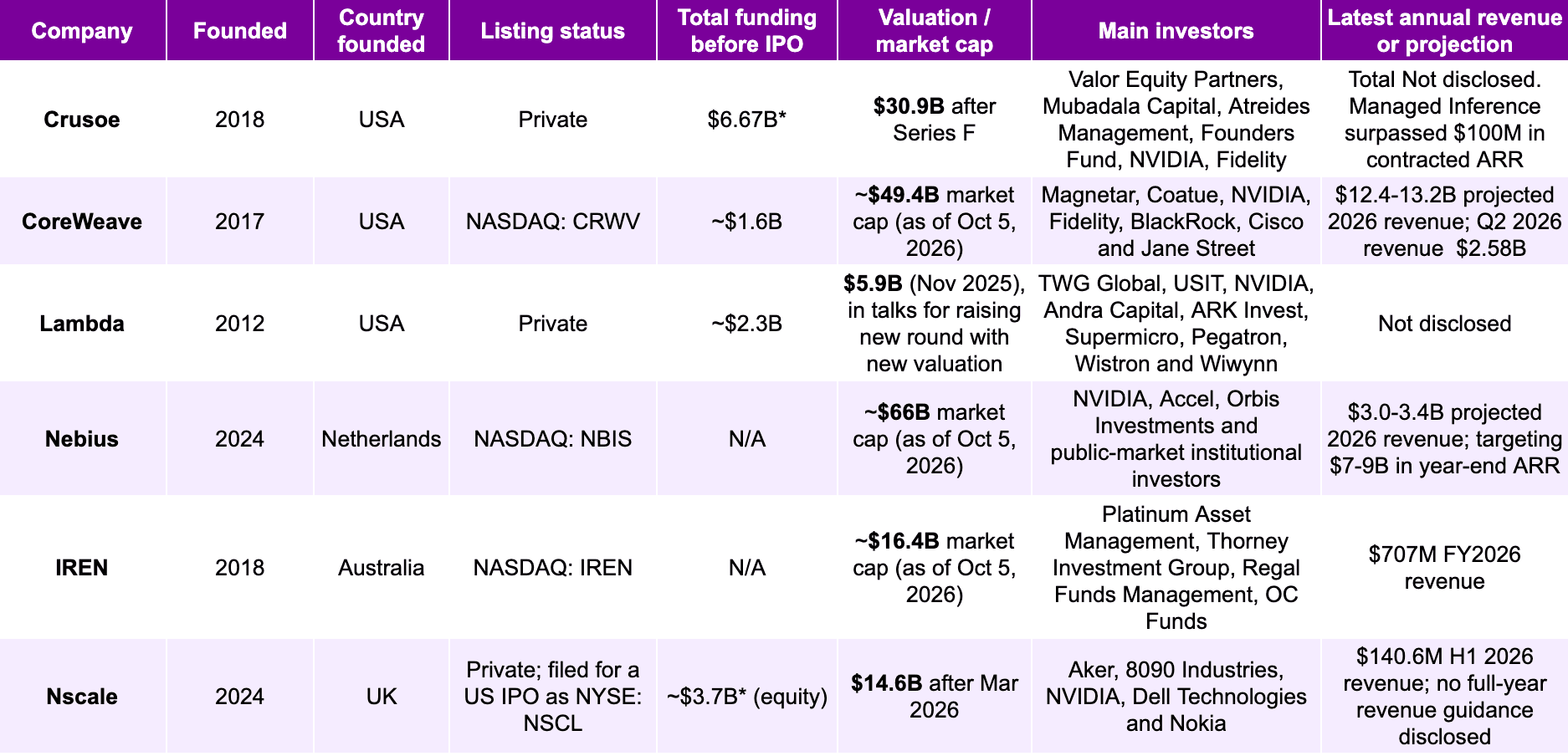
Table 5: Crusoe and competitors comparison in funding, investors, revenue and valuation. *Data from https://tracxn.com/. Other sources: Company websites, Forge Global, Bloomberg, Sacra. © 2026 Jarsy Research

Table 6: Crusoe’s advantages and disadvantages against key competitors. © 2026 Jarsy Research
3.8 Competitive takeaway
Crusoe’s differentiation is its integration of energy, data-center development, manufacturing, cloud computing and managed AI. This breadth could accelerate capacity delivery, but it also increases capital needs and execution risk. Its advantage will depend on whether that integration delivers capacity faster and more efficiently than its more specialized competitors.
4. Outlook
Crusoe enters its next phase with substantial commercial validation. The remaining question is whether it can turn contracted projects into operating capacity, recognized revenue and durable cash flow without losing control of capital requirements or execution.
4.1 Upside and downside

Table 7: Crusoe’s Key Upside and Risk Factors. © 2026 Jarsy Research
Recent developments illustrate the execution and regulatory risks within Crusoe’s pipeline. The company paused development of a proposed 1.8 GW campus in Cheyenne at a customer’s request, although other participants indicated that the project could continue without Crusoe. Texas has also temporarily suspended new data-center permits while regulators review electricity demand, water use and community impacts. It remains unclear how the suspension will affect Crusoe’s approved or existing projects, but it increases the regulatory uncertainty surrounding future development in one of the company’s most important markets.
Crusoe is also diversifying how it secures power. Its announced agreements include approximately 750 MW of potential generation capacity from Bergen Engines and 12 GWh of iron-air battery capacity from Form Energy, with deliveries expected to begin in 2027. These arrangements could reduce reliance on conventional grid connections and support faster development. However, they represent contracted or reserved future capacity rather than operating supply; their value will depend on financing, delivery, installation and successful commissioning.
4.2 What could determine the outcome
Crusoe’s announced pipeline establishes the scale of the opportunity. The following indicators will show whether that opportunity is becoming a durable business:

Table 8: Indicators That Will Determine Crusoe’s Outlook. © 2026 Jarsy Research
Crusoe has secured the capital, customers and infrastructure pipeline needed to compete at scale. Its next phase will be judged less by further expansion than by operating discipline: selecting the right projects, controlling financing and construction costs, and retaining enough of the economics created. That will determine whether Crusoe develops into a durable AI infrastructure platform or remains dependent on continuous capital and exceptional market demand.
Further reading: