Cerebras vs. Nvidia: Who Leads the AI Compute War? | Jarsy Research
Cerebras and Nvidia are competing for leadership in AI compute. This analysis compares Nvidia’s CUDA-optimized GPU ecosystem with Cerebras’ wafer-scale ASIC architecture, examining performance, efficiency, memory bandwidth, real-world deployments, and market positioning to determine who truly leads the next generation of AI hardware.

Han Qin
2025年12月3日


The race for computational power to drive Artificial Intelligence has turned the hardware sector into an intense, high-stakes battleground. Leading the charge is NVIDIA, which recently approached a $4 trillion market capitalization.
NVIDIA maintains a significant advantage with its mature CUDA ecosystem. CUDA is a programming platform that enables developers to efficiently harness GPU power, and nearly all major AI frameworks, including PyTorch and TensorFlow, are deeply optimized for it. This comprehensive, battle-tested software stack dramatically reduces development time and effectively locks in the developer community.
However, Cerebras co-founder Andrew Feldman argues that CUDA’s strength in today’s AI landscape is becoming a weakness, especially regarding the cost and efficiency of AI inference (Source: 20VC with Harry Stebbings).
Founding Story of Cerebras
Cerebras was founded by chip industry veterans with a strong track record. Its five co-founders previously worked together at SeaMicro, which was later acquired by AMD in 2012.
The company is built on the belief that traditional chip design is fundamentally inefficient. By creating the largest chip in the world, the Wafer-Scale Engine (WSE), Cerebras aims to deliver far greater efficiency for AI training and inference than conventional GPU clusters.
The WSE-3 measures 72 square inches and offers 50 times the compute power of Nvidia’s H100 GPU. By comparison, the H100 is only 1 square inch and contains 80 billion transistors (Source: WTW)
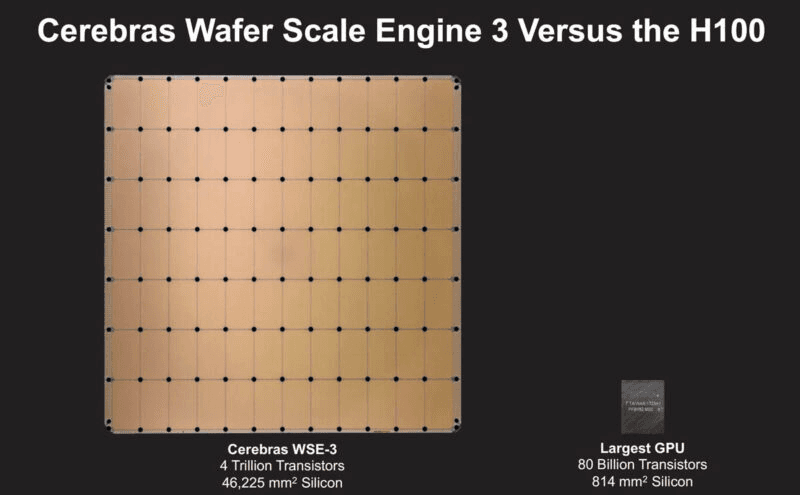
Cerebras WSE 3 Vs NVIDIA H100, Photo credit: servethehome.com
How Do LLMs Work?
GPT stands for “Generative Pre-trained Transformer,” a type of Large Language Model (LLM) designed to understand and generate human-like text. It is:
Generative because it creates new content
Pre-trained because it is trained on massive text datasets
Transformer-based because it uses the transformer architecture, a neural network design that excels at handling sequential data
The Transformer architecture, both Encoder and Decoder, is essentially a pipeline of highly parallel, repetitive matrix multiplications.
The core goal of AI chip design is to find more efficient ways to run these transformer operations.
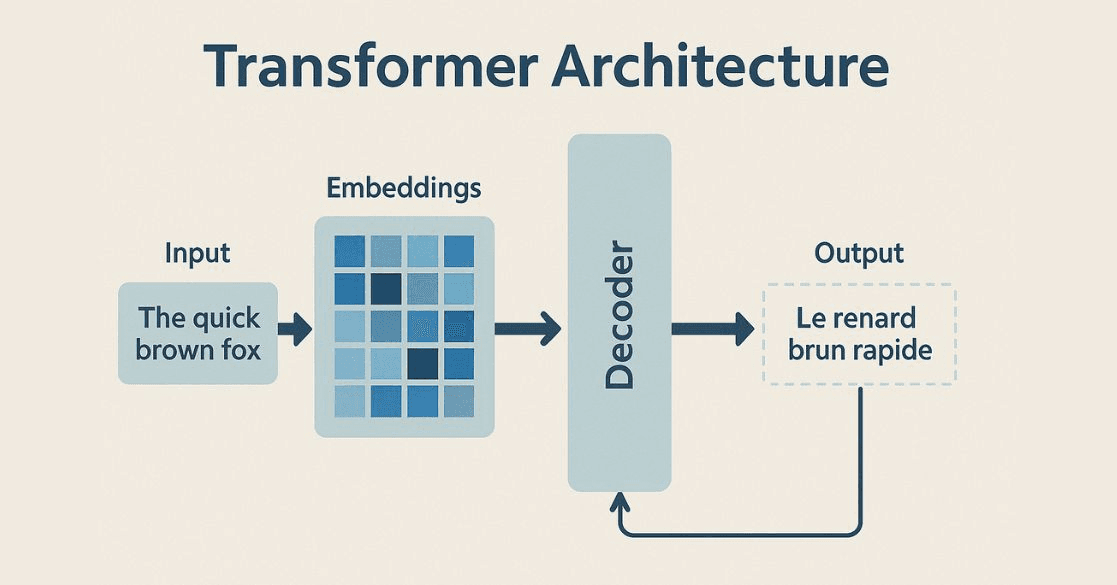
Photo credit: mygreatlearning.com
GPU Limitations for Transformers
NVIDIA dominates the AI hardware world with its GPUs (Graphics Processing Units). But GPUs were originally designed to be general-purpose parallel processors, not transformer-optimized engines.
Transformers require repetitive, specialized math. By contrast, GPUs include many components (graphics units, texture units, etc.) that are underutilized for AI workloads. A significant portion of GPU silicon, designed for graphics, is essentially wasted on transformer computation.
Memory bandwidth is another major issue. Transformers are often bottlenecked by memory movement, especially during decoding. Performance is limited by the speed at which model weights and the KV cache can be streamed from high-bandwidth memory to compute cores.
Cerebras’ Advantage
Feldman argues that AI has not “hit scaling laws.” Instead, he believes current limits stem from inefficient algorithms and poorly optimized hardware.
Cerebras and other players are developing Application-Specific Integrated Circuits (ASICs) purpose-built for transformer workloads (Source: 20VC podcast). Google has also entered the space with its Tensor Processing Unit (TPU) (Source: CNBC). These chips devote the majority of their transistors to efficient matrix-multiplication units, removing the general-purpose overhead found in GPUs.
The WSE-3 also includes massive on-chip memory with unprecedented bandwidth, enabling faster data access and reducing bottlenecks that plague distributed GPU systems.
These advantages make Cerebras systems well-suited for training large AI models and handling complex, data-intensive workloads. For example, training a 175-billion-parameter model on 4,000 GPUs might require 20,000 lines of code, whereas Cerebras can accomplish the same with just 565 lines, in one day (Source: sacra.com).
Targeting Supercomputer Performance
Cerebras has found product-market fit across several sectors:
Government & Research: Cerebras systems run in multiple U.S. Department of Energy (DOE) national laboratories and support national security, scientific research, and energy innovation. Several governments are investing in Cerebras technology for sovereign clouds to meet domestic AI requirements.
Healthcare & Life Sciences: Customers such as GlaxoSmithKline use Cerebras for epigenomics research, while Mayo Clinic employs the systems to advance diagnostics and personalized medicine.
Energy & Finance: TotalEnergies, a $100 billion French energy company, is a notable customer. Cerebras also works with financial institutions on complex modeling and risk assessment.
Cerebras’s Milestones
Cerebras has achieved several notable milestones in recent years:
March 2024: Unveiled the Wafer-Scale Engine 3 (WSE-3), claimed to be the fastest AI chip on Earth. (Source: Microventures)
January 2024: Signed a multi-million-dollar agreement with Mayo Clinic to develop AI models for healthcare. (Source: Microventures)
December 2023: Forbes reported that Cerebras’ revenue and customer commitments were nearing $1 billion. (Source: Forbes)
2023–2024 Revenue Growth: Revenue grew from $78.7 million in 2023 to an estimated $500 million in 2024 - massive acceleration. (Source: sacra.com)
Cerebras vs. Other Players in AI Chip Market
The Battle for the Next Silicon Generation
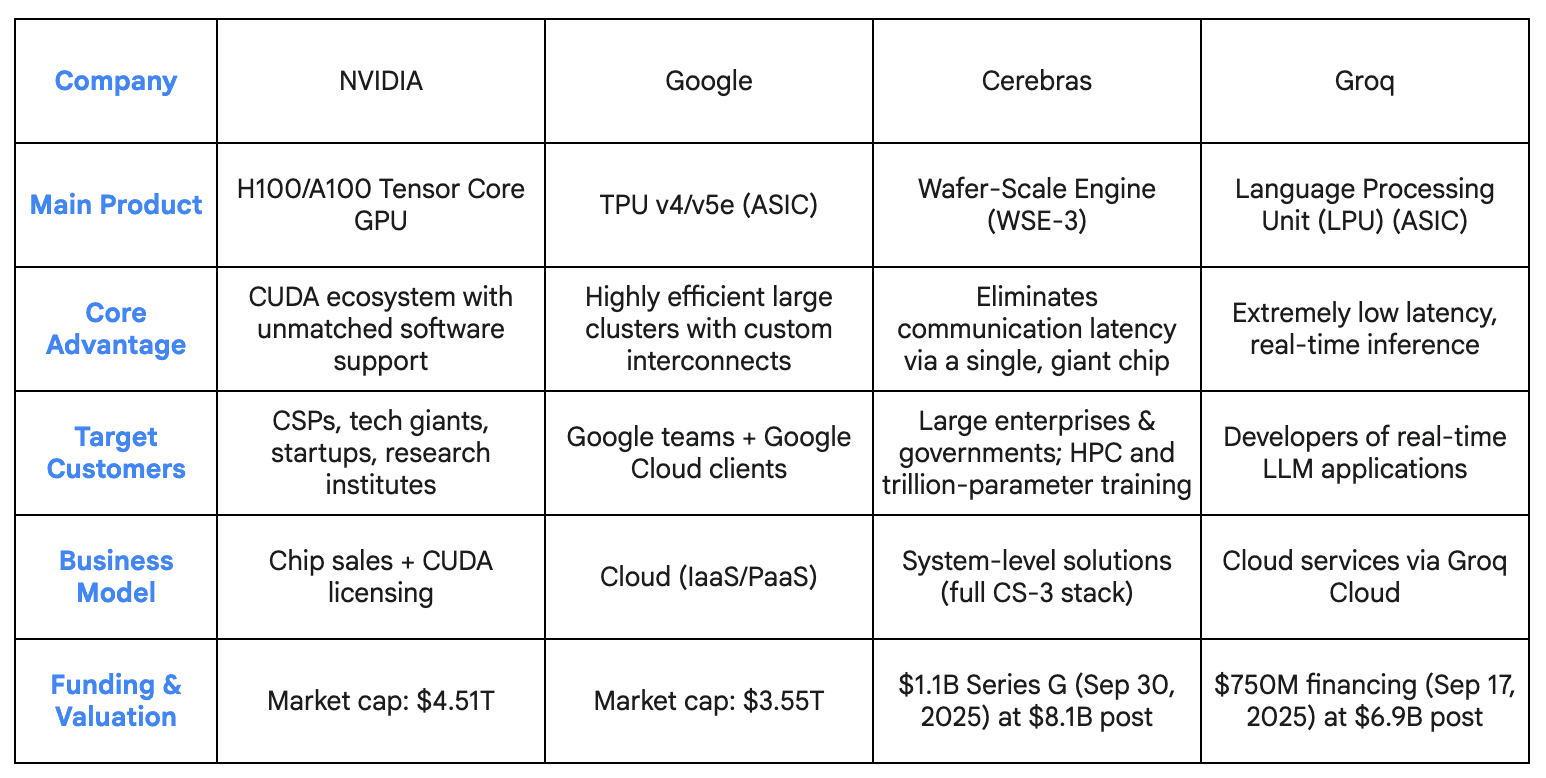
NVIDIA currently holds an overwhelming ~80% market share, protected by the ubiquity of CUDA, which ensures nearly all new AI models run best on its hardware.
However, scaling economics and efficiency demands are starting to challenge this dominance. GPU design, optimized for general-purpose parallelism, faces growing strain due to limited memory bandwidth and the high cost of data movement. These factors expose the inefficiencies of GPUs for extremely large and specific workloads, posing a moderate threat to NVIDIA’s hardware advantage.
Startups such as Cerebras and Groq are targeting these weaknesses directly, offering compelling price-performance improvements in specialized niches through ASIC-based architectures.
NVIDIA is countering by doubling down on its software moat, enhancing tools like NeMo and TensorRT, to extract more performance from its hardware and keep developers locked into the CUDA ecosystem.
NVIDIA remains the indispensable core of AI infrastructure, but the industry is shifting from general-purpose power to specialized efficiency. The coming years will feature an intense race between revolutionary hardware advances and a dominant, adaptive software ecosystem, ultimately leading to faster, cheaper, and more accessible AI for everyone.
The race for computational power to drive Artificial Intelligence has turned the hardware sector into an intense, high-stakes battleground. Leading the charge is NVIDIA, which recently approached a $4 trillion market capitalization.
NVIDIA maintains a significant advantage with its mature CUDA ecosystem. CUDA is a programming platform that enables developers to efficiently harness GPU power, and nearly all major AI frameworks, including PyTorch and TensorFlow, are deeply optimized for it. This comprehensive, battle-tested software stack dramatically reduces development time and effectively locks in the developer community.
However, Cerebras co-founder Andrew Feldman argues that CUDA’s strength in today’s AI landscape is becoming a weakness, especially regarding the cost and efficiency of AI inference (Source: 20VC with Harry Stebbings).
Founding Story of Cerebras
Cerebras was founded by chip industry veterans with a strong track record. Its five co-founders previously worked together at SeaMicro, which was later acquired by AMD in 2012.
The company is built on the belief that traditional chip design is fundamentally inefficient. By creating the largest chip in the world, the Wafer-Scale Engine (WSE), Cerebras aims to deliver far greater efficiency for AI training and inference than conventional GPU clusters.
The WSE-3 measures 72 square inches and offers 50 times the compute power of Nvidia’s H100 GPU. By comparison, the H100 is only 1 square inch and contains 80 billion transistors (Source: WTW)

Cerebras WSE 3 Vs NVIDIA H100, Photo credit: servethehome.com
How Do LLMs Work?
GPT stands for “Generative Pre-trained Transformer,” a type of Large Language Model (LLM) designed to understand and generate human-like text. It is:
Generative because it creates new content
Pre-trained because it is trained on massive text datasets
Transformer-based because it uses the transformer architecture, a neural network design that excels at handling sequential data
The Transformer architecture, both Encoder and Decoder, is essentially a pipeline of highly parallel, repetitive matrix multiplications.
The core goal of AI chip design is to find more efficient ways to run these transformer operations.

Photo credit: mygreatlearning.com
GPU Limitations for Transformers
NVIDIA dominates the AI hardware world with its GPUs (Graphics Processing Units). But GPUs were originally designed to be general-purpose parallel processors, not transformer-optimized engines.
Transformers require repetitive, specialized math. By contrast, GPUs include many components (graphics units, texture units, etc.) that are underutilized for AI workloads. A significant portion of GPU silicon, designed for graphics, is essentially wasted on transformer computation.
Memory bandwidth is another major issue. Transformers are often bottlenecked by memory movement, especially during decoding. Performance is limited by the speed at which model weights and the KV cache can be streamed from high-bandwidth memory to compute cores.
Cerebras’ Advantage
Feldman argues that AI has not “hit scaling laws.” Instead, he believes current limits stem from inefficient algorithms and poorly optimized hardware.
Cerebras and other players are developing Application-Specific Integrated Circuits (ASICs) purpose-built for transformer workloads (Source: 20VC podcast). Google has also entered the space with its Tensor Processing Unit (TPU) (Source: CNBC). These chips devote the majority of their transistors to efficient matrix-multiplication units, removing the general-purpose overhead found in GPUs.
The WSE-3 also includes massive on-chip memory with unprecedented bandwidth, enabling faster data access and reducing bottlenecks that plague distributed GPU systems.
These advantages make Cerebras systems well-suited for training large AI models and handling complex, data-intensive workloads. For example, training a 175-billion-parameter model on 4,000 GPUs might require 20,000 lines of code, whereas Cerebras can accomplish the same with just 565 lines, in one day (Source: sacra.com).
Targeting Supercomputer Performance
Cerebras has found product-market fit across several sectors:
Government & Research: Cerebras systems run in multiple U.S. Department of Energy (DOE) national laboratories and support national security, scientific research, and energy innovation. Several governments are investing in Cerebras technology for sovereign clouds to meet domestic AI requirements.
Healthcare & Life Sciences: Customers such as GlaxoSmithKline use Cerebras for epigenomics research, while Mayo Clinic employs the systems to advance diagnostics and personalized medicine.
Energy & Finance: TotalEnergies, a $100 billion French energy company, is a notable customer. Cerebras also works with financial institutions on complex modeling and risk assessment.
Cerebras’s Milestones
Cerebras has achieved several notable milestones in recent years:
March 2024: Unveiled the Wafer-Scale Engine 3 (WSE-3), claimed to be the fastest AI chip on Earth. (Source: Microventures)
January 2024: Signed a multi-million-dollar agreement with Mayo Clinic to develop AI models for healthcare. (Source: Microventures)
December 2023: Forbes reported that Cerebras’ revenue and customer commitments were nearing $1 billion. (Source: Forbes)
2023–2024 Revenue Growth: Revenue grew from $78.7 million in 2023 to an estimated $500 million in 2024 - massive acceleration. (Source: sacra.com)
Cerebras vs. Other Players in AI Chip Market

The Battle for the Next Silicon Generation
NVIDIA currently holds an overwhelming ~80% market share, protected by the ubiquity of CUDA, which ensures nearly all new AI models run best on its hardware.
However, scaling economics and efficiency demands are starting to challenge this dominance. GPU design, optimized for general-purpose parallelism, faces growing strain due to limited memory bandwidth and the high cost of data movement. These factors expose the inefficiencies of GPUs for extremely large and specific workloads, posing a moderate threat to NVIDIA’s hardware advantage.
Startups such as Cerebras and Groq are targeting these weaknesses directly, offering compelling price-performance improvements in specialized niches through ASIC-based architectures.
NVIDIA is countering by doubling down on its software moat, enhancing tools like NeMo and TensorRT, to extract more performance from its hardware and keep developers locked into the CUDA ecosystem.
NVIDIA remains the indispensable core of AI infrastructure, but the industry is shifting from general-purpose power to specialized efficiency. The coming years will feature an intense race between revolutionary hardware advances and a dominant, adaptive software ecosystem, ultimately leading to faster, cheaper, and more accessible AI for everyone.

Subscribe to our newsletter
Recommended articles
本门户由 Jarsy, Inc.("Jarsy")运营,Jarsy 并不是注册的经纪-交易商或投资顾问。Jarsy 不提供关于本门户上显示的任何资产的投资建议、认可或推荐。本门户上的任何内容均不应被视为出售的要约、购买要约的请求或就证券的推荐。您有责任根据您的个人投资目标、财务状况和风险承受能力,确定任何投资、投资策略或相关交易是否适合您。您应咨询持牌法律专业人士和投资顾问,以获得任何法律、税务、保险或投资建议。Jarsy 不保证本网站上发布的任何投资机会的投资表现、结果或资本回报。通过访问本门户和其中的任何页面,您同意受门户为您提供的条款和政策的约束。在投资中涉及风险,并可能导致部分或全部损失。通过访问本网站,投资者理解并承认 1)投资一般而言,无论是在私募股权、股票市场还是房地产,都是有风险和不可预测的; 2)市场有其波动; 3)您所参与的投资可能不会产生正现金流或如您所期望的那样表现; 4)您投资的任何资产的价值可能随时下降,未来价值不可预测。在做出投资决策之前,建议潜在投资者查看所有可用信息并与他们的税务和法律顾问咨询。Jarsy 不提供关于本门户上发布的任何要约的投资建议或推荐。本文件中的任何与投资相关的信息均来自 Jarsy 认为可靠的来源,但我们对此类信息的准确性或完整性不作任何声明或保证,并因此不承担任何责任。链接到第三方网站或复制第三方文章并不构成 Jarsy 对所链接或复制内容的批准或认可。


