Westinghouse generators, Hydroelectric power station, Niagara Falls, USA, published 1898
Image Credit: GettyImages
Electricity used to be the “easy” part of the energy system: generate it somewhere, move it over wires, and plug it in. Today it’s becoming the central constraint on economic growth, because everything is electrifying (transport, industry, buildings), renewables are scaling fast, and new loads like AI data centers want gigawatt-scale power on tight timelines.
1. A very short history of electricity
The Ancient Spark
Around 600 BCE, Thales of Miletus observed that rubbing amber with fur attracted lightweight objects - the earliest recorded encounter with static electricity. The word “electricity” itself derives from the Greek elektron, meaning amber.
In 1752, Benjamin Franklin flew a kite during a thunderstorm, demonstrating that lightning was electrical in nature. His experiment led directly to the lightning rod, arguably the first practical electrical device.
The Age of Discovery (1800–1880)
In 1820, Hans Christian Ørsted showed that electric current creates a magnetic field. A decade later, in 1831, Michael Faraday discovered electromagnetic induction - the principle behind modern generators. And in 1832 Hippolyte Pixii built the first dynamo based on Faraday’s work. By 1879, Thomas Edison had developed a practical incandescent light bulb and begun constructing the first electrical utility systems, laying the foundation for modern electrification.

Image Credit: Getty Images
The War of Currents (1880s–1890s)
The late 19th century saw a battle between Edison’s direct current (DC) and Tesla and Westinghouse’s alternating current (AC). DC struggled over long distances, while AC (enabled by transformers) could transmit power efficiently across miles. AC’s victory, cemented by the 1893 Chicago World’s Fair and the 1896 Niagara Falls project, established the grid model that still powers the world today.
1900s to now: the grid becomes civilization’s backbone
Electrification spread because it was unbelievably versatile: one energy carrier that can become light, heat, motion, computation. Big hydro and fossil plants made electricity cheap; the grid grew around predictable, controllable generators.
2. Electricity Today: How It’s Generated and Delivered
Modern electricity generation still follows a 19th-century discovery: Convert energy into motion.
Spin a turbine. Induce current. Coal plants, gas turbines, nuclear reactors, hydro dams, all rely on electromagnetic induction. Only solar photovoltaics skip the turbine, converting sunlight directly into electricity. The physics hasn’t changed much. The scale and pressures have.
Clean generation is scaling fast
Although fossil fuels still produce roughly 59% of global electricity, clean electricity grows faster. In 2024, renewables alone made up almost three-quarters of the overall increase in power generation, and the IEA (International Energy Agency) projected renewables’ share rising further (with renewables meeting most demand growth this decade).

Image Credit: IEA.org
Wind and solar are growing fastest and dominate new capacity additions. In many regions, they are now the lowest-cost new sources of power. Nuclear and geothermal represent a small portion of total generation, but they deliver highly consistent output, operating most hours of the year.

Credits: IEA.org, Ember-Energy.org, Jarsy Research
From Power Plant to Plug: How the Grid Works
After electricity is generated, it enters a multi-stage delivery system before reaching end users:
- Step-up transformers increase voltage for long-distance transmission.
- High-voltage lines carry electricity hundreds of kilometers.
- Substations step voltage down for regional distribution.
- Local transformers deliver usable power to homes and industry.


Demand is rising faster than planners expected
Global electricity demand jumped 4.3% in 2024, a step-change versus recent history. Data centers alone consumed about 415 TWh in 2024 (~1.5% of global electricity), and the IEA projects data center electricity use could roughly double by 2030.

Image Credit: IEA.org
Variability Is Increasing but Firm Capacity Is Limited
Wind and solar are expanding rapidly and falling in cost. But they depend on the weather. Firmer power with high reliability such as Nuclear and Geothermal only provides 9% and <1% of global generation, and runs at high capacity already. As coal plants retire in many regions, firm capacity is shrinking in some markets, while demand is rising.
The Grid Is Aging
Much of today’s transmission lines, transformers, and substations were built decades ago. Equipment lead times are long, supply chains are strained, and the system wasn’t designed for bidirectional flows from solar, batteries, and EVs. In the U.S., roughly 70% of large power transformers are over 25 years old. In Europe, nearly 40% of transmission lines exceed 40 years.
That’s the backdrop for the four companies below: two expanding firm supply (fusion and advanced nuclear), one scaling 24/7 geothermal, and one modernizing grid hardware.
3. The revolutionaries

Polaris. Image Credit: Helion
Helion Energy - Fusion Built for Direct Power Conversion
Founded: 2013 | HQ: Everett, Washington
Fusion aims to replicate the process that powers the sun: fusing light atomic nuclei to release huge amounts of energy with minimal emissions. For decades, fusion has been technologically elusive, with most designs relying on massive, complex reactors intended to generate heat for steam turbines. Helion takes a different approach.
Technology: Field-Reversed Configuration (FRC) fusion. Instead of confining plasma in a large doughnut-shaped reactor, Helion creates two magnetized plasma rings, accelerates them toward each other, and compresses them to fusion conditions. When the plasma expands after the reaction, changing magnetic fields induce electrical current directly, eliminating the need for a steam turbine or conventional thermal cycle.
Compared to traditional tokamak-based designs, Helion’s system:
- Avoids large cooling towers and steam infrastructure
- Uses a pulsed, magnetically driven system
- Has fewer moving parts, enables a more compact footprint
- Is designed for modular scaling (tens of megawatts per unit)
Status: Polaris (7th-gen prototype) achieved 150 million°C plasma temperatures and demonstrated measurable deuterium-tritium fusion in February 2026, both are industry firsts for a private company. Construction of Orion, the first commercial plant (50 MW+), is underway in Malaga, Washington. If successful, fusion becomes a new class of dense, clean, dispatchable energy, potentially redefining long-term supply constraints.
TerraPower — Advanced Nuclear with Built-In Storage
Founded: 2008 | HQ: Bellevue, Washington
Technology: Natrium - a 345 MWe sodium-cooled fast reactor with integrated molten salt energy storage (can boost to 500 MWe). Sodium coolant operates at atmospheric pressure, eliminating a major class of accident scenarios.
What makes Natrium interesting:
Nuclear + storage in one plant
More flexible than traditional nuclear
Designed to complement renewables
Status: Non-nuclear construction began July 2024 near Kemmerer, Wyoming. First nuclear concrete targeted 2027, fuel loading 2030, commercial operation 2031. If successful, nuclear re-enters the mainstream conversation as a firm, flexible, carbon-free infrastructure.

Project Red, Nevada, by Fervo Energy. Image Credit: Wired.com
Fervo Energy - Enhanced Geothermal
Founded: 2017 | HQ: Houston, Texas
Technology: Traditional geothermal is geographically limited. Fervo developed Enhanced Geothermal Systems (EGS), using horizontal drilling and hydraulic stimulation adapted from oil & gas to create artificial geothermal reservoirs in hot dry rock.
Status: Cape Station on track for first 100 MW of firm power in October 2026, expanding to 500 MW by 2028. Drilled deepest well to date: 15,765 feet at Project Blanford, reaching 555°F, confirming multi-GW potential. If successful, EGS becomes the steady backbone under a renewable-heavy system, especially valuable for data centers and industrial users.
Heron Power - Reinventing the Transformer for the AI Age
Founded: 2025 (by Drew Baglino, ex-Tesla SVP) | HQ: Northern California
Technology: Today’s transformers are: heavy, slow to manufacture, and hardware-defined. Heron is developing Solid-state transformers (“Heron Link”) using high-frequency power electronics to replace century-old analog transformer technology. Converts medium-voltage AC to 800V DC for data centers, handles bidirectional energy flow, and regulates voltage/frequency via software. If successful, the grid becomes more modular, programmable, and responsive.
Status: 50 GW of orders from 12+ customers including Google and Crusoe. Planning a 40 GW/year U.S. factory, pilot production early 2027.

Heron Link. Image Credit: Heron Power

Credit: Jarsy Research
4. Looking Ahead
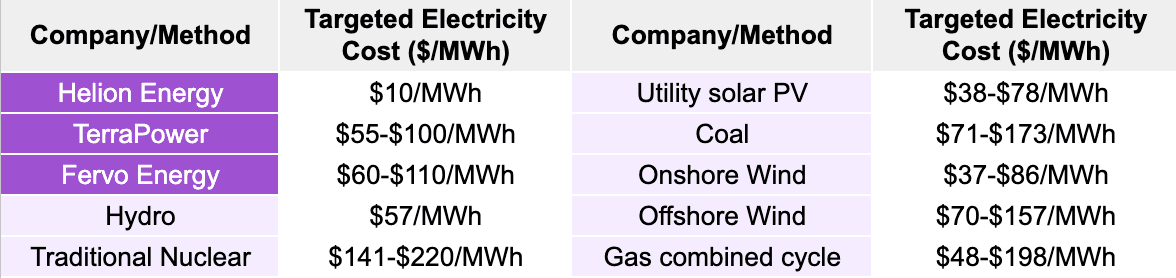
Credits: Lazard’s levelized cost of energy (LCOE) research, Jarsy Research
With more than $4 billion combined flowing into Helion, TerraPower, and Fervo, these are no longer speculative science projects but industrial-scale bets on reshaping the backbone of civilization. If Helion achieves its audacious $10/MWh target, energy abundance would fundamentally reorder economics, from AI and desalination to heavy industry and carbon removal. If TerraPower and Fervo deliver firm, zero-carbon power in the $60–$100/MWh range, they make reliable clean energy cost-competitive with fossil fuels at scale. As the power network undergoes its most dramatic transformation since AC won the War of Currents in the 1890s, these billion-dollar ventures signal that the question is no longer whether the grid will be transformed, but how fast.
Further Learning: Lex Friedman Interview with Helion Energy CEO, Bloomberg interview with Heron CEO, Global Energy Review 2025 by IEA, 2025 Lazard LCOE+ Report