
Mercury: The No. 1 Bank for Startups | Product Evolution, Business Model & Growth

Mercury: The No. 1 Bank for Startups | Product Evolution, Business Model & Growth

A comprehensive analysis of how Mercury evolved from a software-first banking platform into the leading financial operating system for startups—covering product launches, revenue model, rapid growth, and its rise as the top choice for modern businesses.

Han Qin

2025年12月3日

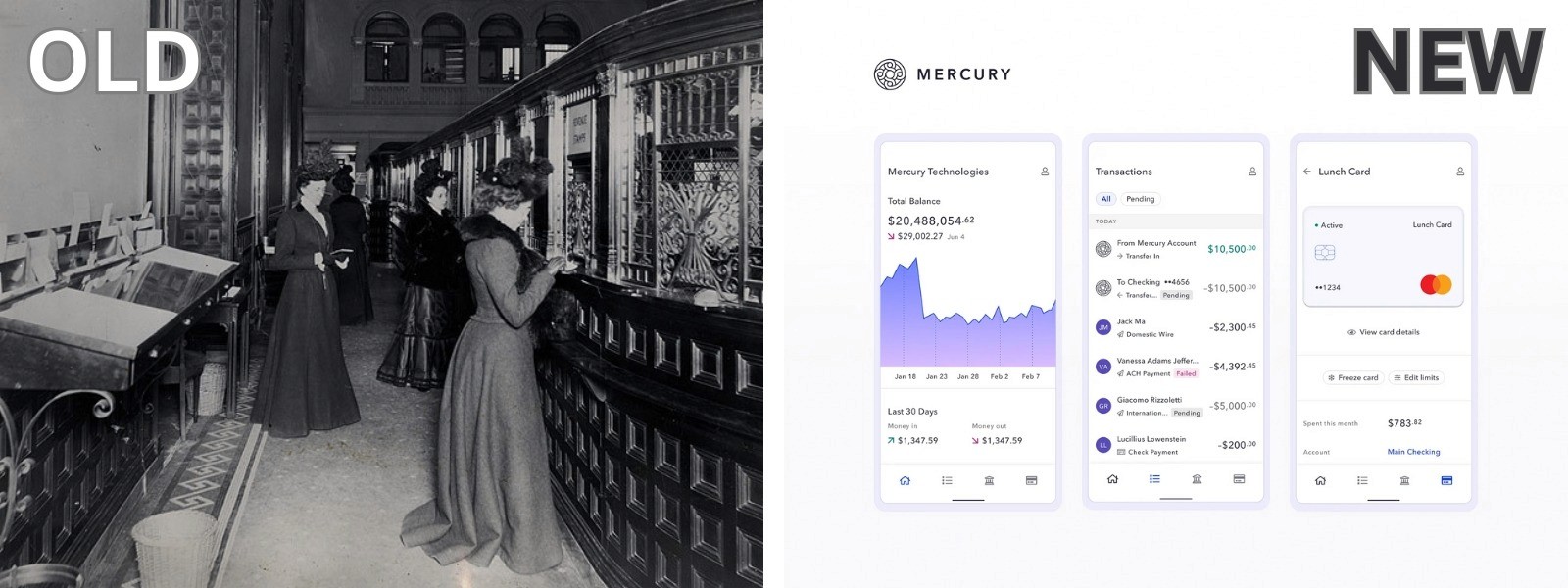
old and new banks
old and new banks

A New Approach to Banking for Startups

Mercury is a software-first financial platform that provides modern banking and financial operations tools for startups, small businesses, high growth companies, and individuals. Founded in 2017 by Immad Akhund and his former Heyzap colleagues Max Tagher and Jason Zhang, Mercury grew out of Immad’s extensive experience as a serial founder, his third startup across eleven years, which exposed him to the persistent pain of opening accounts and managing day to day finances as a startup. Rather than building just another online bank, the team set out to reinvent business banking altogether, addressing the outdated and frustrating processes that plagued founders, including slow onboarding, required branch visits, and endless paperwork.

After securing a $6 million seed round funding from Andreessen Horowitz in Aug 2017, the team set out to build a “minimum delightful product”, the smallest version of a banking platform founders would genuinely enjoy using. Over 18 months, a small engineering team built automated onboarding, modern dashboards, an API-first infrastructure, and banking partnerships robust enough to support real FDIC-insured accounts. When Mercury launched in 2019, it immediately felt like a bank designed by people who understood startup pain firsthand.

Mercury’s Product Evolution and Expansion Timeline

Mercury has rapidly expanded from its 2019 debut as a digital-first business bank into a full financial operating system for startups. Beginning with simple checking, savings, and seamless onboarding, it quickly added APIs, international wires, venture debt (2022), corporate charge cards (2022), treasury products (2023), and then broadened into financial-ops tools like bill pay, reimbursements, invoicing, and spend management (2024). By 2024-2025, Mercury had also moved beyond startups, launching consumer banking and strengthening its position as a comprehensive platform for managing money, payments, and financial operations across modern businesses. Below are the detailed product launches and their timelines.
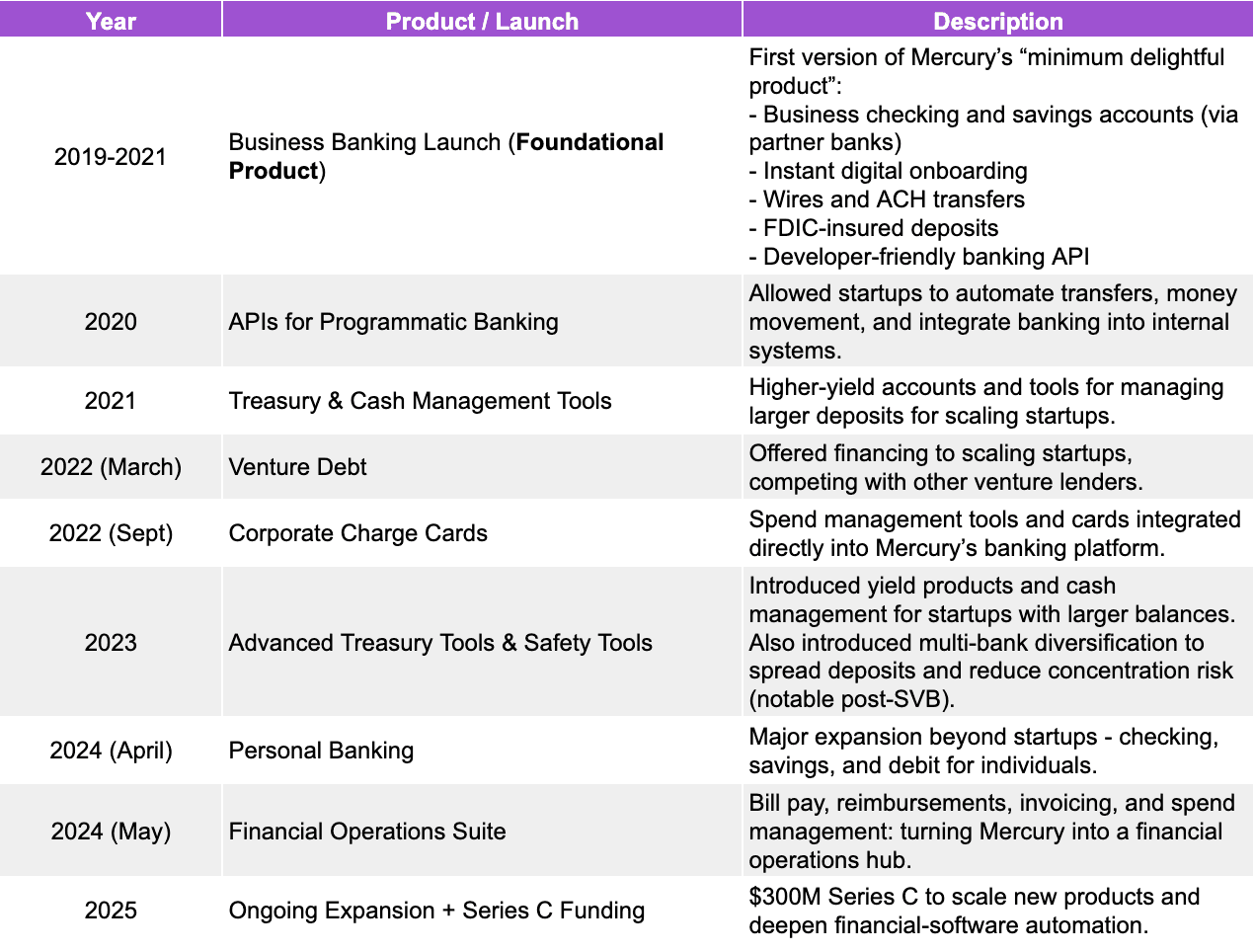

Mercury’s Product Evolution and Expansion Timeline

Copyright © Jarsy Research

Mercury’s Business Model

Mercury runs a software first banking model where core services such as business accounts, ACH transfers, debit cards, and its dashboard are free, while revenue comes from interchange fees on card spending, interest earned on customer deposits, treasury yield spreads, foreign exchange and international wire fees, and optional paid plans for advanced financial tools. This approach allows Mercury to stay founder friendly while growing revenue as customers increase their balances and financial activity. (Mercury currently is only available for US incorporated businesses)
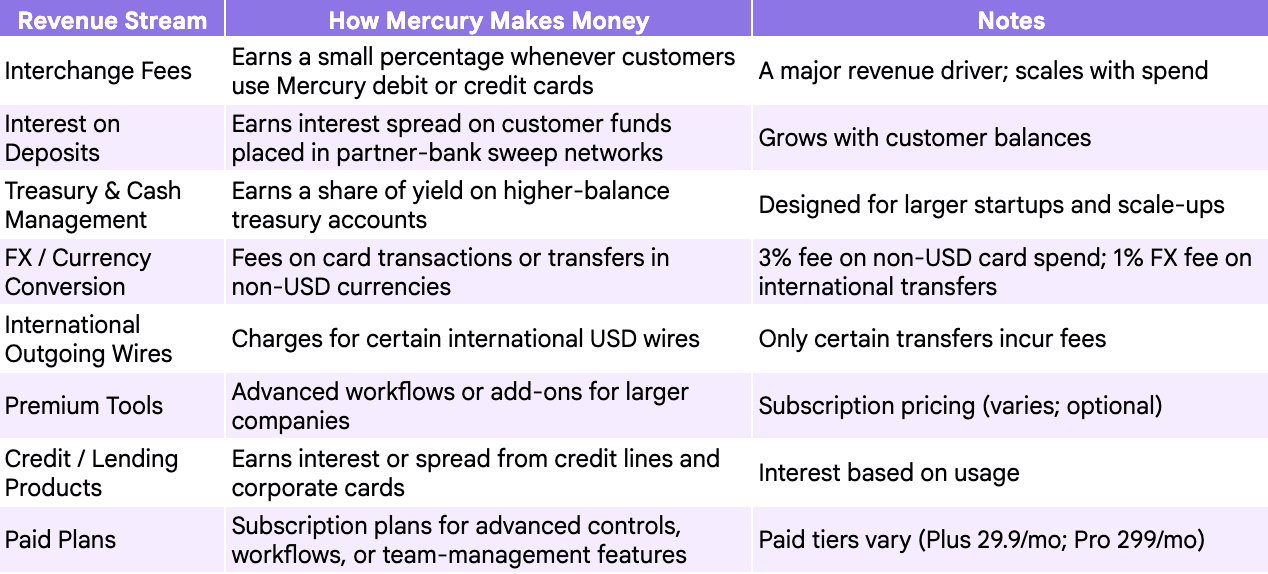

Mercury’s Business Model

Copyright © Jarsy Research

Mercury’s Rapid Growth and Market Momentum

Beginning in 2020, Mercury entered a period of rapid expansion as more startups and small businesses adopted the platform. Its growth accelerated even further in 2023, when the collapse of Silicon Valley Bank sent shockwaves through the startup ecosystem and prompted over 8,000 new companies and more than $2 billion in deposits to move to Mercury within days. By 2024, the company had passed 100,000 customers, and reached about $500 million in annualized revenue, all while maintaining a multi-quarter streak of profitability. That momentum carried into 2025, when Mercury surpassed 200,000 customers and grew annualized revenue to roughly $650 million, reinforcing its position as one of the fastest-scaling and most consistently profitable financial platforms built for modern businesses. This strong and steady performance helped push its valuation from about $1.6 billion in 2021 to $3.5 billion in 2025, when it closed a $300 million Series C, marking Mercury as one of the fastest-growing financial platforms of the decade.
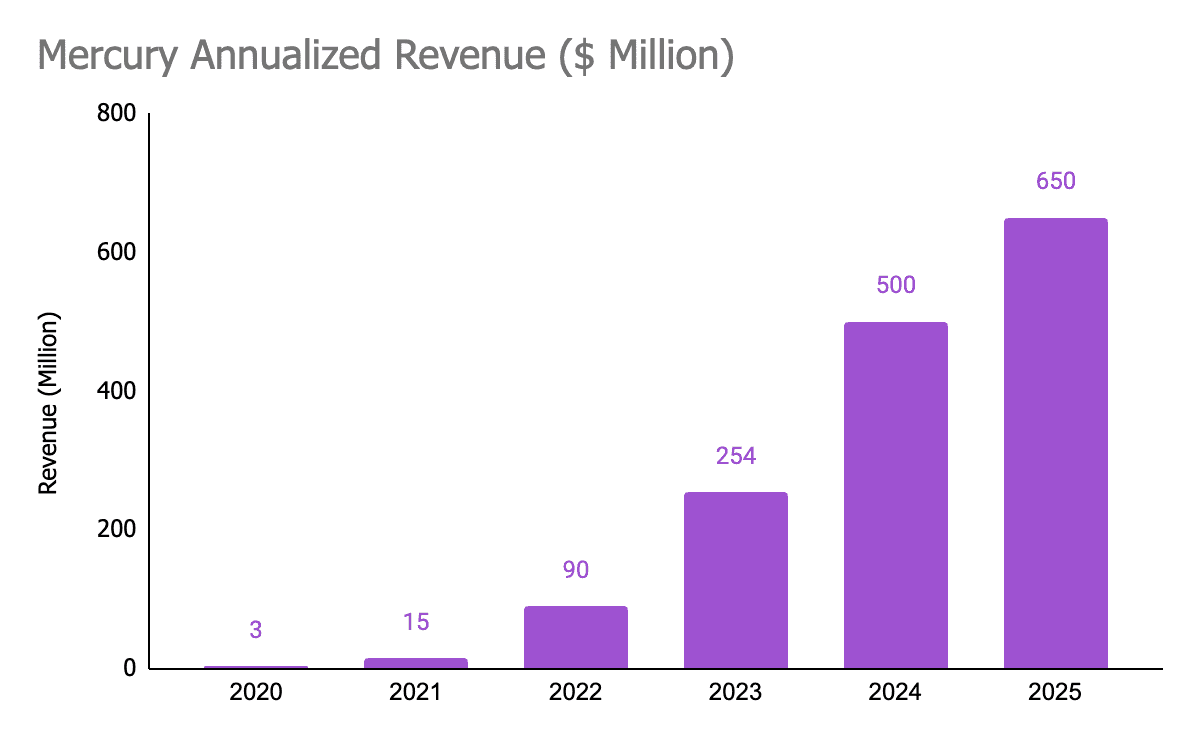

Mercury Annualized Revenue

Data Source: Sacra.com

Overall, Mercury stands as one of the leading banking platforms tailored for startups and small to midsize businesses. In a competitive field that includes Brex, Ramp, Relay, Bluevine, and Rho, Mercury’s edge comes from its banking-first focus, clean product experience, and strong reputation among founders. Its fast onboarding, reliable infrastructure, and developer-friendly approach continue to resonate with young, growing companies. Looking ahead, Mercury’s clarity of purpose and sustained performance position it well to deepen its capabilities and solidify its role as the go-to financial platform for modern startups and SMEs.
A New Approach to Banking for Startups

Mercury is a software-first financial platform that provides modern banking and financial operations tools for startups, small businesses, high growth companies, and individuals. Founded in 2017 by Immad Akhund and his former Heyzap colleagues Max Tagher and Jason Zhang, Mercury grew out of Immad’s extensive experience as a serial founder, his third startup across eleven years, which exposed him to the persistent pain of opening accounts and managing day to day finances as a startup. Rather than building just another online bank, the team set out to reinvent business banking altogether, addressing the outdated and frustrating processes that plagued founders, including slow onboarding, required branch visits, and endless paperwork.

After securing a $6 million seed round funding from Andreessen Horowitz in Aug 2017, the team set out to build a “minimum delightful product”, the smallest version of a banking platform founders would genuinely enjoy using. Over 18 months, a small engineering team built automated onboarding, modern dashboards, an API-first infrastructure, and banking partnerships robust enough to support real FDIC-insured accounts. When Mercury launched in 2019, it immediately felt like a bank designed by people who understood startup pain firsthand.

Mercury’s Product Evolution and Expansion Timeline

Mercury has rapidly expanded from its 2019 debut as a digital-first business bank into a full financial operating system for startups. Beginning with simple checking, savings, and seamless onboarding, it quickly added APIs, international wires, venture debt (2022), corporate charge cards (2022), treasury products (2023), and then broadened into financial-ops tools like bill pay, reimbursements, invoicing, and spend management (2024). By 2024-2025, Mercury had also moved beyond startups, launching consumer banking and strengthening its position as a comprehensive platform for managing money, payments, and financial operations across modern businesses. Below are the detailed product launches and their timelines.


Mercury’s Product Evolution and Expansion Timeline

Copyright © Jarsy Research

Mercury’s Business Model

Mercury runs a software first banking model where core services such as business accounts, ACH transfers, debit cards, and its dashboard are free, while revenue comes from interchange fees on card spending, interest earned on customer deposits, treasury yield spreads, foreign exchange and international wire fees, and optional paid plans for advanced financial tools. This approach allows Mercury to stay founder friendly while growing revenue as customers increase their balances and financial activity. (Mercury currently is only available for US incorporated businesses)


Mercury’s Business Model

Copyright © Jarsy Research

Mercury’s Rapid Growth and Market Momentum

Beginning in 2020, Mercury entered a period of rapid expansion as more startups and small businesses adopted the platform. Its growth accelerated even further in 2023, when the collapse of Silicon Valley Bank sent shockwaves through the startup ecosystem and prompted over 8,000 new companies and more than $2 billion in deposits to move to Mercury within days. By 2024, the company had passed 100,000 customers, and reached about $500 million in annualized revenue, all while maintaining a multi-quarter streak of profitability. That momentum carried into 2025, when Mercury surpassed 200,000 customers and grew annualized revenue to roughly $650 million, reinforcing its position as one of the fastest-scaling and most consistently profitable financial platforms built for modern businesses. This strong and steady performance helped push its valuation from about $1.6 billion in 2021 to $3.5 billion in 2025, when it closed a $300 million Series C, marking Mercury as one of the fastest-growing financial platforms of the decade.


Mercury Annualized Revenue

Data Source: Sacra.com

Overall, Mercury stands as one of the leading banking platforms tailored for startups and small to midsize businesses. In a competitive field that includes Brex, Ramp, Relay, Bluevine, and Rho, Mercury’s edge comes from its banking-first focus, clean product experience, and strong reputation among founders. Its fast onboarding, reliable infrastructure, and developer-friendly approach continue to resonate with young, growing companies. Looking ahead, Mercury’s clarity of purpose and sustained performance position it well to deepen its capabilities and solidify its role as the go-to financial platform for modern startups and SMEs.

Subscribe to our newsletter

Email

Subscribe to our newsletter

Email

Recommended articles

开始投资

Jarsy Inc. 版权所有。

© 2024

本门户由 Jarsy, Inc.("Jarsy")运营,Jarsy 并不是注册的经纪-交易商或投资顾问。Jarsy 不提供关于本门户上显示的任何资产的投资建议、认可或推荐。本门户上的任何内容均不应被视为出售的要约、购买要约的请求或就证券的推荐。您有责任根据您的个人投资目标、财务状况和风险承受能力,确定任何投资、投资策略或相关交易是否适合您。您应咨询持牌法律专业人士和投资顾问,以获得任何法律、税务、保险或投资建议。Jarsy 不保证本网站上发布的任何投资机会的投资表现、结果或资本回报。通过访问本门户和其中的任何页面,您同意受门户为您提供的条款和政策的约束。在投资中涉及风险,并可能导致部分或全部损失。通过访问本网站,投资者理解并承认 1)投资一般而言,无论是在私募股权、股票市场还是房地产,都是有风险和不可预测的; 2)市场有其波动; 3)您所参与的投资可能不会产生正现金流或如您所期望的那样表现; 4)您投资的任何资产的价值可能随时下降,未来价值不可预测。在做出投资决策之前,建议潜在投资者查看所有可用信息并与他们的税务和法律顾问咨询。Jarsy 不提供关于本门户上发布的任何要约的投资建议或推荐。本文件中的任何与投资相关的信息均来自 Jarsy 认为可靠的来源,但我们对此类信息的准确性或完整性不作任何声明或保证,并因此不承担任何责任。链接到第三方网站或复制第三方文章并不构成 Jarsy 对所链接或复制内容的批准或认可。

本门户由 Jarsy, Inc.("Jarsy")运营,Jarsy 并不是注册的经纪-交易商或投资顾问。Jarsy 不提供关于本门户上显示的任何资产的投资建议、认可或推荐。本门户上的任何内容均不应被视为出售的要约、购买要约的请求或就证券的推荐。您有责任根据您的个人投资目标、财务状况和风险承受能力,确定任何投资、投资策略或相关交易是否适合您。您应咨询持牌法律专业人士和投资顾问,以获得任何法律、税务、保险或投资建议。Jarsy 不保证本网站上发布的任何投资机会的投资表现、结果或资本回报。通过访问本门户和其中的任何页面,您同意受门户为您提供的条款和政策的约束。在投资中涉及风险,并可能导致部分或全部损失。通过访问本网站,投资者理解并承认 1)投资一般而言,无论是在私募股权、股票市场还是房地产,都是有风险和不可预测的; 2)市场有其波动; 3)您所参与的投资可能不会产生正现金流或如您所期望的那样表现; 4)您投资的任何资产的价值可能随时下降,未来价值不可预测。在做出投资决策之前,建议潜在投资者查看所有可用信息并与他们的税务和法律顾问咨询。Jarsy 不提供关于本门户上发布的任何要约的投资建议或推荐。本文件中的任何与投资相关的信息均来自 Jarsy 认为可靠的来源,但我们对此类信息的准确性或完整性不作任何声明或保证,并因此不承担任何责任。链接到第三方网站或复制第三方文章并不构成 Jarsy 对所链接或复制内容的批准或认可。

开始投资

Jarsy Inc. 版权所有。

© 2024