
The technology, business, and economics behind the 2026 FIFA World Cup, the biggest, richest, and most heavily wired tournament football has ever staged. Image Credit: Jarsy
1. A Brief History and the Numbers
The FIFA World Cup began in 1930 in Uruguay as a 13-team experiment that few European nations were willing to cross the Atlantic to join. Over the next century, it evolved into the world's most-watched recurring sporting event. The field expanded from 13 teams to 16, then 24 in 1982 and 32 in 1998, while television and the internet transformed the tournament into a global spectacle reaching billions.
The 2026 edition marks the next great leap. Hosted by the United States, Canada and Mexico from June 11 to July 19, it is the first World Cup shared by three countries and the first to feature 48 teams. The tournament will span 16 cities and a record 104 matches, 63% more than Qatar 2022, with the United States hosting 78 of them. By nearly every measure, it is the largest World Cup ever staged.
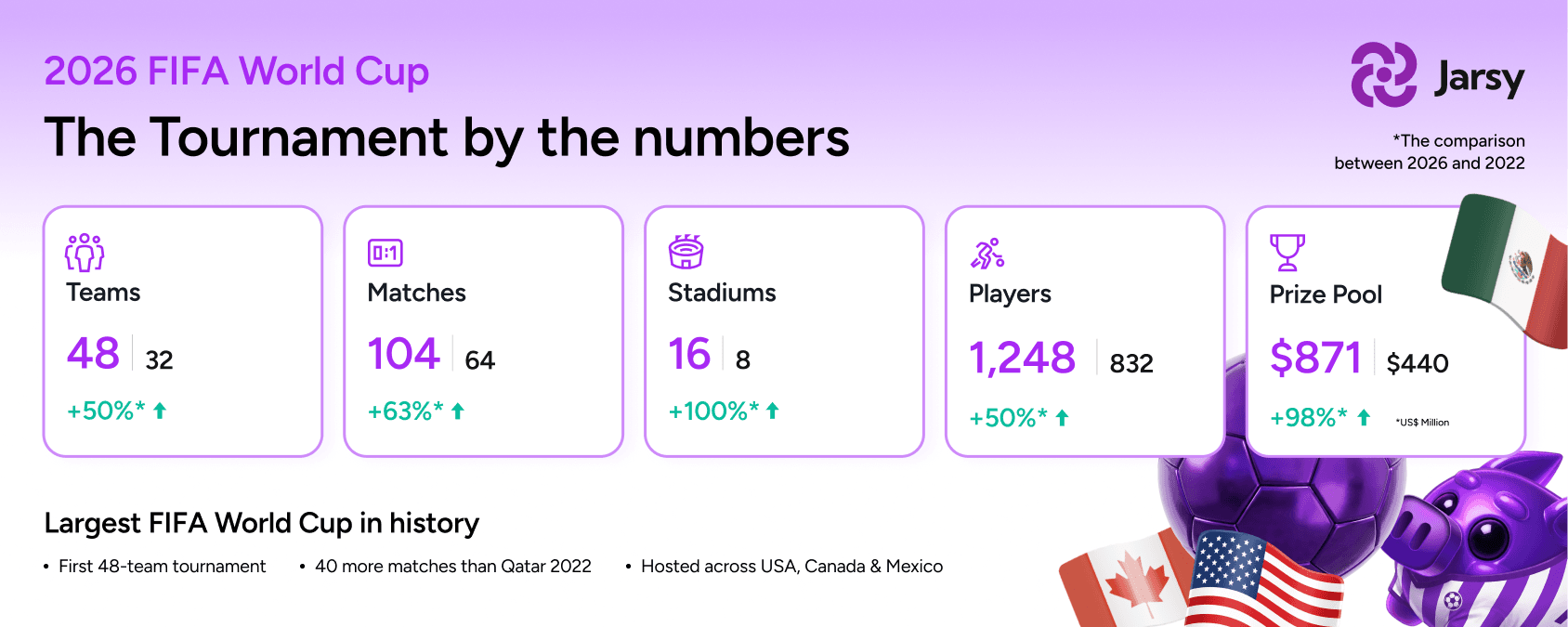
Sources: FIFA, Reuters. © 2026 Jarsy Research
Yet the defining story of 2026 may not be its sporting scale, but its economic scale. What began as a football tournament has become a global commercial platform, generating billions of dollars across broadcasting, sponsorship, hospitality, tourism, betting, payments and digital media.
2. Economic Impact
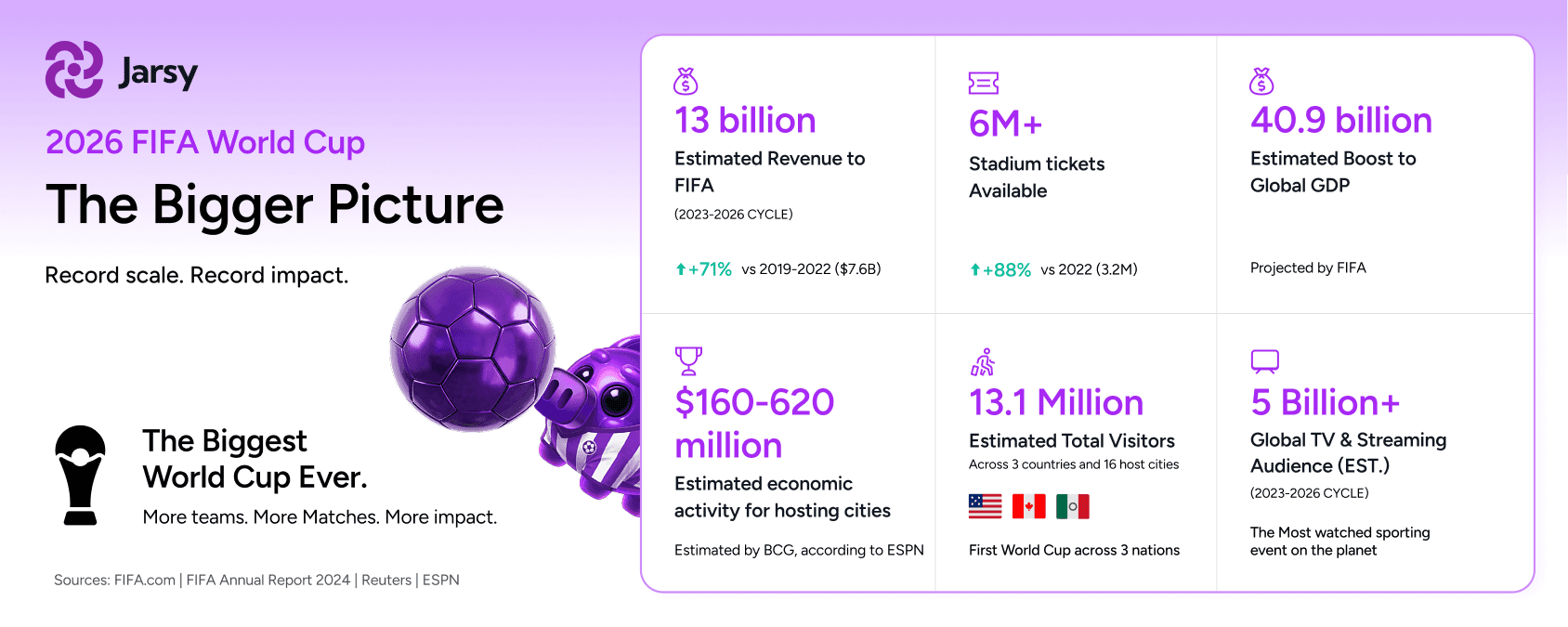
FIFA expects the tournament to generate roughly $8.9 billion in revenue, helping drive a record $13 billion commercial cycle, up 71% from the previous cycle and more than double the revenue generated a decade ago. The expansion from 64 to 104 matches created a surge in commercial inventory, allowing FIFA to sell more broadcasting rights, sponsorship packages, hospitality experiences, and tickets than ever before.
The largest revenue source remains broadcasting, expected to contribute nearly $4 billion, followed by more than $3 billion from ticketing and hospitality and around 2.8 billion from sponsorships. Demand has been strong despite record prices, with FIFA reporting more than 500 million ticket applications for roughly 6+ million available seats.
What makes 2026 especially remarkable is its efficiency. Unlike Qatar 2022, which spent more than $200 billion building stadiums, transport systems, hotels, and supporting infrastructure, the United States, Canada, and Mexico are largely reusing existing venues and facilities. Most matches will be played in NFL stadiums and established urban centers, allowing a far greater share of revenue to flow directly to FIFA rather than into construction projects. In financial terms, it may be the most capital-efficient World Cup ever staged.
Sources: FIFA, Reuters, ESPN, BCG. © 2026 Jarsy Research
The economic impact extends well beyond football. Analysts estimate the tournament could contribute roughly $40.9 billion to global GDP, attract more than 13 million visitors, and support over 824,000 jobs worldwide. Hotels, airlines, restaurants, sportswear brands, broadcasters, payment networks, ride-hailing platforms, and betting operators are all expected to benefit from the six-week surge in global consumer spending. Global sports wagering alone could exceed $50 billion during the tournament.
Yet economists remain cautious about the long-term gains for host cities. Much of the spending is concentrated in tourism and hospitality and may simply replace other travel that would have occurred elsewhere. While the World Cup delivers a meaningful short-term boost to local economies, the biggest winner remains FIFA itself, a global sports organization that has increasingly evolved into one of the world's most powerful media and commercial platforms.
3. The Technology: Football's Biggest Live Test
The 2026 World Cup is not merely the largest tournament in football history; it is also the most technologically sophisticated. Many of the systems now taken for granted were introduced only recently: goal-line technology arrived in 2014, VAR followed in 2018, and semi-automated offside decisions debuted in 2022. The 2026 tournament represents the next stage of that evolution, introducing player digital twins, expanded AI-assisted officiating, connected equipment, automated media workflows and increasingly digital stadiums.
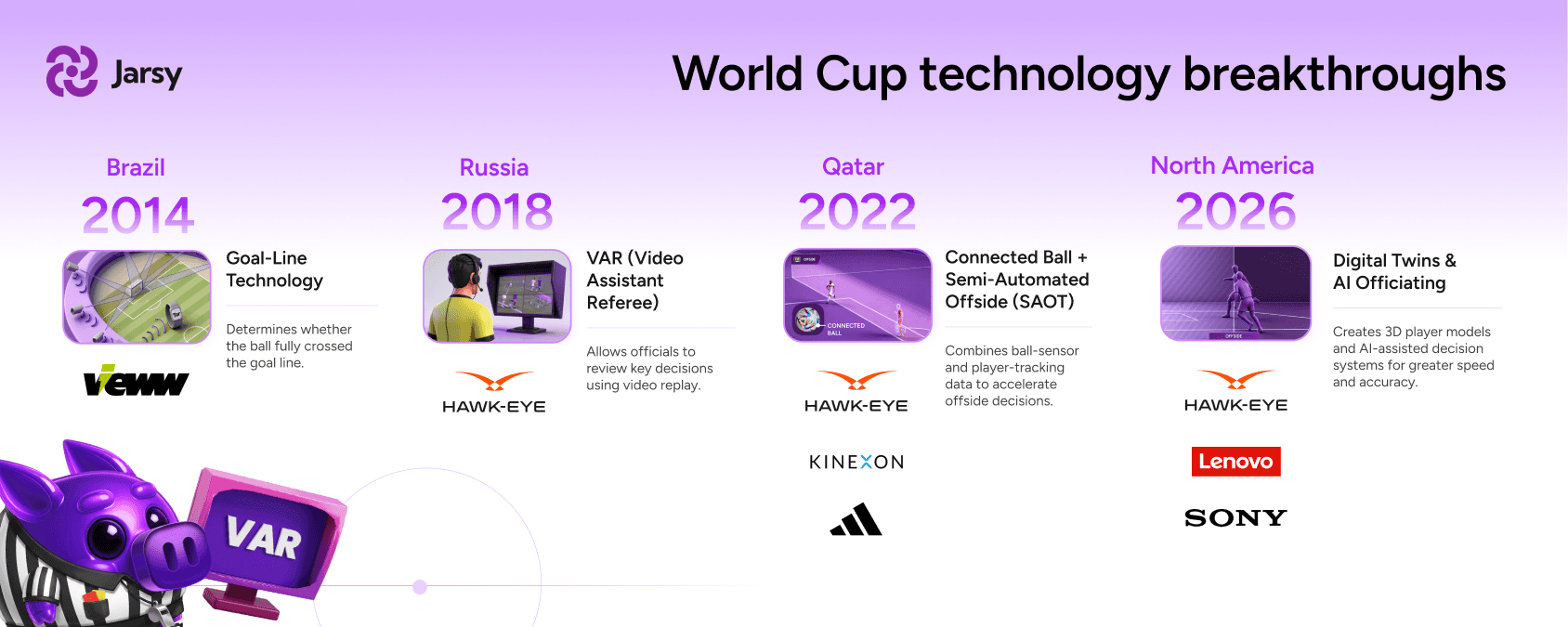
Sources: FIFA, Vieww, Hawk-Eye, Adidas, Lenovo. © 2026 Jarsy Research
The result is a tournament in which virtually every action can be measured, analyzed and acted upon in real time. Cameras track players, sensors inside the ball record every touch, AI assists referees and coaches, while broadcasters and analytics platforms transform match data into content and insights. Behind these systems sits a growing ecosystem of technology companies using the World Cup as one of the world's most visible proving grounds.
3.1 AI Refereeing and Digital Twins
The biggest officiating upgrade in 2026 is FIFA's latest Semi-Automated Offside Technology (SAOT) (provided mainly by Hawk-Eye). Around 30 cameras track 29 points on every player's body 50 times per second, generating millions of positional data points throughout each match.
New for 2026 is the introduction of player digital twins. As FIFA's Official Technology Partner, Lenovo conducted 3D body scans for all 1,248 players, creating highly detailed digital avatars that precisely match each player's height, limb length and body proportions. These digital twins replace the generic player models used at Qatar 2022 and improve the accuracy of offside decisions by allowing the system to model each player individually.

3D scan for digital twin. Image credits: Lenovo
The technology combines Hawk-Eye's tracking systems, Sony's imaging technology and Lenovo's AI infrastructure. Together they represent one of the first large-scale deployments of digital twins in professional sport. What began with goal-line technology in 2014 has evolved into a system capable of building a real-time digital model of the match itself.
3.2 The Connected Ball: Adidas and KINEXON
One of the most significant technology introductions at Qatar 2022 was the connected match ball. Developed by Adidas and German sports-tech company KINEXON, it embedded a 500Hz inertial measurement unit (IMU) inside the ball, allowing FIFA to identify the precise moment of every touch, pass and shot.
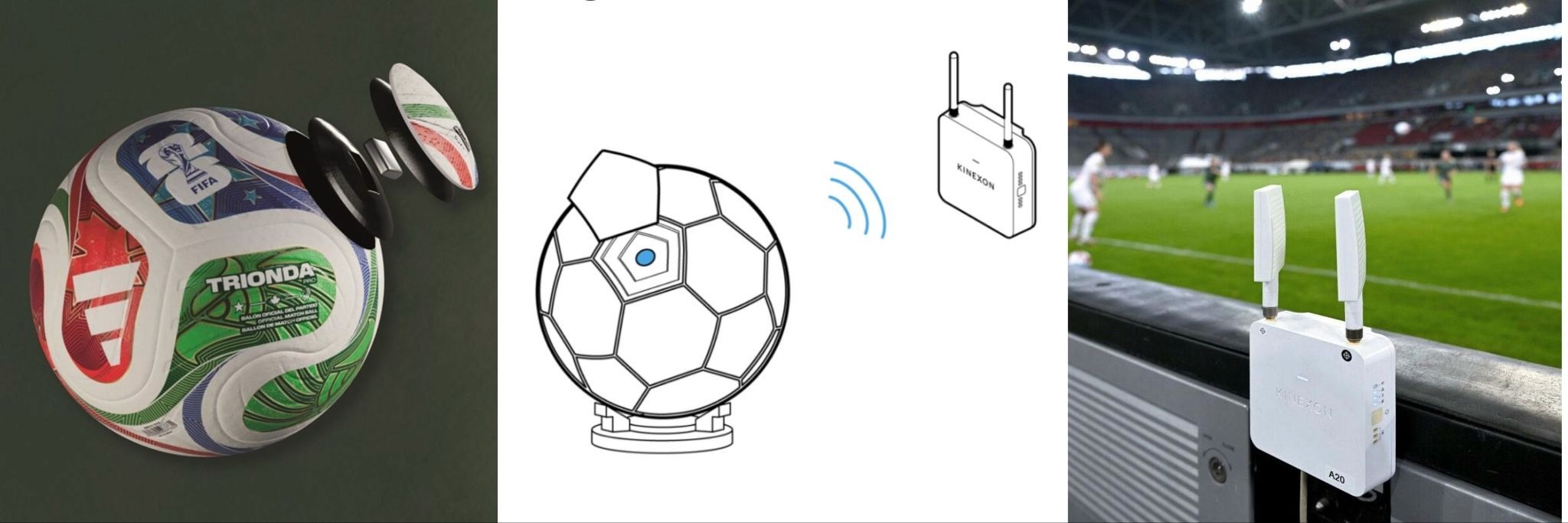
Adidas Trionda Match Ball. Image credits: Adidas, Kinexon
The 2026 Adidas Trionda builds on this foundation. While retaining the same 500Hz sensor technology, it integrates the ball more tightly into FIFA's broader officiating and analytics ecosystem, which now includes player digital twins, enhanced tracking systems and AI-assisted decision-making. The significance of the connected ball extends beyond refereeing. Every touch becomes a real-time data point shared across officiating systems, broadcasters, analytics platforms and betting operators.
3.3 Sports Analytics: Turning Data Into Insights
The connected ball and tracking systems discussed earlier generate millions of data points during every match. FIFA's Enhanced Football Intelligence (EFI) platform sits at the center of this ecosystem, transforming player-tracking and ball-sensor data into tactical insights for teams, broadcasters and analysts.
Powered by Hawk-Eye's tracking systems and Adidas and KINEXON's connected-ball technology, EFI can measure metrics such as defensive pressure, line-breaking passes, space creation and positional control. These insights help explain not only what happened during a match, but why it happened.
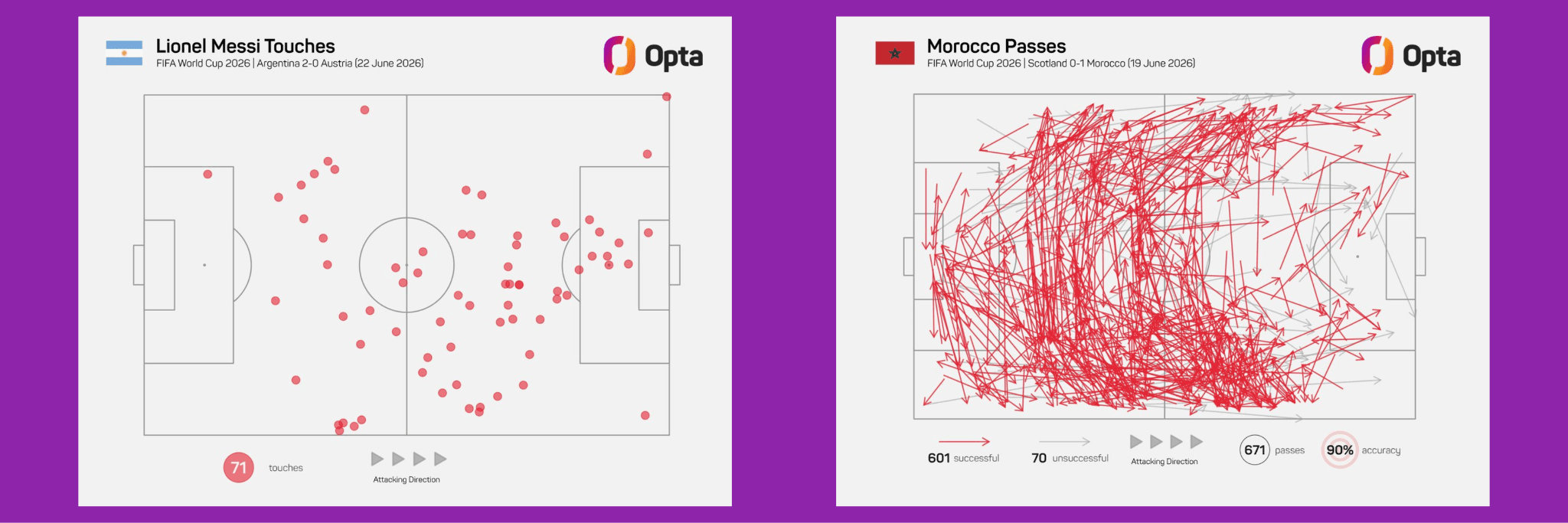
Opta Stats Examples for World Cup 2026. Image credits: Opta (Stats Perform)
Around FIFA's platform sits a broader analytics industry. Companies such as Stats Perform, Hudl, Catapult and SkillCorner provide specialized tools for video analysis, player tracking and performance evaluation, while Sportradar and Genius Sports distribute official data to broadcasters and sportsbooks. As football becomes increasingly data-driven, analytics has evolved from a niche capability into a core part of the sport's infrastructure.
3.4 AI Coaching: One Match, Thousands of Content Pieces
As FIFA's Official Technology Partner, Lenovo introduced Football AI Pro, a platform designed to help teams analyze opponents, identify tactical patterns and generate scouting reports. Similar AI capabilities are increasingly being integrated into products from Hudl, Stats Perform, Catapult and other analytics providers.

Sources: Silicon.co.uk, listcorp.com, Stats Perform, SkillCorner. © 2026 Jarsy Research
Tasks that once required analysts to review dozens of hours of match footage can increasingly be completed in minutes. Coaches can search for specific tactical situations, identify recurring patterns and generate opponent reports far more efficiently than before. While AI is unlikely to replace coaches, the 2026 World Cup offers a glimpse into how AI-assisted decision-making may become a standard part of future coaching workflows.
3.5 AI Broadcasting: From Matches to Millions of Clips
The World Cup is no longer consumed only through television. Fans increasingly follow matches through TikTok, Instagram, YouTube and X, creating demand for content that can be produced and distributed in near real time.
Companies such as WSC Sports and Stats Perform use AI to automatically identify key moments, generate highlights, create captions and package content for different audiences. A single goal can be transformed into dozens of clips optimized for different platforms, languages and formats. In 2025 alone, WSC Sports generated 16 million video highlights and processed more than 450,000 live broadcasts. As viewing shifts toward social and mobile platforms, AI-powered content creation is becoming an essential part of the sports-media ecosystem.
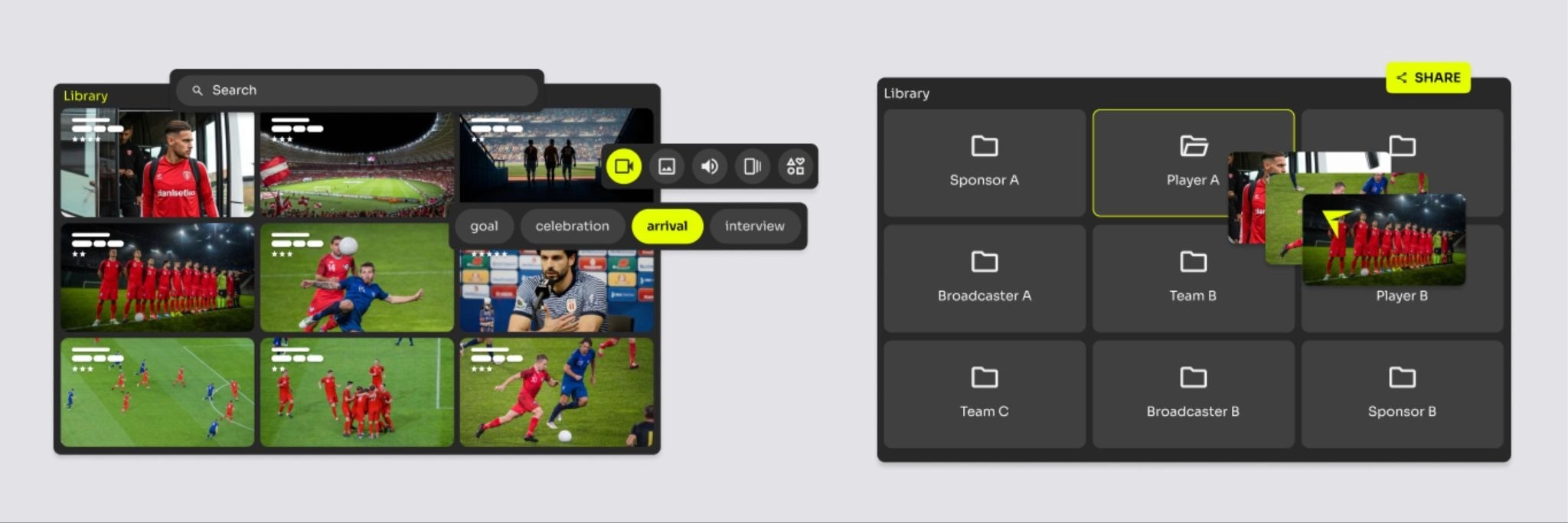
WSC Sports product Interface. Image credits: WSC Sports
3.6 Digital Identity and Blockchain
Technology is changing not only how matches are played and broadcast, but also how fans interact with the tournament. Several host venues are deploying biometric identity systems that allow registered fans to use facial authentication for stadium entry and access control. At Gillette Stadium near Boston, fans can link tickets and payment methods to a facial profile, while Mercedes-Benz Stadium in Atlanta has deployed Wicket's facial-authentication platform across ticketing and credentialing workflows.
Beyond the stadium gates, FIFA is experimenting with blockchain infrastructure. FIFA Collect has introduced blockchain-based collectibles and tokenized ticket initiatives, while FIFA recently named Kraken the Official Crypto Exchange Supporter of the 2026 World Cup. Although most stadium purchases still rely on conventional payment methods, the tournament represents FIFA's deepest engagement with digital assets and blockchain technology to date.
4. Sportsbooks & The Rise of Prediction Markets
The FIFA World Cup has long been one of the world's largest betting events. The 2026 tournament is expected to become the biggest betting event in history, with Macquarie Bank analysts (CNBC report) projecting more than $50 billion in global betting volume. What makes this World Cup different is not the amount being wagered, but the emergence of prediction markets as a challenger to traditional sportsbooks.
4.1 The Incumbents: Sportsbooks
For decades, sports betting has been dominated by bookmakers and sportsbooks such as FanDuel, DraftKings, bet365 and BetMGM. Unlike exchanges that match users with one another, sportsbooks act as the counterparty to every bet. They set the odds and earn a built-in margin on each wager, commonly known as the “vig” or “take rate”, which allows them to profit regardless of the outcome of individual matches.
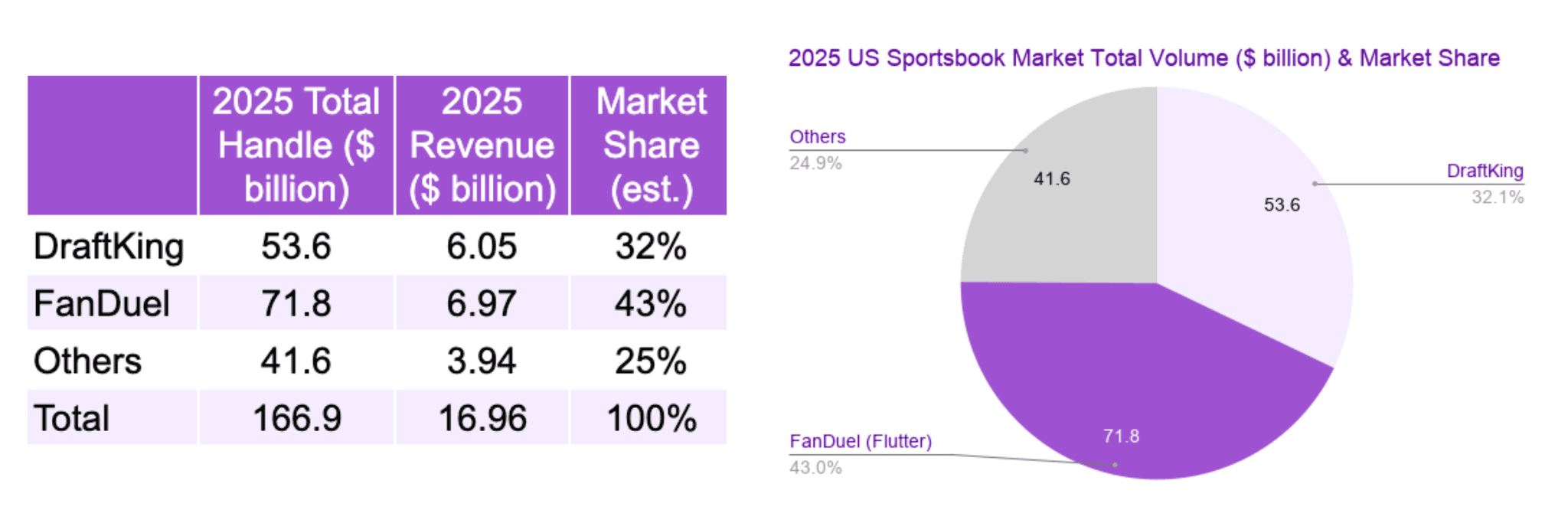
Market size and revenue comparison. Data sources: DraftKing, FanDuel, American Gaming Association. © 2026 Jarsy Research
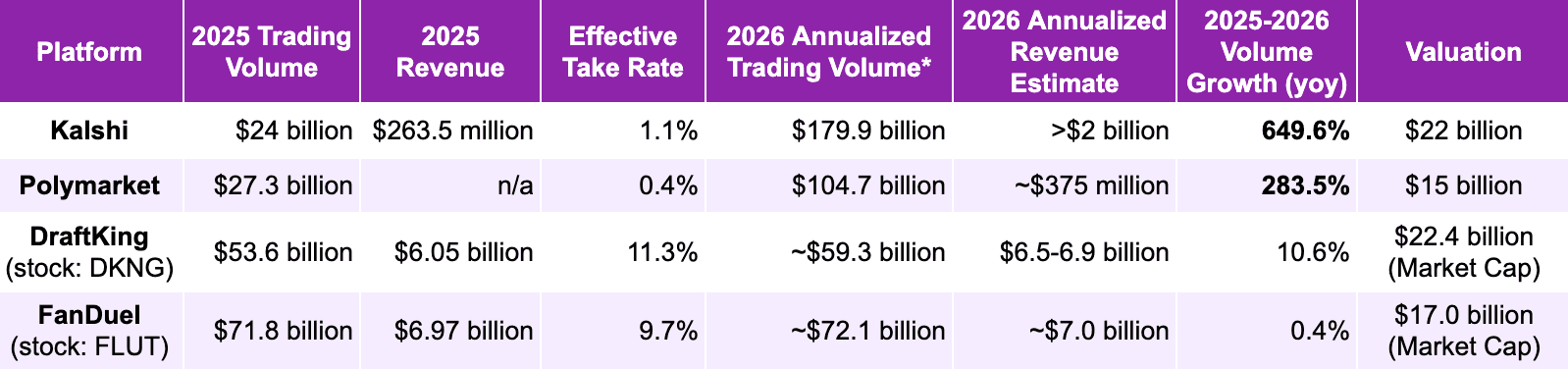
In 2025, regulated U.S. sportsbooks processed nearly $167 billion in wagers and generated approximately $17 billion in revenue. FanDuel and DraftKings dominate the market, controlling roughly 43% and 31% of U.S. sportsbook revenue respectively. The economics are highly attractive. In 2025, DraftKings generated $6.05 billion of revenue from $53.6 billion of handle, implying an effective take rate of 11%. FanDuel operates under a similar model and made $6.97 billion of revenue.
4.2 The Challengers: Prediction Markets
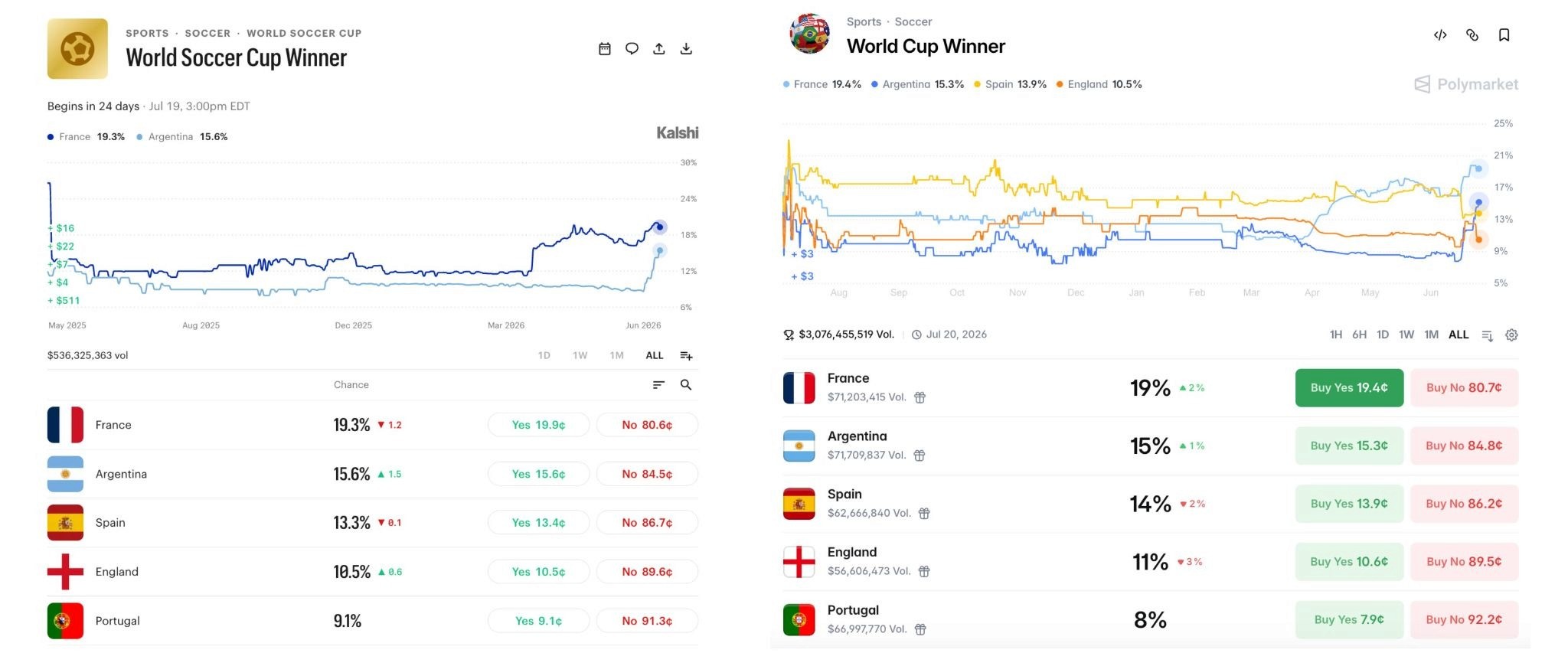
Prediction markets take a fundamentally different approach. Instead of betting against a sportsbook, users trade event contracts with one another. A contract asking "Will Argentina win the World Cup?" might trade at 25 cents, implying a 25% probability. If Argentina wins, the contract settles at $1; otherwise it settles at $0. Prices move continuously as traders buy and sell positions, creating a market-driven estimate of probability.
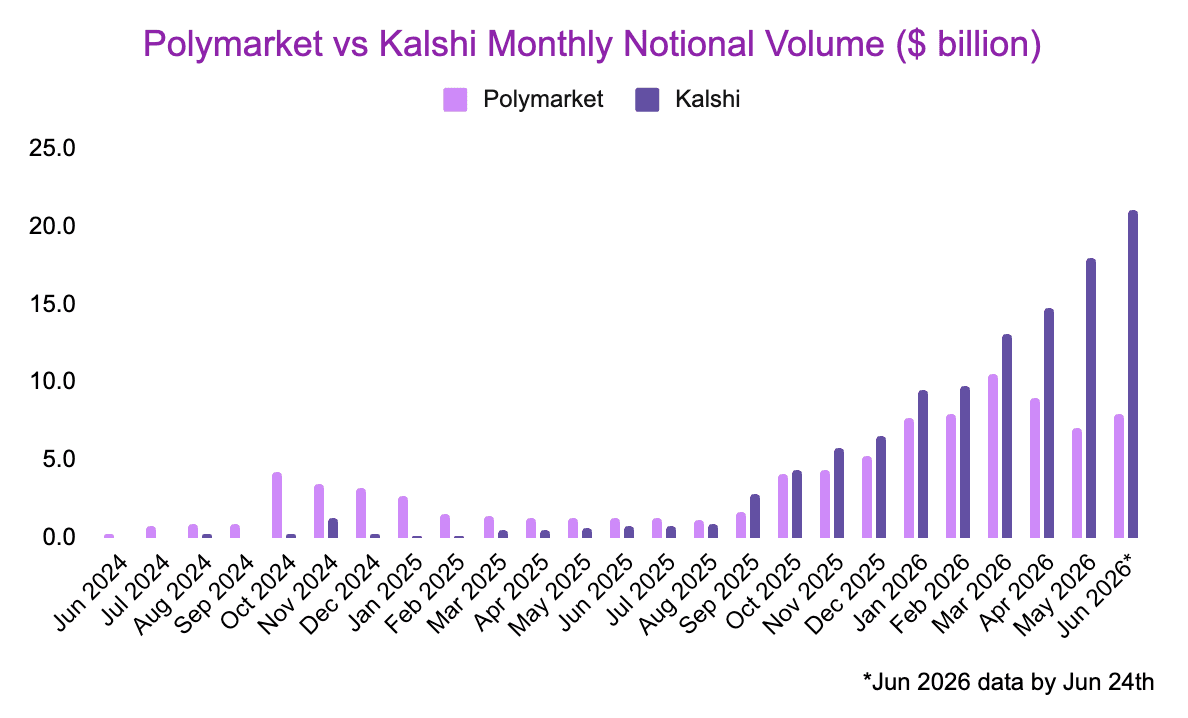
The model resembles a financial exchange more than a sportsbook. Platforms do not take the opposite side of trades or profit from customer losses; instead, they earn transaction fees on trading activity. While traditional sportsbooks typically generate take rates of around 10%, prediction markets operate on much thinner fees, generally below 1%, and rely on significantly higher trading volumes.
Data Source: Dune.com. © 2026 Jarsy Research
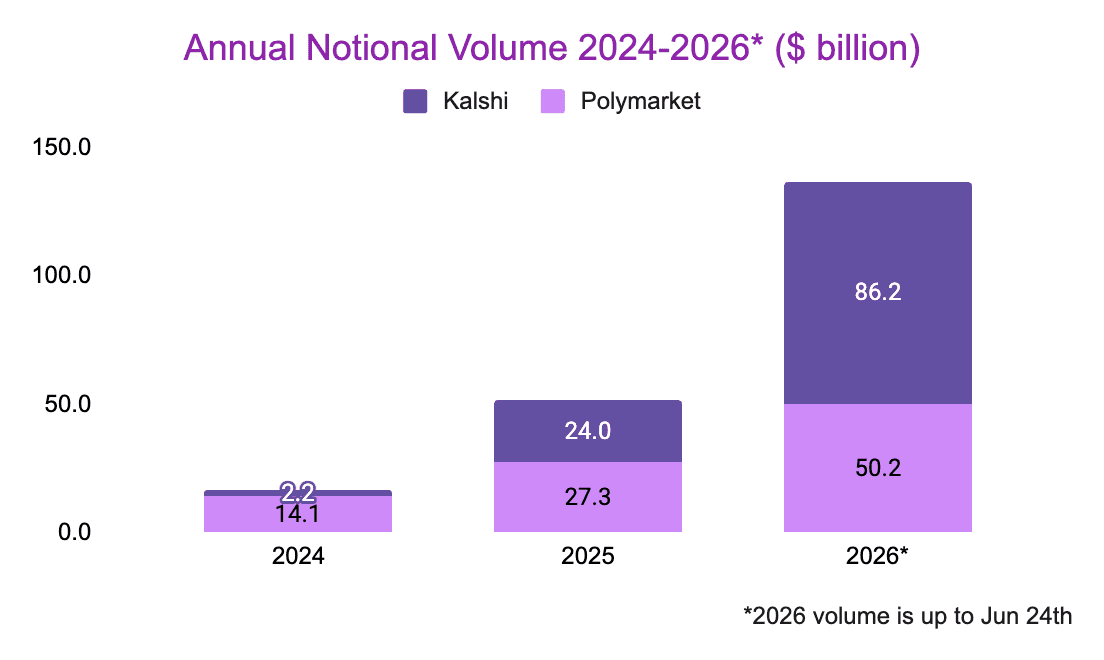
The category has grown at remarkable speed. Kalshi, regulated by the U.S. Commodity Futures Trading Commission (CFTC), generated an estimated $263 million of revenue (yahoo finance) on $24 billion of trading volume in 2025, before accelerating to an annualized $180 billion of trading volume and over $2 billion of annualized revenue in 2026. Polymarket, the leading crypto-native prediction market, grew from $27 billion of trading volume in 2025 to an annualized $105 billion in 2026, while its valuation has reached approximately $15 billion. In comparison, traditional sportsbook leaders DraftKings and FanDuel are expected to grow betting handle by only 10.6% and 0.4%, respectively, highlighting the dramatically faster growth of prediction markets.
*Annualized trading volumes are estimated by Jarsy. Data Sources: DraftKing financial reports, FanDuel financial reports, Yahoo finance, Sacra, Dune.com. © 2026 Jarsy Research
Using current trading activity across outright winner markets and individual match markets, we estimate that the 2026 FIFA World Cup could generate approximately $11.8 billion of trading volume on Kalshi and $8.7 billion on Polymarket from its major markets alone, representing more than $20 billion in combined prediction-market activity. If realized, the tournament would become the largest sporting event ever for prediction markets.
World Cup Winner Event Betting. Image Credits: Kalshi, Polymarket
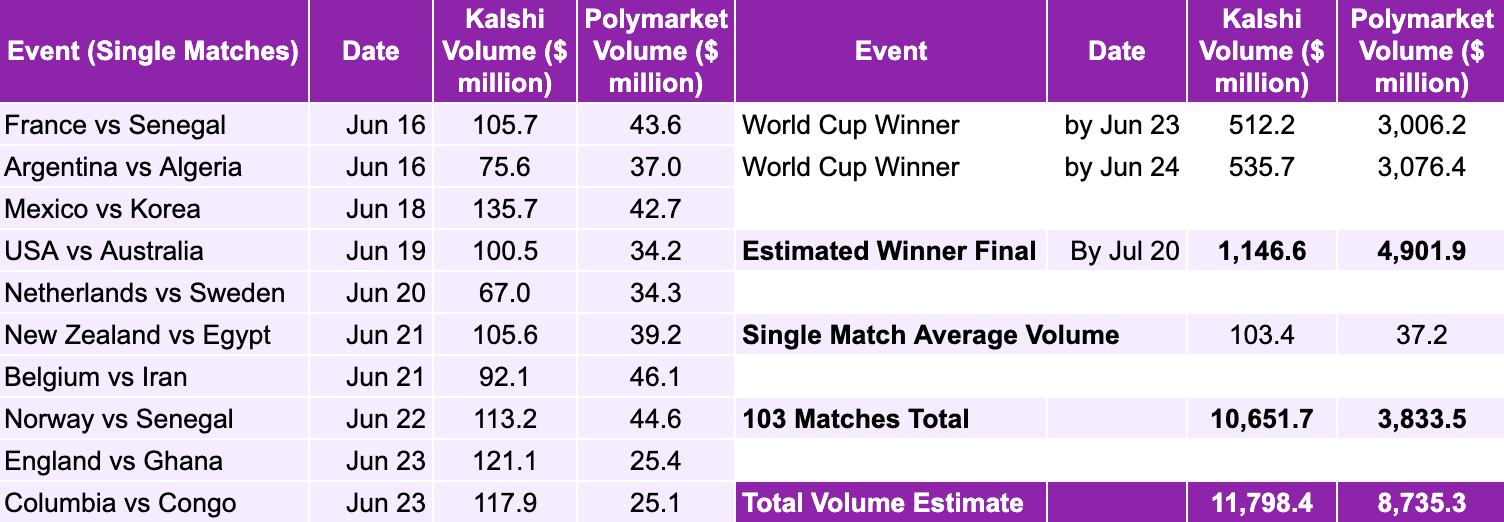
Data Sources: Kalshi, Polymarket. Total major markets volume estimated by Jarsy. © 2026 Jarsy Research
For readers interested in a deeper dive into prediction markets, including their history, regulatory landscape, business models, and investment implications, we recommend our previous research report: The Markets That Bet on Everything: Polymarket, Kalshi, and the Rise of Event Trading.
5. The Winners
Only one nation will lift the FIFA World Cup trophy, but commercially, many organizations, companies and countries will emerge as winners.
At the center sits FIFA, whose 2023-2026 commercial cycle is expected to generate a record approximately $13 billion in revenue. Around FIFA is an ecosystem of beneficiaries: host countries attracting millions of visitors, global sponsors reaching billions of viewers, technology companies demonstrating their latest innovations, broadcasters monetizing record audiences, and betting and prediction-market platforms engaging fans throughout all 104 matches.
What makes the 2026 World Cup unique is that many of its biggest commercial winners are no longer traditional sports businesses. AI companies are helping referees make decisions in real time. Data companies are powering broadcasters, clubs and sportsbooks. Prediction markets are creating entirely new ways for fans to participate in the tournament, while blockchain platforms are introducing new forms of digital ownership and fan engagement. For many of these companies, the World Cup is not simply another customer, it is the world's largest live demonstration of their technology. ⚽🏆💡🏃♂️🏟️
Further Reading: World Cup 2026 Tech by Wired, World Cup Socioeconomic Impact report by FIFA, CNBC report on the World Cup, Beyond the Pitch report by Reuters